


Why Are Social Skills Important for Kids' Growth
Wondering why are social skills important for your child? Discover how social skills shape development, school success, and mental health, plus how ABA helps.

This morning, a child waited at the bathroom door while his mom finished brushing her hair, then remembered to say, “Can I have a turn after you?” A few minutes later, he glanced at the breakfast table, noticed his sister's hesitation, and slid the cereal bowl a little closer instead of grabbing it.
Those tiny moments are easy to miss. They're also where social skills are already doing their work.
Table of Contents
A Morning That Says More Than It Seems
A lot of parents think social skills begin at school or in therapy. In real life, they show up before the school bus ever arrives. The pause before answering, the attempt at eye contact, the way a child accepts a choice instead of melting down, all of that is practice in joint attention, flexibility, and reading other people's cues.
When a parent says, “Wait your turn,” and the child manages not to snatch the toy, that's not just obedience. It's a small rehearsal for cooperation, self-control, and sharing space with other people. When a child says good morning to a neighbor after a prompt, that's not a random polite habit. It's a learned social behavior that helps them enter a room without feeling lost.
Small moments carry bigger meaning
What looks like a simple morning routine is really a chain of social decisions. A child notices another person, pauses, adjusts, and responds. That's the basic pattern behind friendships, classroom participation, and later independence.
Practical rule: if your child can manage a tiny social exchange at home, you already have something to build on.
That's why these early interactions matter so much. They're the starting point for everything that follows.
What Social Skills Really Are and How ABA Approaches Them
Social skills are the everyday behaviors that help a child share attention, communicate needs, read other people, manage emotions, and solve small problems with others. Think of them as the operating system under everything else. Reading, sports, games, and friendships are the apps. Social skills are what let all of them run.
ABA, or Applied Behavior Analysis, is a way of teaching that breaks skills into steps a child can realistically learn and practice. A BCBA, or Board Certified Behavior Analyst, is the professional who designs and supervises that plan. In a strong ABA program, the work isn't about making a child sound robotic. It's about helping them use real words, gestures, and responses in real situations.
What teaching often looks like in practice
A child might learn how to greet someone by first practicing the words, then the timing, then the eye contact, then the same skill with different people. That can happen through modeling, role-play, play-based teaching, and practice in natural routines like snack time or playground time. The point is not to memorize a script, it's to use the skill when it matters.
Modern ABA also leans on a child's interests. If a child loves cars, a therapist can build turn-taking, requesting, and waiting into car play. If a child likes drawing, the same skills can be practiced while sharing markers or asking for help.
A child learns social skills faster when the lesson feels like part of life, not a separate drill.
That's why good programs focus on more than isolated behavior. They connect the skill to the setting where the child will need it.
Where Social Skills Show Up Most in a Child's Life
Social skills matter in more than one corner of a child's world. They shape early development, school participation, mental health, and friendships, and those areas keep overlapping as a child grows. A long-term study summarized by the Robert Wood Johnson Foundation found that kindergarten social competence predicted adult outcomes, including 54% higher odds of a high school diploma, 46% higher odds of full-time employment at age 25, and roughly double the odds of a college degree for each one-point increase on a five-point social competence scale (RWJF summary).
A toddler who points to show interest is building shared attention. A kindergartner who asks to join a game is practicing entry into a group. A child who says, “I'm mad,” instead of hitting is using a communication skill to protect relationships. A tween who repairs a disagreement without needing an adult every time is building independence.
Four domains where social skills shape a child's life
| Life Domain | Everyday Example | Long-Term Payoff |
|---|---|---|
| Early development | Pointing, waiting, copying, responding to a name | Stronger communication and cooperation |
| School success | Joining a group, following turn-taking, answering prompts | Better classroom participation |
| Mental health | Naming feelings instead of reacting physically | More self-regulation and fewer escalations |
| Friendships | Repairing a disagreement, reading a peer's mood | More stable peer relationships |
These domains aren't separate boxes. A child who can join a game at recess may feel more accepted, which can lower stress in class. A child who can calm down after disappointment may have an easier time keeping friends. Social competence underpins the rest.
Schools don't always treat that overlap with enough seriousness, which is where the problem starts.
The Hidden Gap in How Schools Treat Social Skills
A 2025 cross-country review found that early childhood programs in more than 50 countries still put the main emphasis on cognitive skills like language and spatial awareness, while social skills are often left out or treated as a minor piece (Research in Germany overview). That gap matters because children don't just need to learn letters and numbers. They need to learn how to enter a group, wait for a turn, and handle frustration without falling apart.
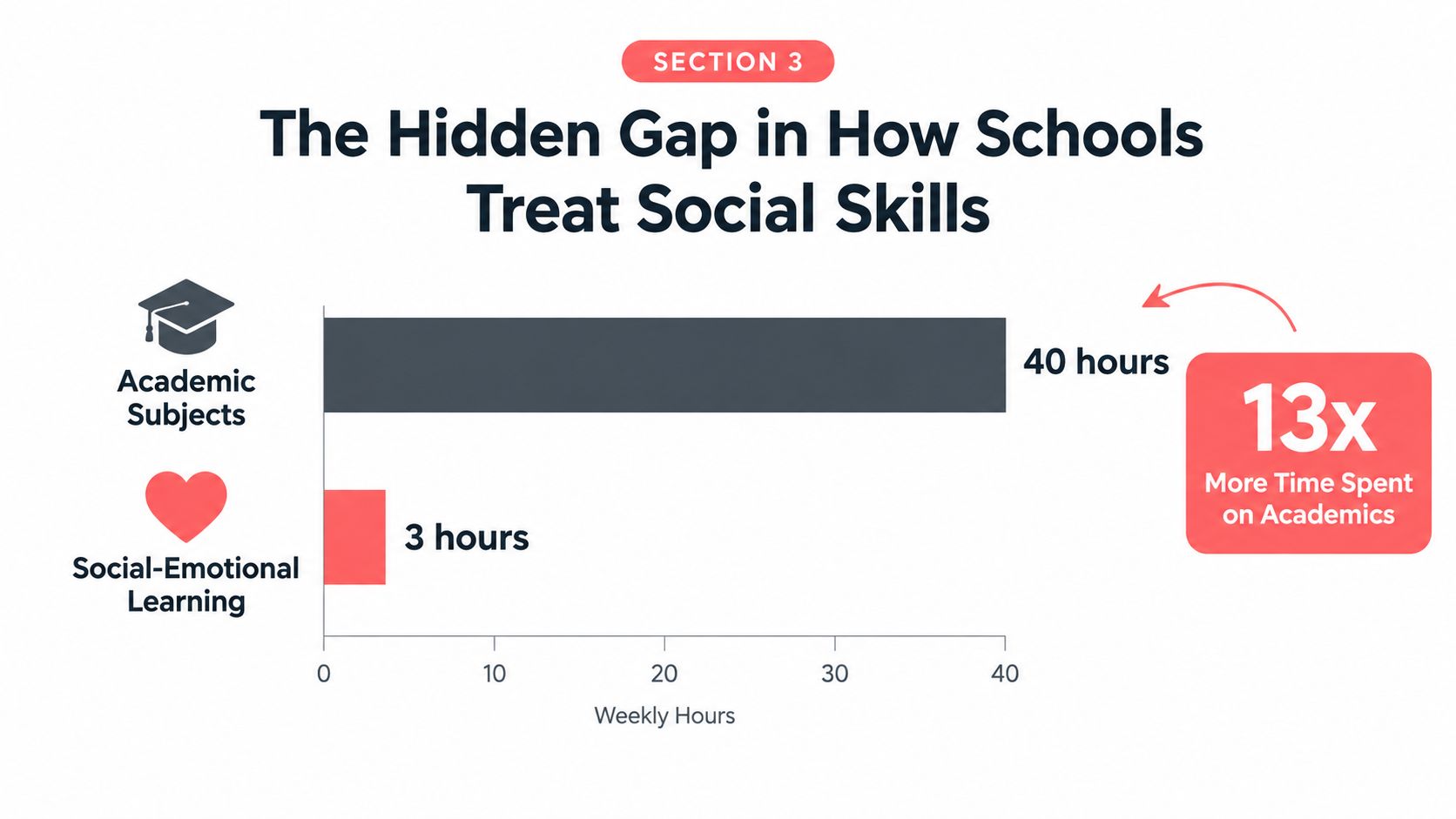
In many classrooms, the day is crowded. Teachers are racing through literacy, math, transitions, and behavior management. There may be no protected time for practice in greeting, sharing, conflict repair, or perspective-taking, even though those are the skills children use all day long.
A child can be reading at grade level and still not know how to ask a classmate to play. That mismatch frustrates families because the report card can look fine while the child is struggling to connect. When schools make room for social practice, children get repeated chances to rehearse the exact behaviors that help them participate.
If your child's school needs help building those routines, school support services can help turn social goals into part of the school day instead of an afterthought.
How Peers Shape Social Growth Just as Much as the Child
Children don't learn social skills in a vacuum. They learn them in the middle of other children's reactions, mistakes, and rhythms. A recent study of autistic children in inclusive classrooms found that peer interaction can improve communication, emotional reciprocity, and social adaptability, while also showing barriers like stigma, peer rejection, limited awareness, and not enough teacher training (inclusive classroom research).
What peer learning looks like in real life
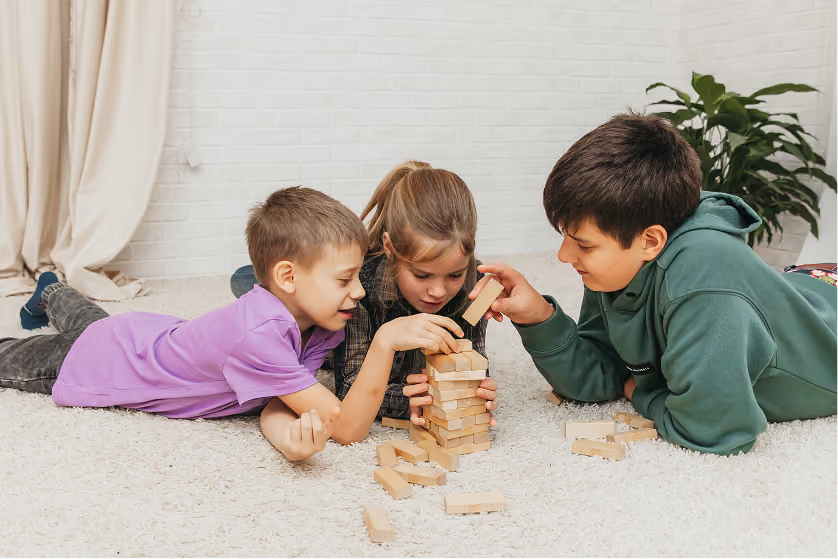
A child reaches for the block tower, another child says, “Wait, I'm still using that,” and the first child has to adjust. A third child suggests a new rule for the game. An adult steps back just enough to let the exchange unfold, then jumps in only if the group gets stuck.
That back-and-forth matters because it gives children practice with tone, timing, repair after a misunderstanding, and shared goals. A worksheet can't teach that the same way a live peer interaction can. Children who learn differently often benefit here because peers model language and social rhythm in a natural way that adults don't always recreate.
Peer-mediated learning also changes the setting itself. The child is not just the one being taught. They're part of a group where everybody's actions shape the outcome.
Social growth is a two-way street. A child shapes the peer group, and the peer group shapes the child.
That's why inclusion works best when adults don't just watch for problems. They intentionally build the conditions where children can practice together.
What an ABA Social Skills Program Actually Looks Like
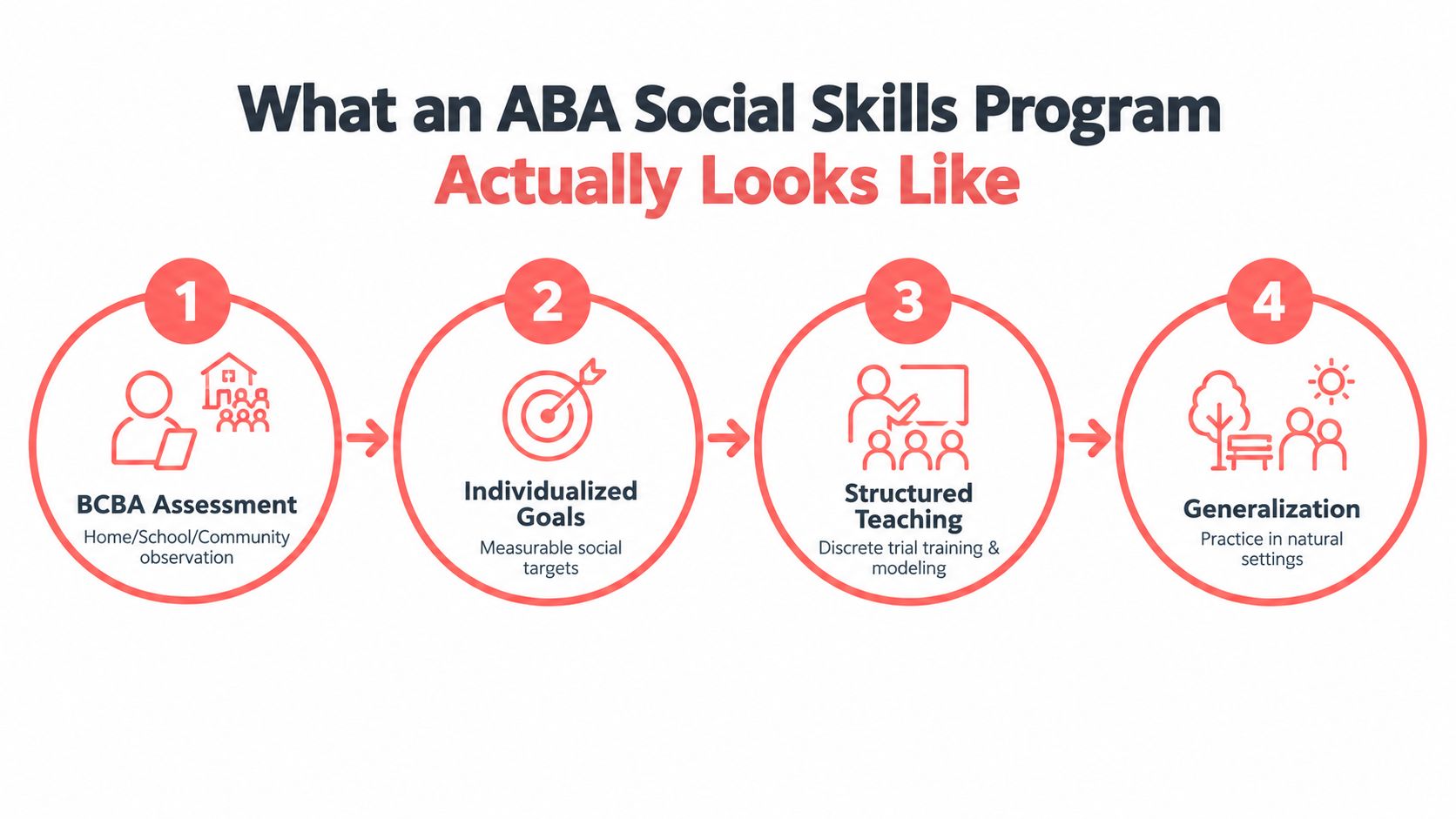
A BCBA-led ABA program starts with observation, not assumptions. The BCBA may watch the child at home, in school, and in the community, then narrow the plan to specific targets like greeting a peer, joining a group, waiting in conversation, or recovering from a rejected request. That makes the work concrete enough to measure and flexible enough to fit real life.
From target to everyday use
First comes the goal. The team breaks the skill into small steps, so “say hello to a peer” might become looking toward the person, using a greeting, and waiting for a response. Then the teaching begins through modeling, role-play, video examples, and practice in natural settings.
Reinforcement matters too. At the start, a child may need a lot of support and praise. Over time, the help fades so the child uses the skill more independently. That's where generalization comes in, the part many parents care about most. A skill has to show up with different people, in different places, and during different routines, or it doesn't really stick.
How FriendlyABA fits into that picture
FriendlyABA offers social skills development as one of its ABA services, and it uses BCBAs and trained therapists to support practice in home, school, and community settings. The value lies in the structure, a plan built around observable behavior, regular review, and caregiver collaboration. Social skills development support is strongest when it's tied to the child's daily routines, not separated from them.
If the skill only works at the therapy table, it isn't finished yet.
Parents are usually part of the process, too. They learn the same prompts and language so dinner, errands, and playtime all become chances to practice.
Small Things Parents Can Try This Week
Parents don't need a perfect plan to help social growth. They need a few repeatable habits that fit into a normal day. These are short, low-pressure moves you can try right away, even if your child isn't in ABA right now.
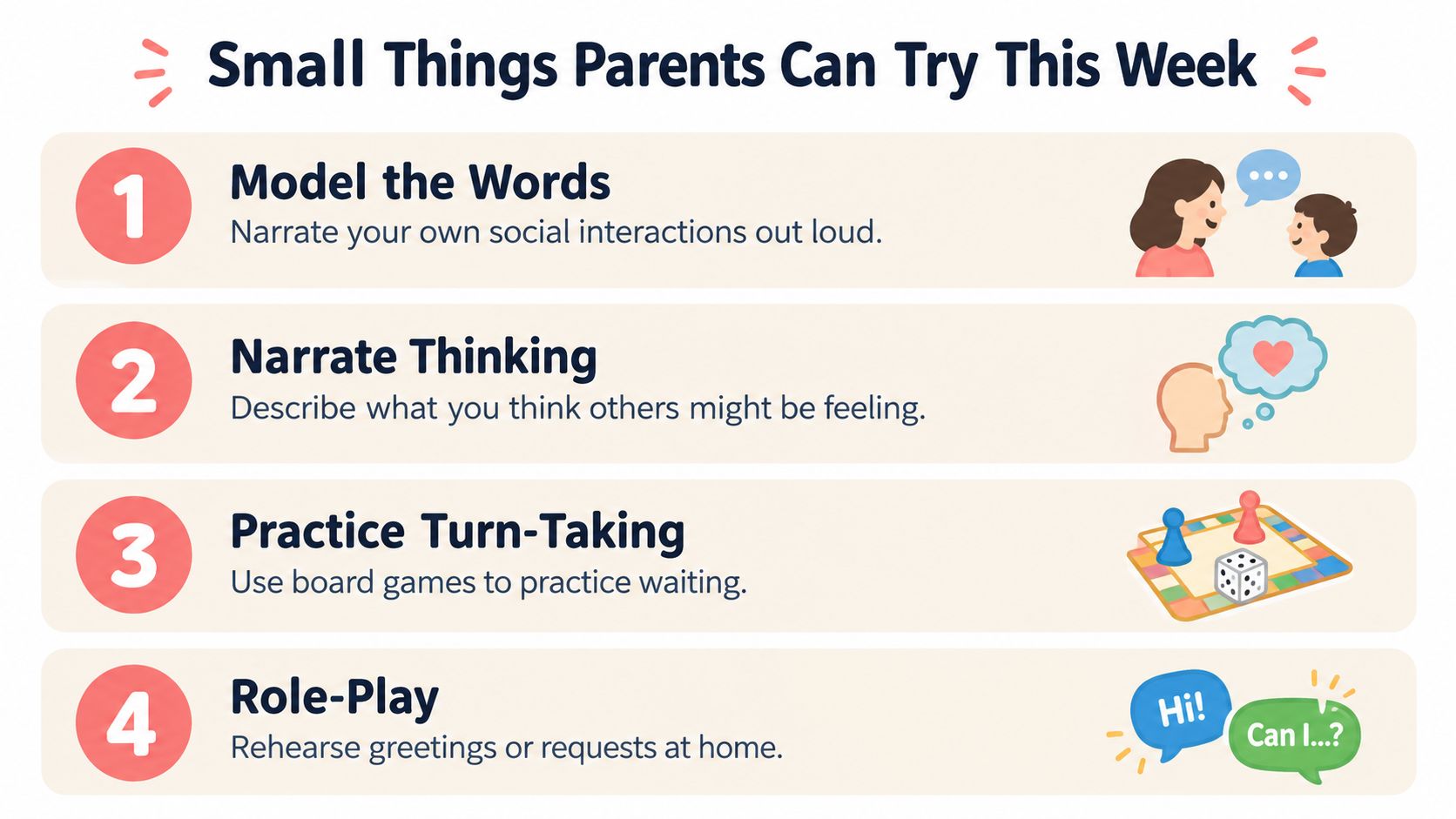
Four small habits that add up
- Model the words: Say the sentence you want your child to use out loud, like, “I'm waiting for my turn,” while you're checking out at the grocery store.
- Narrate your thinking: Comment on what you notice, such as, “She looks tired, so I'm going to speak softly,” to help your child connect cues with choices.
- Practice turn-taking: Use a board game, a card game, or even a simple ball toss, and keep the turn short enough that waiting feels possible.
- Role-play greetings: Rehearse a wave, “Hi,” or “Can I play?” at home so the words are familiar before your child has to use them with real peers.
If you want an easy way to anchor this at home, building communication skills in everyday moments can fit into the same routines you're already doing.
Keep the goal small and steady
These strategies work because they create repetitions, not pressure. A child doesn't need an hour of training to make progress. They need a few chances to hear, see, and try the skill in the kinds of moments they already live inside.
Consistency matters more than perfection. If you pause after asking a question, model a friendly greeting, or give one extra chance to wait, that's meaningful practice.
Small Moments, Big Milestones and What Comes Next
The morning scene from the start of this article is the real work. The child's pause before grabbing, the quick look at a sibling's face, the attempt to use words instead of force, those are the exact kinds of milestones a good team watches for. They may look small, but they point to bigger abilities like cooperation, self-control, and social confidence.
That's why social skills aren't a side subject. They're the invisible thread running through development, school, mental health, and friendships. A child who learns to handle a small interaction today is rehearsing the same pattern they'll need in a classroom, on a team, at a job, and in a friendship later on.
The gap between where a child is and where a parent hopes they'll be closes one interaction at a time. A single turn taken well. A single repair after a mix-up. A single greeting that lands.
FriendlyABA works with families who want that growth to be intentional, measurable, and built around real daily life. If you're unsure what to focus on next, a consultation can help you sort out the first useful steps without trying to guess alone.
FriendlyABA can help you turn everyday routines into practical social practice, with ABA support that fits home, school, and community life. If you're ready for a personalized plan for your child with autism or another developmental need, visit FriendlyABA to book a consultation and talk through what meaningful next steps could look like.
Our Latest Insights
You don't have to figure it out alone
Whether you're exploring ABA therapy for the first time or searching for a provider who truly feels like the right fit, we're here to help.