


What Is Functional Communication Training in ABA
What is functional communication training in ABA? A parent-friendly guide to how FCT works, why it helps, and what real progress can look like for kids.

Functional Communication Training, or FCT, is a teaching method that replaces problem behavior with an easier, more appropriate way for a child to ask for what they really want. It was introduced in 1985 by Carr and Durand in a study of 4 children with developmental disabilities, and that paper became the field's starting point for FCT in ABA (historical overview of the 1985 paper).
A parent at the kitchen counter knows how fast this can happen. Your child reaches for a tablet, you say wait, and suddenly the whole moment starts to unravel because “wait” is too abstract to hold onto.
Table of Contents
- Step 1, identify the function
- Step 2, choose a replacement response
- Step 3, teach and prompt
- Step 4, spread it into daily life
When Words Get Stuck and Behavior Takes Over
The hardest part of these moments is that they rarely feel dramatic at the start. A child reaches, a parent redirects, and then the volume rises, the body tenses, and everybody in the room feels stuck.
That's where FCT earns its place in ABA. It treats the behavior as a message, then teaches a better way to send that message. A child who screams for a snack, drops to the floor to avoid a task, or grabs to get attention is not being randomly difficult. They're trying to make something happen, and FCT gives them a more workable tool.
A simple way to think about it
If the old behavior is the child's fastest way to get a need met, FCT asks, “What's the easier, more acceptable response that should work just as well?” That question matters because the replacement response has to fit the need, not just look polite on the outside. The basic logic is the same whether the child uses speech, pictures, signs, or a device.
FCT starts after a functional behavior assessment, often called an FBA. An FBA helps the BCBA, which stands for Board Certified Behavior Analyst, figure out why the behavior is happening. That's the part many parents don't see, but it's the part that keeps FCT from turning into guesswork.
Practical rule: If the behavior helps the child get something, avoid something, or get noticed, the replacement response should do the same job in a better way.
For families who want a broader ABA primer, FriendlyABA's overview of ABA therapy is a useful place to start. Once the “why” is clearer, the teaching plan usually feels less mysterious and more doable.
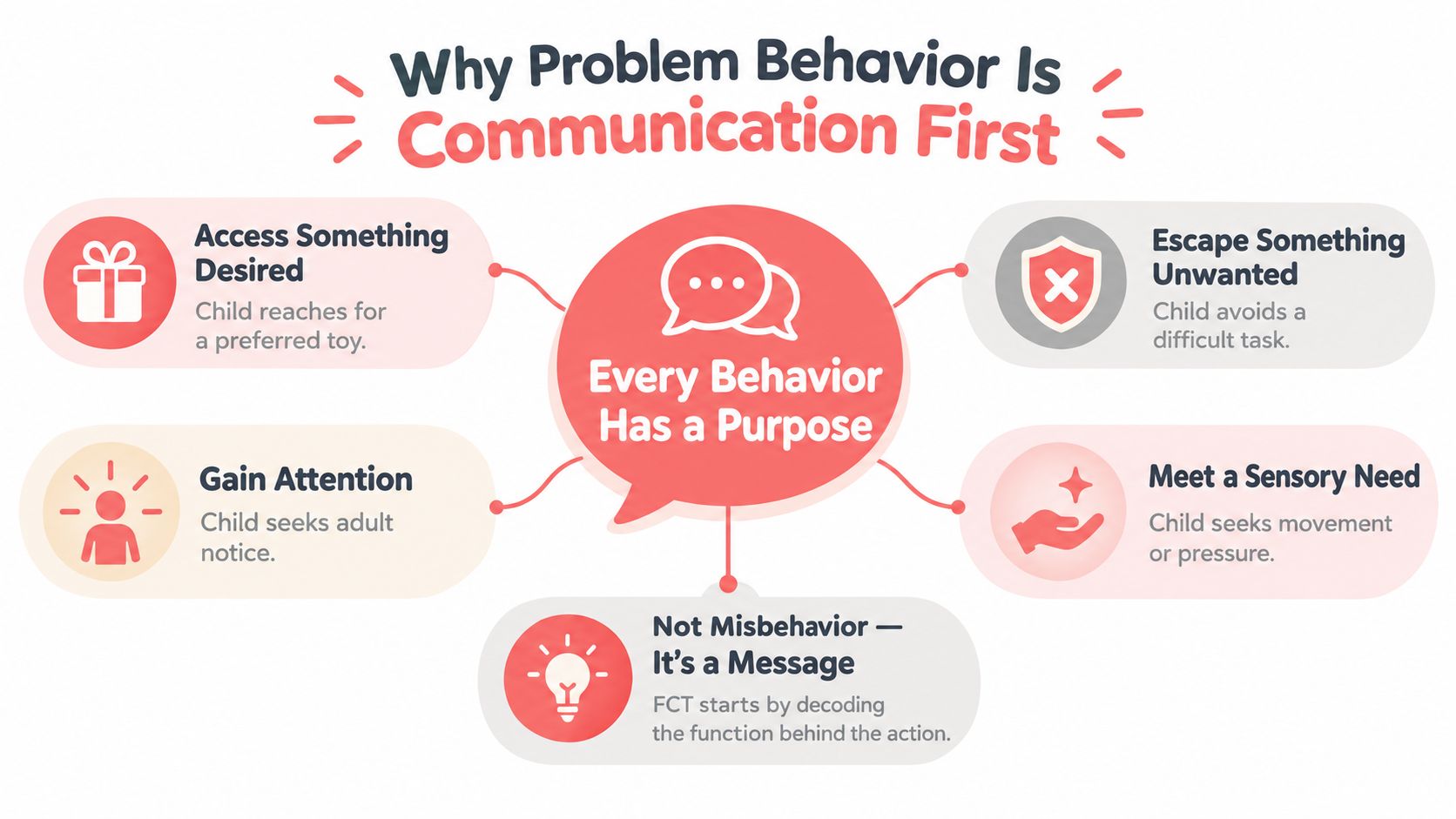
Why Problem Behavior Is Communication First
Most parents have already figured this out in real life, even if no one has said it out loud. Behavior tends to serve a purpose. It might help a child access something they want, escape something they don't want, get adult attention, or meet a sensory need.
The trouble starts when adults try to respond to the behavior without understanding the purpose behind it. A sticker chart or reward chart can be helpful in some situations, but it can also miss the point if it only focuses on stopping a behavior and never teaches the child a better way to get the same outcome.
What the FBA is looking for
An FBA looks at what happens right before the behavior, what the behavior looks like, and what usually happens right after it. In practice, the team watches patterns, takes ABC data, and compares what seems to make the behavior more likely. ABC stands for Antecedent, Behavior, Consequence.
That sounds technical, but parents already know these patterns in plain language. You notice that your child melts down every time the iPad is taken away, or every time a hard task starts, or every time you step out of the room. The FBA gives that hunch a structure so the team can build the right replacement response.
For a more everyday example of how communication skills grow in routines, FriendlyABA's parent-friendly guide to building communication in daily moments connects well with this idea. FCT works best when the teaching matches the child's real life, not a made-up training script.
Why “function-based” matters
A child who throws materials to escape a worksheet doesn't need a generic request like “please.” They need a communication response that gets them a break, help, or a brief pause, depending on the function. That's the key difference between function-based teaching and a one-size-fits-all approach.
If the old behavior works, the child has no reason to switch. FCT changes that by making the new communication response the simpler path.
Once the team knows the function, the teaching plan becomes much clearer. The child isn't being asked to stop communicating. They're being shown a better way to communicate.
The Four Steps of Functional Communication Training
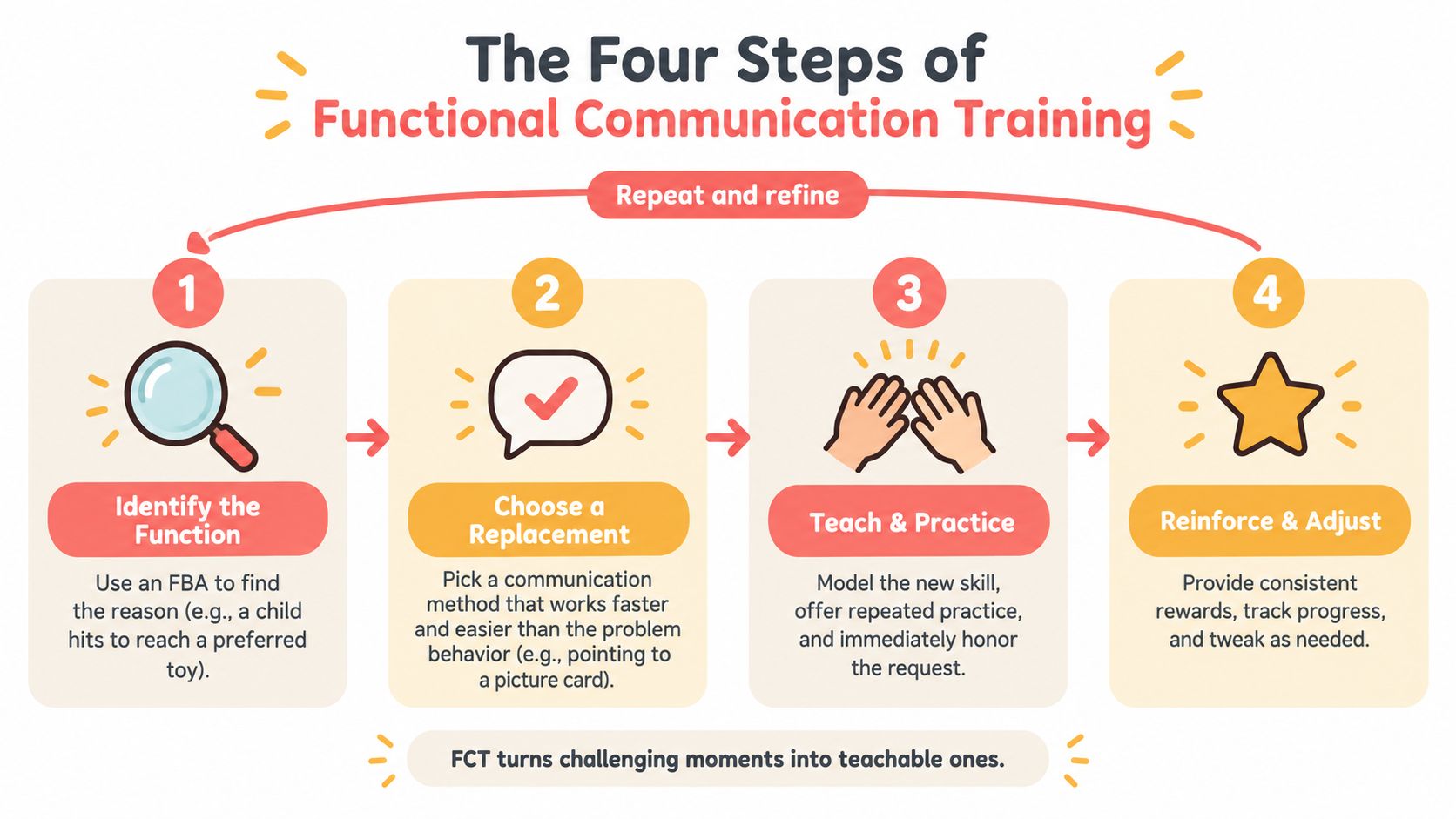
Parents usually find FCT easier to understand when it is broken into a four-step process. The structure gives the work a clear order. First the team learns why the behavior is happening, then it teaches a better way to communicate, and finally it helps that new skill show up in everyday life (parent overview of the four-step model).
Step 1, identify the function
The starting point is the FBA. That assessment helps the team name what the behavior is accomplishing for the child. A child who grabs a toy may be trying to get access. A child who acts out when work begins may be trying to escape the task.
Step 2, choose a replacement response
The replacement response should be easier to use than the problem behavior and should lead to the same outcome. It may be a picture card, a sign, a spoken word like “more,” or a button on a speech device. The right choice depends on the child's skills and the support plan.
A parent does not need a fancy response for FCT to work. The key is that the child can use it quickly, and the adults around the child can honor it consistently.
Step 3, teach and prompt
The team practices the new response in a controlled way, often starting with simple situations. Adults prompt the response when needed, then reinforce it right away when the child uses it. That quick payoff matters, because the child is learning that communication gets results.
Step 4, spread it into daily life
The final step is where many families see the difference between a skill that is learned and a skill that is actually used. The response has to work with different people, in different places, and during real routines. Prompts fade over time so the child can use the skill on their own. Without that step, the child may only use the new communication in one therapy moment and not at home, at school, or in the community.
The idea began with Carr and Durand's original work, and later practice has kept the same basic shape while refining how support is delivered. That is also why FCT still makes sense to parents. It starts with a real communication need, then teaches a response that fits daily life (historical overview of the 1985 paper).
A short session can look plain. A therapist sets up a reason to communicate, helps the child use the new response, honors it right away, and repeats the practice enough times for the skill to start sticking. The process is simple to describe, but it depends on timing, consistency, and good clinical judgment.
What the Research Actually Shows
A child may learn the new words, then still reach for screaming, grabbing, or running when the old pattern has been working for a long time. Research on FCT matters because it asks a practical question parents care about, does the new communication hold up well enough to matter in real life, not just in a clinic session.
The strongest findings point in the same direction. When the replacement response matches the function of the behavior, FCT can produce very large behavior change. One longitudinal report from the University of Nebraska–Lincoln followed 103 children and their parents across 18 years of FCT projects beginning in 1992, and it found an average reduction in destructive behavior of 90% across the projects, with individual project means of 86%, 86%, 95%, and 96% (long-term outcome report).
What seems to matter most
FCT works like a function-based exchange. The therapist first uses the FBA to identify what keeps the problem behavior going, then teaches a simpler communicative response that gets the same result, and places the problem behavior on extinction so the new communication becomes the easier path (review of parent-implemented FCT). If a child cries to escape a task, for example, the replacement response has to give a safe way to ask for a break. If the new response does not meet the same need, the old behavior usually stays in place.
That review found a moderate-to-large reduction in challenging behavior and a large increase in communication in parent-implemented FCT, especially when the intervention happened in natural settings (review of parent-implemented FCT). Families should still read that result with a steady eye. Fidelity and maintenance were often underreported, so the research supports FCT, but it also shows that coaching and follow-through matter.
What the evidence doesn't promise
FCT does not spread itself across every routine. A child may use the new skill well at the table and then forget it in the yard, the classroom, or the grocery store unless adults plan for practice in those places. The evidence also does not promise the same outcome for every child, every function, or every setting.
A review of 215 single-case studies found FCT reduced challenging behavior for 135 participants and met evidence-based practice standards across disability groups (systematic review summary). That is a strong signal, and it still leaves room for individual differences, especially in school-based AAC work, where setting and choice of the target response can change how well the skill sticks.
| Question | What the Research Says |
|---|---|
| Does FCT reduce problem behavior? | Yes, often substantially when the replacement response matches the function of behavior. |
| Does communication improve too? | Yes, communication gains are commonly reported alongside behavior reduction. |
| Does it always generalize automatically? | No, skills often need planned practice across people, places, and routines. |
| Does it work for every child? | No intervention works for everyone, and support needs vary by learner and context. |
What FCT Looks Like at Home, School, and in the Community
A child can learn the same replacement skill and still use it differently depending on the setting. That's why good FCT planning pays attention to people, routines, and the kind of reinforcer the child is trying to reach.
At home, it might start with a pantry routine. A child who used to scream near the shelf now walks to a picture card on the fridge and requests a snack, and a parent honors that request quickly. The big shift is not just the card, it's that the child can make the request before the behavior escalates.
At school, the target may look more formal. A student who used to leave circle time can hand a break card to the paraprofessional, and the team builds that pause into the day in a predictable way. That works best when the classroom staff respond the same way each time, because inconsistency makes the old behavior easier to fall back on.
At the store or park, the replacement response often has to be portable. A child who used to grab toys can tap a caregiver's arm or use a simple communication device to say they need a minute, and the caregiver can coach the next step calmly. Public settings add noise, waiting, and extra people, so the response has to be quick and realistic.
Watch for this: If the child only uses the new response after a prompt, the skill is still in training. If they begin reaching for the card, device, or gesture on their own before the problem behavior starts, generalization is taking hold.
The bigger pattern is this. Home, school, and community settings each bring different demands, different helpers, and different reinforcers. FCT holds up best when those differences are planned for instead of treated as an afterthought.
What Parents Can Try This Week With the Right Support
Parents don't need to run FCT alone to start building the conditions for it. Small observations and clean communication with the clinical team can make a real difference in how the plan gets built.
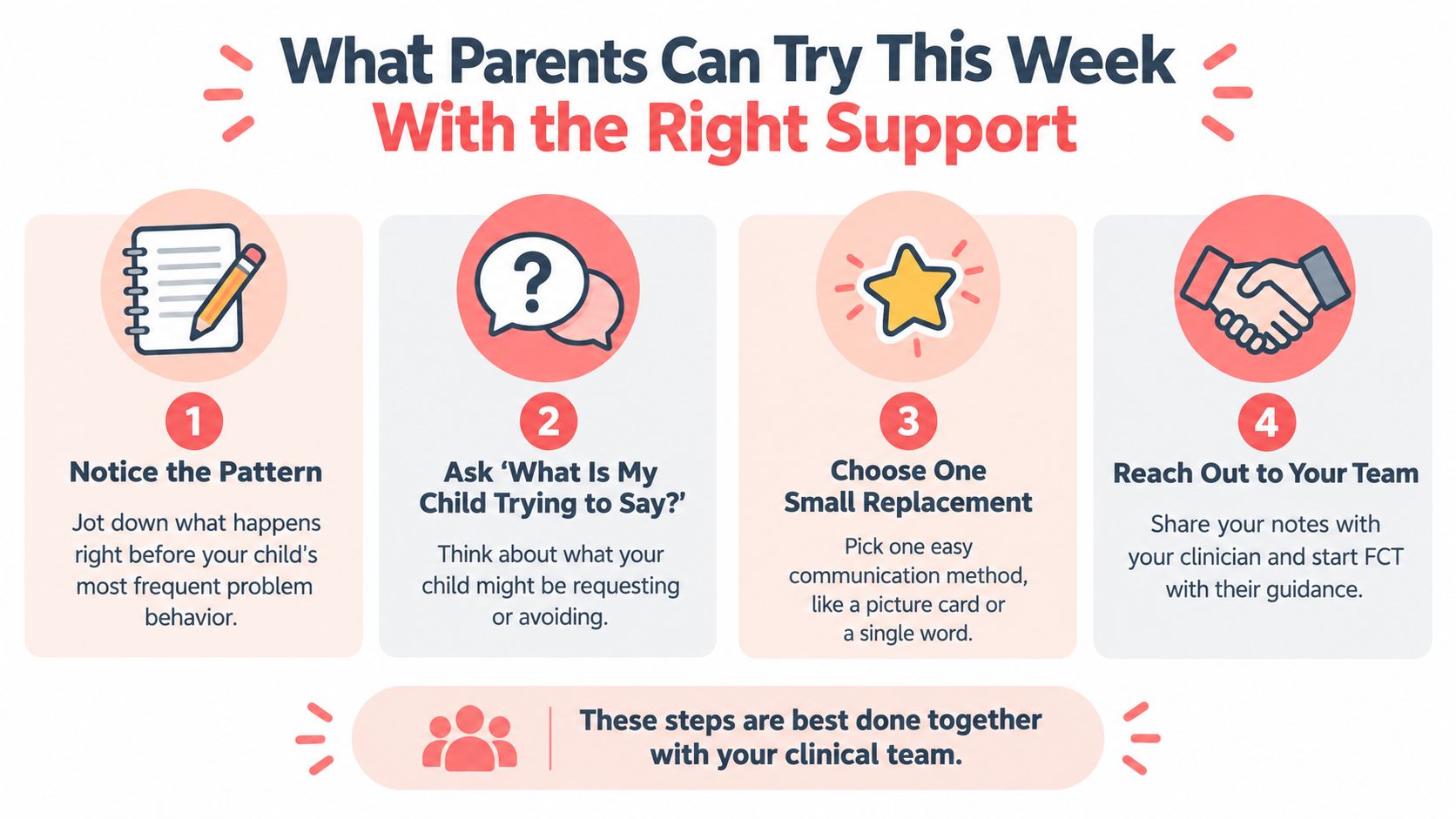
Four simple moves that help
- Notice the pattern: Jot down what happens right before your child's most frequent problem behavior. That note helps the BCBA and therapist see what the behavior may be doing.
- Name the likely function: Ask yourself whether your child may be trying to get something, get out of something, get attention, or meet a sensory need.
- Ask about one small replacement: Bring that pattern to your team and ask whether a picture card, a sign, or a simple word would fit your child right now.
- Respond quickly to early attempts: If your child uses even a rough version of the new response, honor it quickly so the replacement behavior starts to feel more useful than the old one.
The part many parents miss is timing. If a child asks with a gesture and adults wait until the behavior gets bigger, the old behavior can stay more powerful. Reinforcement has to arrive early enough to teach the lesson clearly.
That said, these steps are not standalone FCT. Fidelity matters, and so does the clinical plan behind them. The point is to gather useful information and support the new response, not to guess your way through the process.
If you want a parent-support resource that fits this kind of coaching, FriendlyABA's parent coaching services align well with the daily routines where communication practice really sticks.
Common Misconceptions Parents Bring to FCT
A lot of parents worry that FCT will teach a child to hold back feelings or stay quiet. What it really does is add a clearer way to communicate a real want or need. That often brings relief, because the child no longer has to rely on behavior to get the message across.
Another common misunderstanding is that FCT is just ignoring problem behavior. Families usually hear that and picture adults doing nothing while things get worse. Work is teaching and reinforcing the replacement response, so the child has a better path that works. Extinction may still be part of the plan, but it is only one piece of the intervention.
Reinforcement also gets misunderstood. Some parents hear that word and think of a bribe. In FCT, reinforcement matches the function of the behavior, so the child gets the same kind of outcome through a more acceptable response. The message is simple: this communication is the fastest, clearest way to get the need met.
Another myth worth clearing up
FCT is not only for severe behavior, and it is not only for clinics. The broader review literature supports FCT as an evidence-based practice when it is designed and carried out well. At the same time, some situations call for experienced support, especially when safety is a concern or several settings need to use the same plan.
The part parents often notice first is the shift in the child's face and body. A card, sign, or word can replace a meltdown with a workable request, and that change makes the whole process easier to understand.
Most misconceptions fade after families see the new response work in real life. The room feels calmer, the child seems more understood, and the behavior stops looking so random. That is usually when FCT stops sounding like a treatment plan and starts looking like a better conversation.
If you are trying to decide whether FCT fits your child's needs, FriendlyABA can help you sort through the function of the behavior, the right replacement response, and how to support it across home, school, and community routines. FriendlyABA offers ABA services and parent coaching with BCBA-led guidance, so you can take the next step with a team that understands small moments and big milestones.
Our Latest Insights








You don't have to figure it out alone
Whether you're exploring ABA therapy for the first time or searching for a provider who truly feels like the right fit, we're here to help.