


Access to Better Communication: A Parent's Guide
Explore practical approaches to access to better communication for your child. Learn about AAC, FCT, and caregiver strategies with FriendlyABA guidance.

You're at the kitchen table when your child reaches for a snack, points toward the cupboard, and then begins to cry. You offer several guesses, but each one seems to make the moment harder. You're both tired, and you're left wondering whether the problem is a lack of words, a lack of understanding, or just not having a reliable way to share what's needed.
Many parents begin looking for access to better communication during moments like this. They may be preparing for an ABA assessment, considering an AAC system, or trying to help a child who communicates well in one setting but struggles in another. The encouraging news is that communication support doesn't depend on one method, one device, or one therapy room. Progress can come through speech, gestures, pictures, technology, functional communication training, and carefully coached support from the adults around the child.
Table of Contents
Understanding the Journey to Better Communication
A child who throws a cup may be asking for help. A child who pushes away a plate may be saying “no.” A child who cries when a tablet is put away may be trying to request more time, protest a transition, or communicate that the change feels overwhelming. The behavior can look confusing, but it often carries a meaningful message.
At a first consultation, I help families slow the moment down. We look at what happened before the behavior, what the child did, and what happened afterward. We also ask what the child can already do, what the child enjoys, and which daily routines create the most opportunities for communication.

Communication means participation
Access to better communication isn't limited to spoken language. It includes the ability to:
- Request: Ask for a favorite snack, toy, activity, or person.
- Refuse: Say no, reject an item, or communicate “all done.”
- Choose: Select between two foods, activities, or clothing options.
- Ask for help: Signal that a task is difficult or something is out of reach.
- Share attention: Show another person something interesting or enjoyable.
- Participate: Take a turn, answer a question, join a routine, or contribute at school.
A systematic review of children from birth through age six found gains across expressive and receptive communication, functional communication behaviors, participation, interaction strategies, and symbol production and comprehension across AAC systems. The findings are summarized in the American Speech-Language-Hearing Association review of AAC outcomes.
Practical rule: Start with the communication your child needs most during the day, not the communication method that looks most advanced.
One child may begin with a picture for “break.” Another may use a gesture, a sign, a vocal approximation, or a speech-generating device. The right starting point is the response that the child can access, understand, and use often enough for it to become meaningful.
What Is Augmentative and Alternative Communication
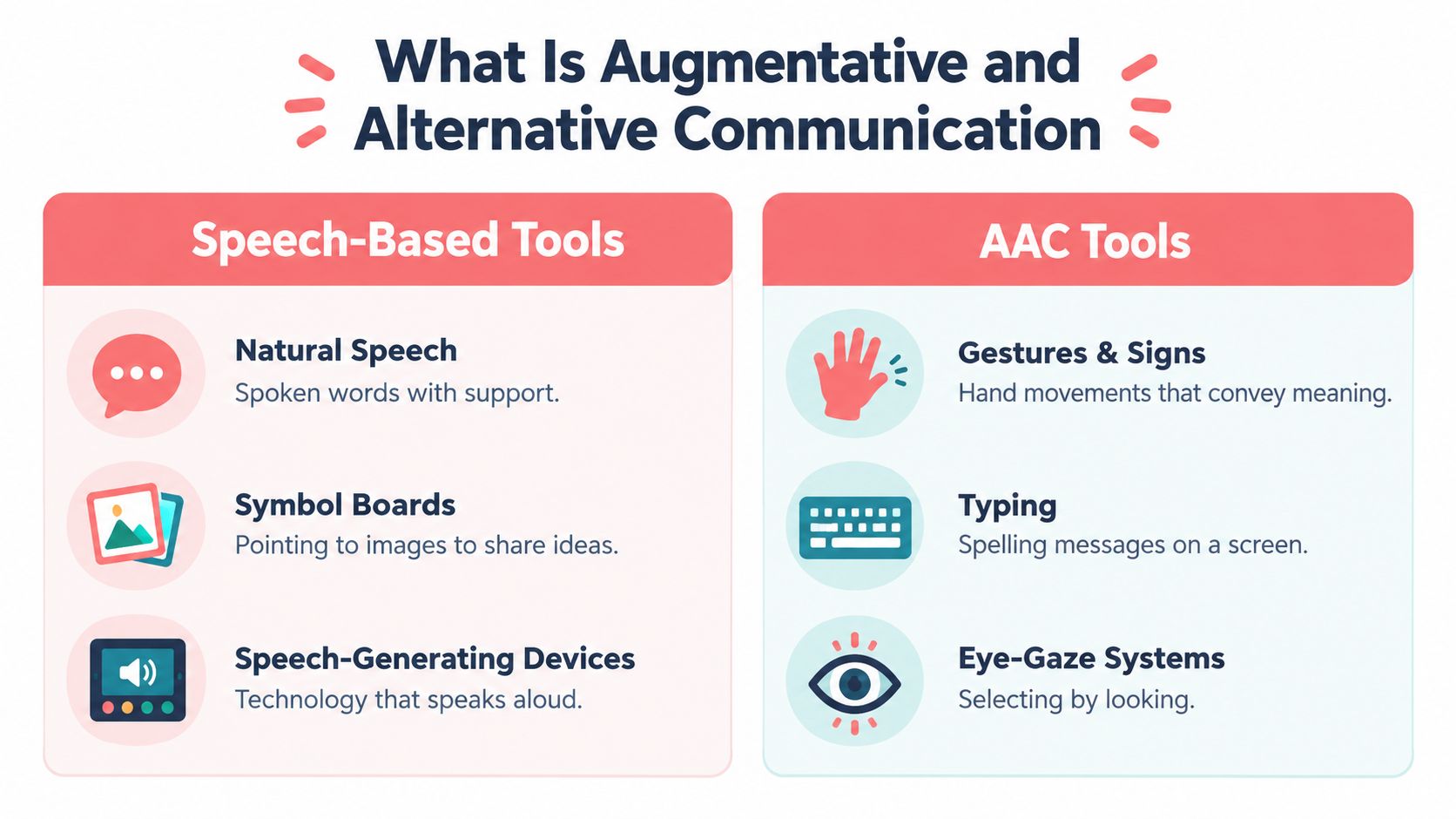
Augmentative and alternative communication, or AAC, is a group of tools and strategies that support communication when speech is limited, difficult to understand, or not yet reliable. “Augmentative” means the system adds to speech. “Alternative” means it can provide another way to communicate when speech isn't available.
AAC isn't a last resort, and it isn't one specific tablet. A child might use more than one form depending on the situation. A picture card may be easiest during a busy transition, while a speech-generating device may offer more vocabulary during a calm conversation.
Low-tech and high-tech options
Low-tech AAC doesn't require batteries or an internet connection. Examples include:
- Picture boards: A small board with images for common requests, activities, or feelings.
- PECS cards: Picture Exchange Communication System materials used to teach intentional exchanges.
- Gesture and sign systems: Hand movements that carry consistent meaning.
- Written choices: Words, letters, or simple visual schedules.
High-tech AAC can include a tablet app with speech output or a dedicated speech-generating device. Some systems allow a child to select symbols by touching the screen. Others may support typing, switches, or eye-gaze access when hand use is difficult.
The device itself doesn't teach communication. A child needs instruction, repeated opportunities, motivating reasons to communicate, and adults who respond consistently. A high-tech system isn't automatically more effective than a simple picture board. A child who can quickly hand over a “help” card may have more functional access in a particular routine than a child who has an advanced device but can't locate the right message.
Choosing a system that fits daily life
During an assessment, a BCBA, speech-language pathologist, and family may consider:
- Motor access: Can the child point, touch, reach, scan, type, or look toward a target?
- Visual understanding: Does the child recognize photographs, drawings, symbols, written words, or objects?
- Communication purpose: Does the child need to request, protest, answer, greet, describe, or ask for help?
- Portability: Can the system travel to the car, classroom, playground, and community?
- Partner support: Will caregivers and teachers know how to model and respond to it?
- Vocabulary growth: Can the system expand as the child communicates more ideas?
A useful system must work in real routines, including noisy rooms, hurried mornings, and unfamiliar places. The goal isn't to make the child use a particular device perfectly. The goal is to make communication more available, understandable, and independent.
A short demonstration can help families see how different systems work in practice:
How Functional Communication Training Reduces Challenging Behavior
Functional Communication Training, or FCT, teaches a child a safer and more effective way to communicate the same message that challenging behavior may be expressing. The process begins by identifying the behavior's purpose. A BCBA may ask whether the child is trying to gain attention, escape a difficult task, access an item, or communicate discomfort.
Consider a child who pushes materials onto the floor whenever a writing activity begins. The behavior may be helping the child escape a task that feels too difficult. In FCT, the team might teach the child to hand over a “break” card, press a button for “help,” or use a spoken approximation such as “finished.”
The three parts of FCT
- Identify the function: Observe what happens before and after the behavior and look for a consistent pattern.
- Teach a replacement response: Choose a communication response that serves the same purpose and is easier for the child to use.
- Reinforce the communication: Respond promptly when the child uses the replacement response, while avoiding delivery of the same outcome directly after the challenging behavior when it's safe and clinically appropriate.
The replacement response must be practical. If a child needs to escape a task, a complicated multi-step message may not work during the hardest moment. A single picture, gesture, sign, or vocal response may be a better starting point.
FCT isn't about assuming that every behavior has one simple cause. Pain, sensory discomfort, sleep disruption, communication difficulty, and changes in routine can all matter. A qualified clinician should assess patterns carefully and create a plan that respects the child's needs, preferences, and safety.
A replacement response should be easier to use than the behavior it replaces.
At home, caregivers can support FCT by keeping the communication response available, practicing it during calm moments, and responding consistently. For a plain-language explanation, see what Functional Communication Training involves.
Comparing AAC and FCT as Complementary Approaches
AAC and FCT answer different questions.
AAC asks, “What tool or system can help this child communicate?” FCT asks, “How can we teach this child when and why to use a communication response?” One provides access to a message. The other provides a structured teaching approach.
A child might use a picture card, tablet button, sign, or spoken word as the AAC response. FCT helps the child learn that the response can be used to request a break, ask for attention, reject an activity, or gain access to something enjoyable.
AAC and FCT: How They Work Together
| Approach | Primary Role | Best For |
|---|---|---|
| AAC | Provides a communication method or access system | Children who need support expressing requests, refusals, choices, questions, or comments |
| FCT | Teaches when and how to use a functional communication response | Children whose challenging behavior may be linked to an unmet communication need |
| AAC combined with FCT | Connects a usable system to meaningful outcomes | Families seeking consistent communication support across routines and settings |
A review of high-tech AAC interventions examined 18 multiple-baseline or multiple-probe experiments across 17 studies and found that high-tech AAC can be considered an evidence-based practice for teaching social-communication skills to people with autism spectrum disorder or intellectual disabilities and complex communication needs. The same review found that high-tech AAC wasn't significantly better than low-tech AAC in alternating-treatment comparisons, as described in the systematic quality review of high-tech AAC interventions.
That distinction matters when families are choosing equipment. An advanced device may be appropriate for one child, while a low-tech system may be more reliable for another. The decision should consider access, vocabulary, learning context, caregiver confidence, and whether the system can be used naturally beyond therapy.
Communication support becomes stronger when adults coordinate the tool and the teaching plan. A child can practice requesting a break at home, use the same idea during schoolwork, and carry it into a community outing. Consistency helps the child understand that communication works with different people, in different places, for different purposes.
The Caregiver Coaching Pathway That Scales Communication Gains
A child may learn to request help in a therapy room, then face very different demands at breakfast, in the car, at school, or during bedtime. Communication support grows when caregivers can use the same teaching principles in those ordinary moments. Coaching turns daily routines into practical opportunities for repeated, meaningful practice.
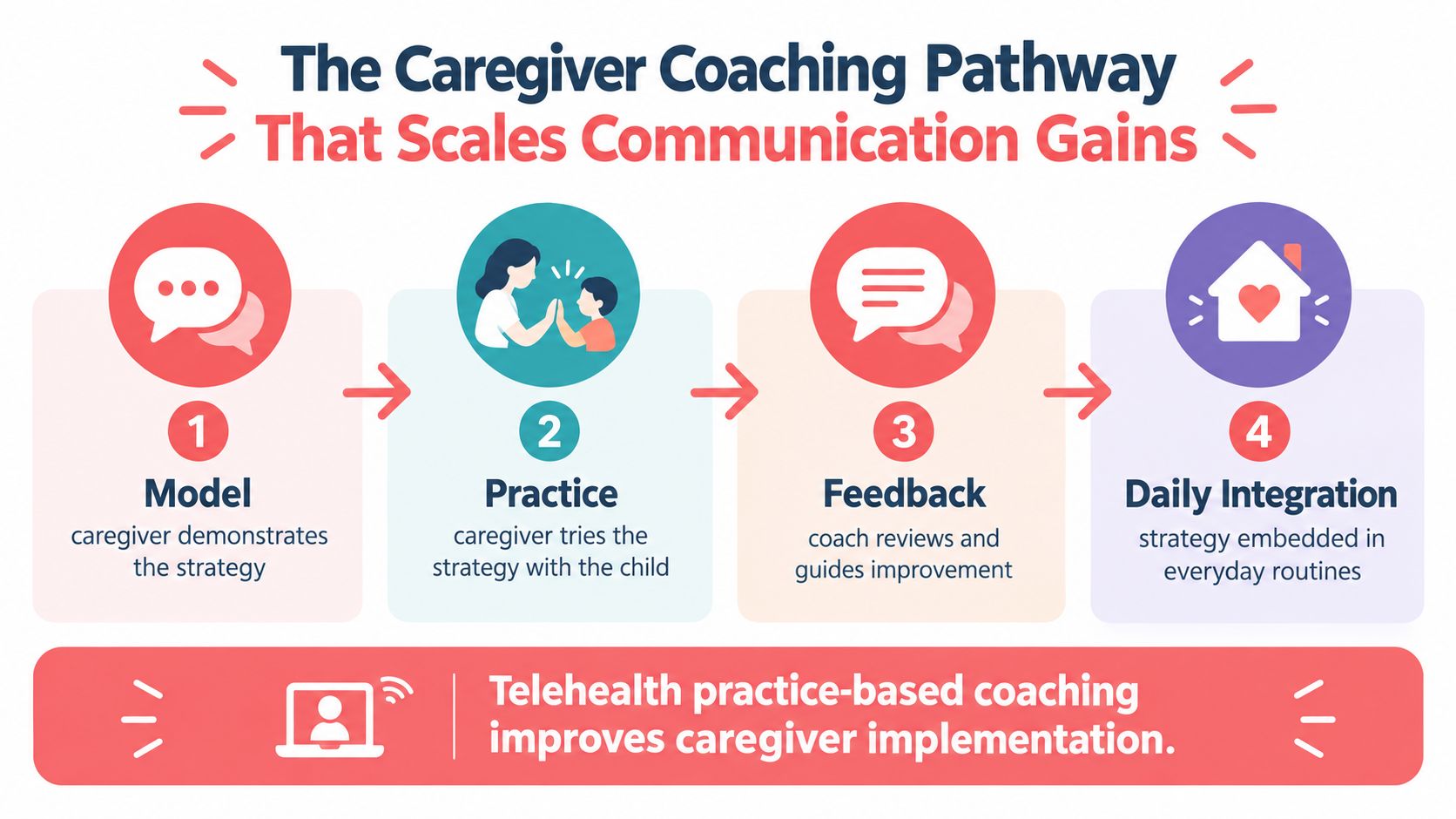
Research on telehealth practice-based coaching found improved caregiver fidelity, reduced challenging behavior, and increased manding, meaning communication used to request something. A meta-analysis reported large effects for parents and caregivers at Tau-BC 0.89, teachers at 0.95, and therapists at 0.99, as described in the caregiver coaching research.
What coaching looks like in practice
A coach works beside the caregiver rather than handing over a list of techniques:
- Model: The clinician demonstrates how to offer a choice, prompt a response, or respond to a communication attempt.
- Practice: The caregiver tries the strategy during a real routine with the child.
- Feedback: The coach points out what worked and recommends one manageable adjustment.
- Daily integration: The family uses the strategy during routines that already occur.
Breakfast can become practice for choosing between two foods. During the transition to the car, a caregiver can model “wait,” “help,” or “all done.” In play, pausing before handing over a favorite toy gives the child time to request it without adding unnecessary frustration. These routines also show whether a communication system is practical outside the clinic. A tablet may work well when charged and within reach, while a printed choice board or other low-tech backup may be more dependable during travel or busy family routines.
Coaching plans should fit the family's actual day. A strategy that works in a quiet clinic may need adjustment for siblings, work schedules, transportation, or several appointments. The clinician can help the family choose one routine, one target message, and one response pattern before adding more.
Why consistency matters
Caregivers do not need to become therapists. They need clear steps, chances to practice, and support when a plan does not fit.
A coach can also measure whether the plan is being used. During breakfast, for example, the coach might count how often a parent models the target message, such as “more,” after presenting a choice. The goal is not perfect performance. The count helps the team see whether instructions are clear and whether the routine needs a simpler prompt. Building communication skills in everyday moments begins with noticing routines that already matter to the child.
Navigating Barriers Beyond the Therapy Room
A child may have a useful communication system and still struggle to use it across services. One provider may call a request a “mand,” another may call it a “functional communication response,” and a school team may use different pictures or prompts. The family then has to translate plans between home, school, medical appointments, and community programs.
A 2024 review found that limited integration and interoperability between electronic communication systems across institutions can add considerable effort for caregivers and care teams. Research on virtual pediatric services also identified difficulty understanding provider explanations, challenges communicating when English is a family's second language, and the digital divide as barriers. In a caregiver survey focused on child and adolescent mental health services, 54% of families agreed that communication was a barrier to accessing care, according to the review of communication barriers in pediatric services.

Questions that reduce coordination problems
At an assessment or care meeting, ask:
- Who will share updates: Which provider communicates with the school, speech therapist, pediatrician, or other members of the team?
- What vocabulary will we use: Will everyone use the same words for requests, breaks, help, refusal, and prompting?
- What happens when technology fails: Is there a printed board, card, or backup method available?
- What language support is available: Can the family access a qualified interpreter rather than relying on a child or relative?
- How will instructions be explained: Can the provider demonstrate the strategy and provide plain-language written steps?
- Where will the system work: Can the child use it at home, in class, during transportation, and in the community?
Technology should reduce effort, not create another task for an already overwhelmed caregiver. A tablet may be valuable, but it needs charging, protection, updates, and trained communication partners. A paper backup may be less exciting, yet far more dependable during a rushed transition.
The wider goal is interoperability in human terms. Families shouldn't have to repeat the same history to every provider or decode conflicting instructions. Better coordination makes it easier for adults to respond in ways the child recognizes.
Your Next Steps Toward Access to Better Communication
Start by writing down three communication moments that are hardest right now. You might choose snack time, leaving the house, and homework. For each one, note what your child does, what you think your child may be communicating, how adults respond, and what outcome follows.
Bring those observations to an assessment. A thorough evaluation should consider strengths, preferences, developmental history, current communication methods, and the goals that matter most to your family. It should also ask where the child needs communication support, whether that's at home, school, during community activities, or across all three.
A practical starting plan
- Choose one high-value message: Begin with “help,” “break,” “more,” “no,” or another message that can make a daily routine easier.
- Make the response accessible: Keep the picture, device, sign, or written choice where the child needs it.
- Practice before frustration peaks: Teach the response during calm moments, then use it when the same need occurs naturally.
- Respond consistently: Let the child experience that the communication response has a meaningful effect.
- Coordinate with partners: Share the same response and prompting approach with teachers, therapists, and other caregivers.
- Review and adjust: If the system is difficult to access or doesn't fit the routine, change the plan rather than blaming the child.
Caregiver training can help families apply these steps between sessions. Read more about parent training for autism when you're considering what support might fit your household.
At FriendlyABA, BCBAs and trained therapists use detailed assessment, individualized treatment planning, caregiver collaboration, and progress monitoring to support communication in home, school, and community settings. The approach may include AAC, FCT, parent coaching, social skills practice, and coordination with school staff, depending on the child's needs and family priorities.
Small moments matter. A child handing over a break card instead of throwing materials, selecting a preferred food, or asking for help during a difficult routine may look like a small change, but each moment can build access, confidence, and participation.
FriendlyABA offers individualized ABA services, caregiver coaching, and communication support in everyday settings, with strategies shaped around your child's strengths and family priorities. Visit FriendlyABA to explore a consultation and take the next step toward more dependable communication support.
Our Latest Insights












You don't have to figure it out alone
Whether you're exploring ABA therapy for the first time or searching for a provider who truly feels like the right fit, we're here to help.