


8 Goals for Parents Supporting ABA at Home
Explore 8 practical goals for parents supporting a child with developmental needs, from communication and routines to self-care and school coordination.

Some of the hardest moments at home don't look dramatic from the outside. It might be getting stuck at the front door while your child resists shoes, hearing a scream when you turn off the tablet, or realizing bedtime still takes an hour of prompting every single night. When you're in it, it can feel like everything needs attention at once.
It usually doesn't.
The most useful goals for parents often start smaller than people expect. One functional skill. One daily routine. One repeatable moment to practice. That could be asking for help at snack time, washing hands after coming inside, or moving from play to bath with less stress. Those small moments are where real progress tends to stick.
At FriendlyABA, our BCBAs, which are Board Certified Behavior Analysts trained to assess behavior and design treatment plans, build goals around what happens in real family life. ABA stands for Applied Behavior Analysis. In plain language, it's a practical approach to understanding behavior, teaching skills, and adjusting support based on what your child responds to. Good ABA goals aren't one-size-fits-all, and they shouldn't feel disconnected from your home. They should reflect your child's strengths, communication preferences, family priorities, and comfort. They also shouldn't promise a fixed timeline or outcome.
That's why the best parent goals usually form a progression. First, make home life more workable. Then build communication, routines, regulation, independence, social participation, and consistency across settings.
Table of Contents
1. Build Functional Communication Skills in Daily Routines
Communication is usually the first place I'd start because it changes so many other parts of the day. When a child can clearly ask for more, help, break, or all done, parents often feel less like they're guessing and more like they're responding. That's true whether your child uses spoken words, signs, pictures, gestures, or an AAC device.
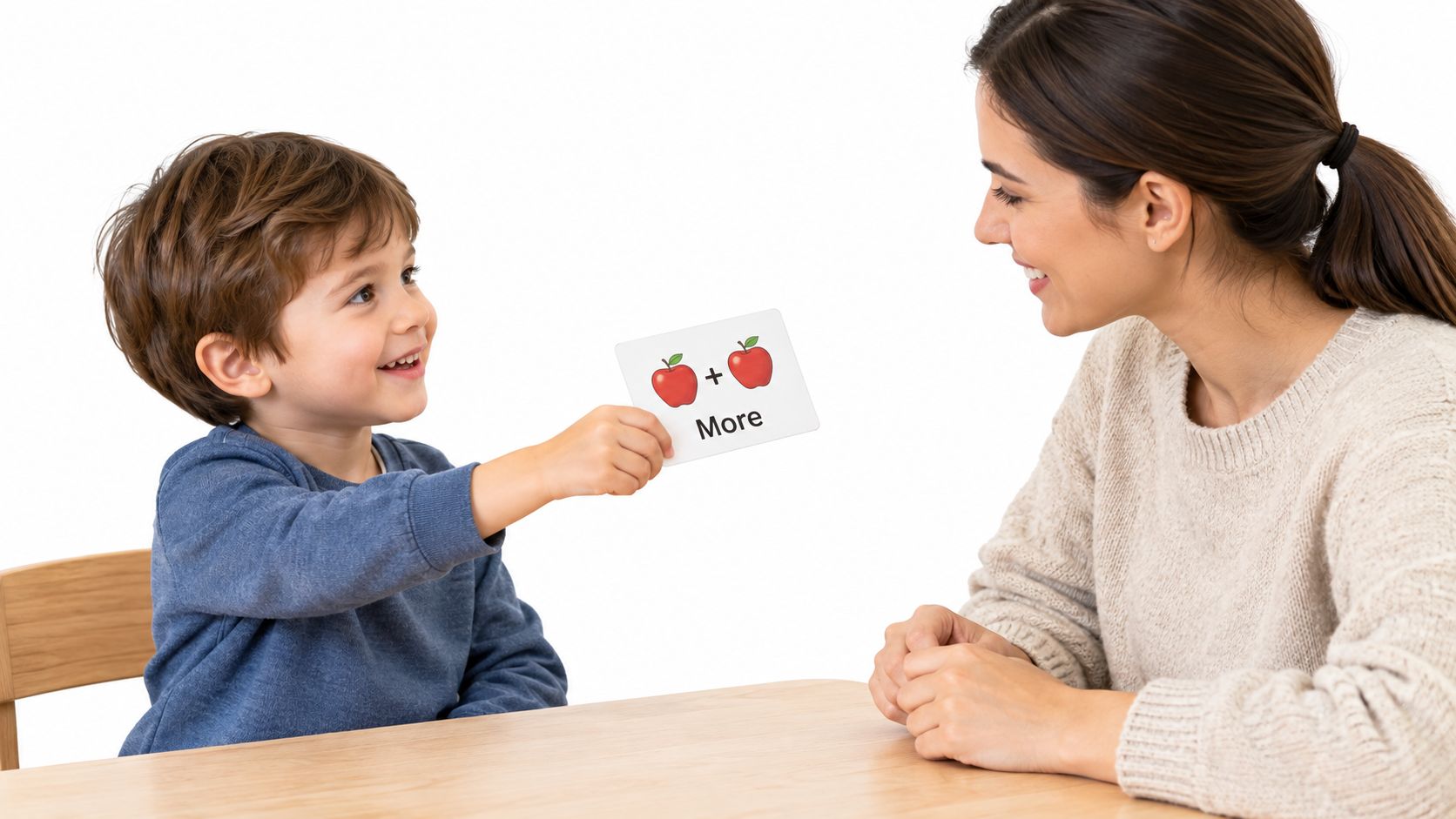
A strong communication goal for parents isn't “get my child talking more.” It's much more concrete. For example, your child hands you a picture card for “more” during snack, taps “help” on a device when a toy is stuck, or points to a visual choice board between two shirts.
Make communication worth using
Children communicate more when it works for them. If a child loves bubbles, crackers, car rides, or one specific toy, those are the moments to practice. A BCBA can help you choose one or two early targets and show you how to prompt without taking over.
A few home examples look like this:
- Snack time request: A non-speaking 4-year-old hands over a “more” card before getting another bite.
- Problem-solving request: A 7-year-old learns to say or sign “help” instead of leaving the table when a zipper or worksheet feels hard.
- Transition support: A school-age child points to a visual schedule to show what comes next.
Practical rule: Start with communication that solves a real daily problem, not communication that only looks good on paper.
Families often do better when they use the same communication method across places. If your child is learning to request with a picture, sign, or device at home, school should know what that looks like too. FriendlyABA teams often coach parents in short routines first, then expand into bath time, car rides, and play once the child starts using the skill more reliably.
If you want a practical example of how to embed this into normal life, FriendlyABA's guide to building communication skills in everyday moments shows what this can look like outside formal therapy time.
2. Establish Consistent Daily Routines and Self-Help Skills
Many families come in asking for behavior help when what they really need first is a more predictable routine. When the order of the morning changes every day, or when adults jump in at a different step each time, children often need more prompting because the task itself isn't clear yet.
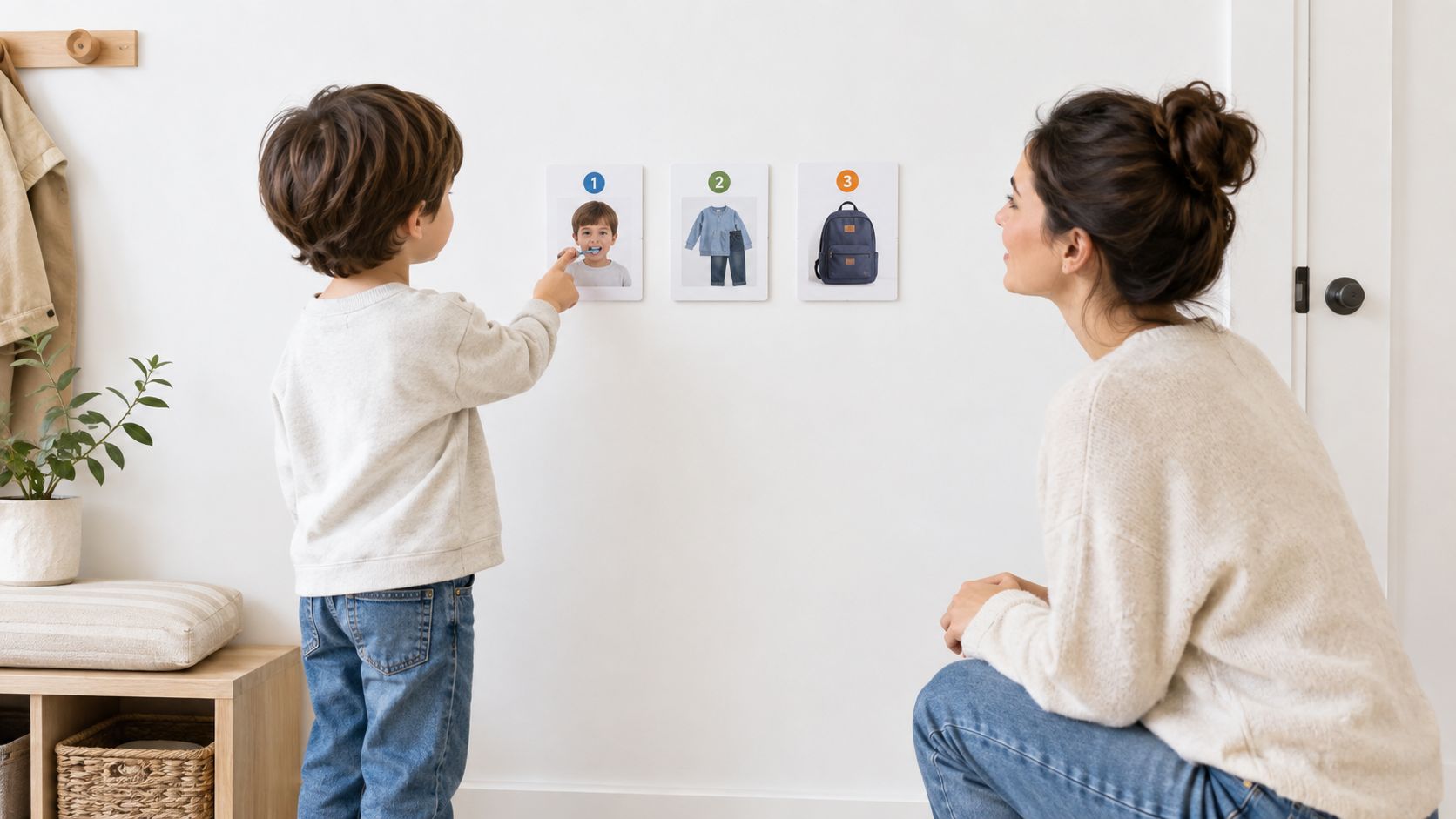
Routine goals work best when they're visible and repeatable. A photo schedule by the sink, a toothbrush checklist, or a bedtime sequence with the same steps every night gives your child a map. It also gives every adult the same script.
Choose the routine that causes the most friction
Don't try to overhaul the whole day at once. Pick the routine that drains the most energy right now. For one family, that's getting dressed. For another, it's toileting, bedtime, or sitting through lunch long enough to finish basic steps.
These routine goals are often the most useful:
- Morning sequence: Wake up, toilet, get dressed, brush teeth, shoes on.
- Hygiene routine: Wash hands, soap, rinse, dry, throw towel away.
- Bedtime routine: Pajamas, bathroom, book, lights dim, bed.
The trade-off here matters. More support may get the routine done faster today, but it can also keep your child dependent on adult prompting. Less support can feel slower at first, but it creates room for independence. The best balance is usually structured support with planned fading, not all-or-nothing help.
A separate ABA study found modest but meaningful correlations between caregiver education and participation goals and two functional goal areas: pragmatic communication (r = 0.17) and self-help or daily living skills (r = 0.18), which supports keeping parent goals tied to practical outcomes families use every day (ABA caregiver participation findings).
If you're looking for home-based ideas that fit daily life, FriendlyABA's post on supporting your child's independence at home gives parents a strong starting point.
3. Support Transitions and Manage Sensory Needs for Calm, Connected Moments
Some children don't resist transitions because they're refusing to cooperate. They resist because the change feels too abrupt, too loud, too unpredictable, or physically uncomfortable. That distinction matters. If issue is overload, adding more demands usually makes the moment harder.
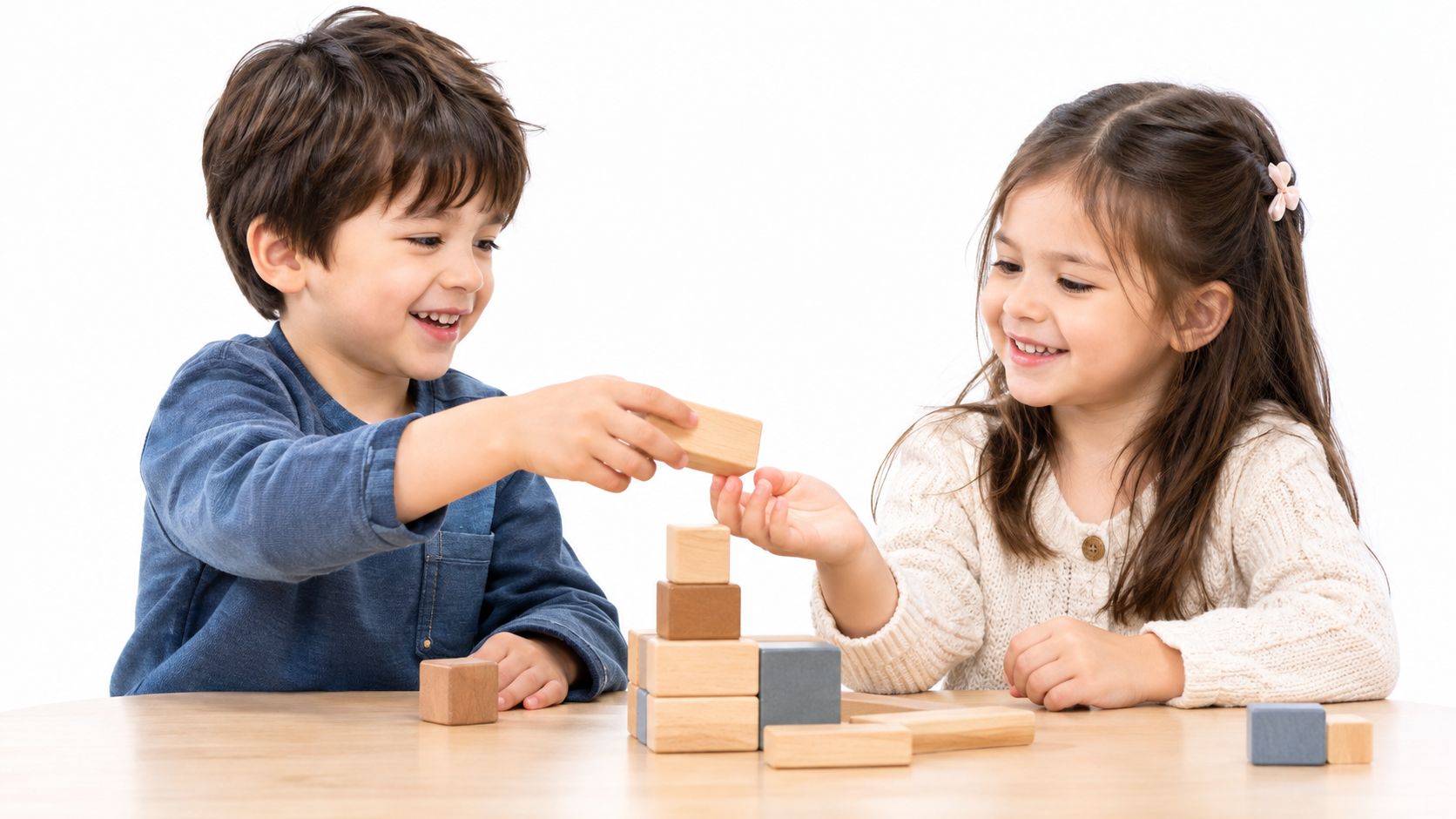
Parent goals should focus less on “stop the meltdown” and more on helping the child move through the situation with support. That can include advance notice, a visual timer, a transition song, a comfort item, a quiet corner, or access to headphones.
Watch the early signs, not just the peak behavior
A child who covers ears in the grocery store, freezes before getting into the car, or starts pacing before cleanup is already telling you something. Parents often make the biggest gains when they learn to respond earlier, before the full escalation.
One child may do better with a 10-minute, 5-minute, and 1-minute warning before leaving the park. Another may need a movement break before homework. A child who's overwhelmed by the car may start with very short rides, a calming playlist, and one familiar comfort item.
Calm transitions usually come from preparation, not persuasion.
Try to document what seems to help and what seems to make things worse. Not every support needs to be permanent. Some tools are short-term scaffolds that help a child tolerate and understand the routine before those supports are gradually reduced.
This also works better when home and school share the same sensory information. If your child benefits from a visual countdown at home and scheduled sensory breaks at school, consistency can lower stress across the whole day instead of making each setting start from scratch.
4. Reduce Challenging Behaviors Through Skill Building and Environmental Support
When parents say, “We need to stop the behavior,” I usually slow the conversation down. Hitting, dropping to the floor, screaming, self-injury, property destruction, or intense avoidance are serious concerns, but the most effective response is rarely just reacting harder in the moment. First, the team needs to understand what the behavior is doing for the child.
That's the role of a functional assessment. A BCBA looks at patterns around the behavior, what happens before it, what happens after it, and what the child may be trying to access or escape. Once that's clearer, treatment shifts from punishment-based thinking to teaching a safer, more effective replacement skill.
Teach what to do instead
If a child hits during transitions, the replacement skill might be “one more minute,” “help,” or “all done” paired with a visual warning. If a child engages in self-injury during difficult work, the replacement could be requesting a break while the task is adjusted into smaller steps.
Useful parent goals in this area often include:
- Stay neutral: Keep your voice and body language as calm as possible, even when the behavior is stressful.
- Use prevention tools: Adjust task length, warning time, noise level, or choice-making before the difficult moment starts.
- Reinforce replacement skills: Respond quickly when your child asks for help, break, or more time in an appropriate way.
Some of the best behavior work happens before the behavior starts.
There's also a practical reality families should hear clearly. Early progress can look uneven. A child may test whether the new communication response really works, or whether the old pattern still gets a faster result. That doesn't always mean the plan is wrong. It often means the adults need a more consistent response and a replacement skill the child can use successfully under stress.
The strongest parent goals here are specific, observable, and limited in number. Clinical documentation standards for ABA treatment also emphasize measurable caregiver goals and a caregiver behavior-management training plan tied to family priorities, baseline levels, and mastery criteria (Carelon ABA treatment report guidelines).
5. Increase Independence in Play, Learning, and Recreation
It is 4:30, you are making dinner, and your child already knows how to do the puzzle, start the worksheet, or choose a familiar toy. Still, nothing happens until you come sit close, give the first direction, and keep it going. Families often read that as refusal or inattention. Often, it is dependence on adult prompts.
That distinction matters because the goal is broader than task completion. Children need chances to start, keep going, and recover from small stuck moments with less adult involvement. Those are the same skills that support home routines now and social participation later.
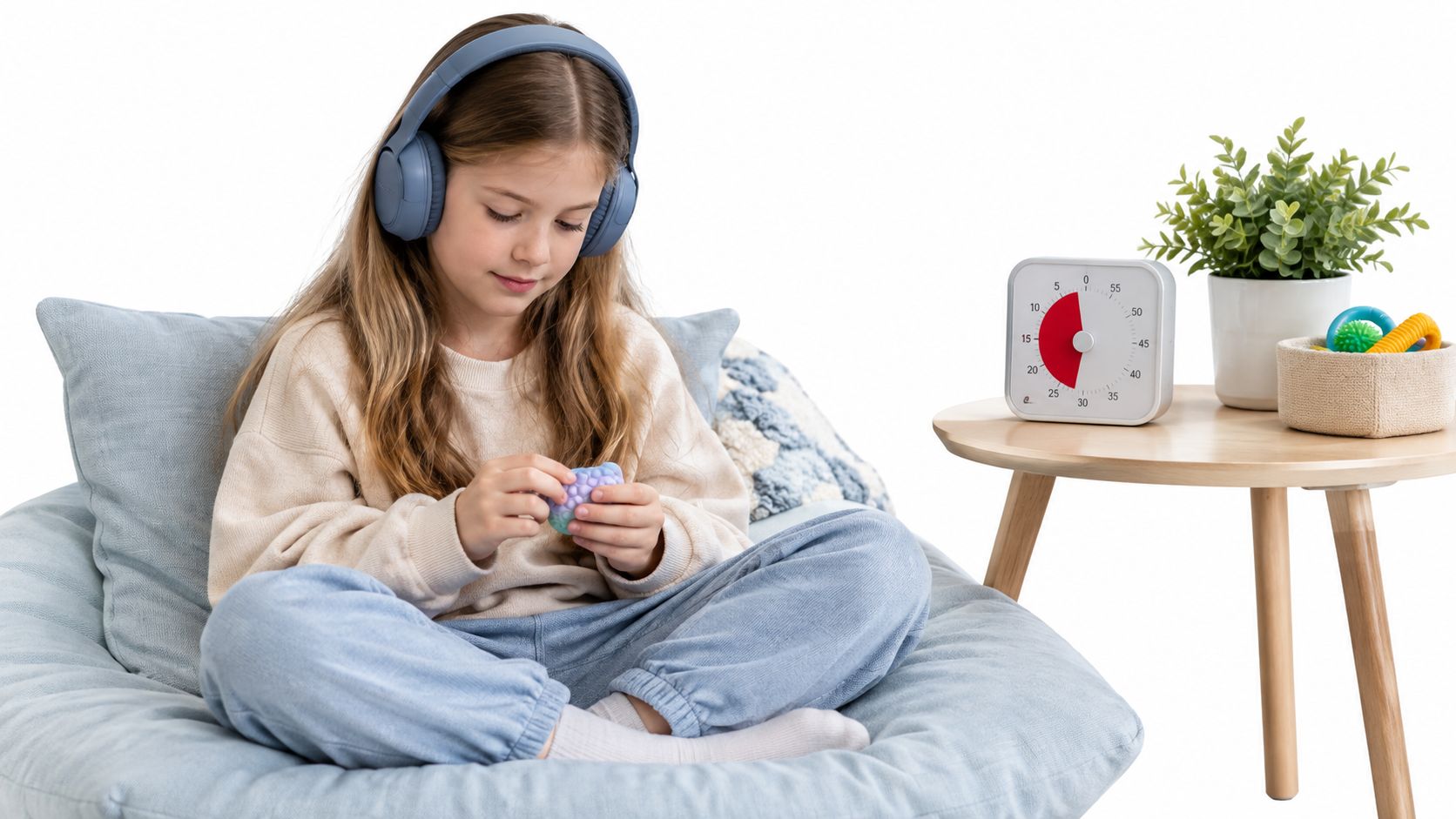
A useful parent goal in this stage sounds more like this: “My child will begin one familiar play or learning activity with one cue and stay with it for a short, defined period,” or “My child will complete the first few steps of a leisure activity before asking for help.” Clear targets make practice easier and reduce the urge to overhelp.
One trade-off shows up quickly. Fast help gets the activity done. Delayed help builds independence. In daily life, parents usually need both. The practical question is where you can tolerate a little slowdown so your child gets to try.
Try changing your support in the moment instead of changing the whole activity:
- Set up the materials, then pause before giving the next cue.
- Use the least intrusive prompt first, such as pointing, handing over one item, or giving a short reminder.
- Keep early practice brief so success happens before frustration rises.
- End while the child is still doing at least part of the activity independently.
The pattern matters more than the specific toy or worksheet. A preschooler may learn to start play by choosing between two familiar options and putting one on the floor. A school-age child may open the homework folder, complete one item, and then check back in. Recreation counts too. Putting on music, taking out art supplies, or beginning a simple movement activity can all be valid independence goals if the child usually waits for adult direction.
Watch for prompt dependence across settings. If your child can do the skill after a full verbal script but not after a brief cue, the next step is not more talking. The next step is fading prompts. In ABA, prompting means any help given to increase the chance of a correct response. Fading means reducing that help carefully so the child does more of the work.
Progress is rarely linear. Illness, poor sleep, school demands, and changes in routine can lower independence for a while. Add support back in when needed, then fade it again once the child is steady. That is not losing ground. It is how a family plan stays realistic and usable in everyday life.
6. Develop Peer Interaction and Social Skills
Saturday morning at the playground often looks like this. Your child wants the same swing another child is using, moves in too close, or walks away before the game even starts. Parents usually do not need a broad goal like "be more social." They need a plan for the next small social step the child can practice.
In this part of the progression, social skills build on the earlier goals. A child who can request, wait briefly, follow a simple routine, and stay regulated has a better starting point for peer interaction. Therapy should support that process, but practice happens in ordinary places like the park, preschool, family gatherings, and after-school activities.
Start with one social action that is easy to observe. Good early targets include handing over a toy, waiting one turn, responding to a peer's greeting, copying a simple play action, or staying in a shared activity for two minutes. In ABA, a target behavior is the specific skill you are teaching and measuring. Clear targets help parents notice progress and adjust support without guessing.
Structured practice works better than hoping social success appears in a busy group setting. One familiar peer, one preferred activity, and one adult giving brief prompts is often enough. That setup gives the child a fair chance to succeed without turning the interaction into an adult-run performance.
Here is what that can look like across ages and settings:
- Early play: Two children roll a ball back and forth. The adult pauses, points to the peer, and waits before helping.
- Preschool group time: A child practices sitting near classmates and copying one motion in a song.
- School-age conversation: A child uses a simple cue card for "ask, answer, then wait" during a short game or snack.
Keep the coaching light. Too much adult talking can interrupt the interaction you are trying to build. A short reminder before the activity and one quick prompt during the activity is often more useful than constant correction.
Afterward, review one thing that went well and one thing to change next time. If the child stayed near peers but did not speak, that still counts as information. The next goal might be adding a wave or a one-word comment, not expecting full conversation right away. Progress varies, especially when settings are noisy, routines change, or the peer is unfamiliar.
For families who want more examples of how to coach these moments in real life, FriendlyABA's guide to helping children navigate social situations with confidence shows how to practice social skills without separating them from everyday routines.
A short visual example can also help parents picture how structured social teaching looks in practice:
7. Create Consistency Between Home, School, and Community Through Family-School Coordination
Monday morning goes smoothly at home. Your child uses a picture card to ask for help with shoes, follows the bathroom routine, and gets out the door with one reminder. Later that day, school reports refusals, tears, or no communication. In practice, that usually points to a mismatch between adult supports, not a child who "knows it here but won't do it there."
This goal matters because it connects the earlier work. Communication, routines, regulation, and independence hold up better when adults respond in similar ways across settings. Therapy should support daily life, not sit off to the side of it.
Parents are often the people who notice the gaps first. A teacher may use spoken prompts, a grandparent may anticipate every need, and a community program may not recognize the child's break card. Small differences like that can lower follow-through fast.
A useful family-school plan fits on one page or in one short message thread. Include three parts: the skill the child is practicing, the cue adults will use, and the response adults will give when the child attempts the skill. Brief and specific works better than detailed and hard to maintain.
For example, if the current goal is asking for help, the shared plan might sound like this: use the same help icon or phrase, wait a few seconds before stepping in, then respond right away when the child asks. If the goal is smoother transitions, adults might all use a two-minute warning, one visual cue, and the same short countdown.
Consistency does not mean every setting looks identical. School has group demands. Home has sibling routines. Community settings are less predictable. The aim is shared supports for the most important target skills, with room to adjust to each environment.
If your child has an IEP, or Individualized Education Program, ask a practical question: "What are the one or two support strategies that would help us respond the same way at home?" That question tends to get better results than asking for every classroom detail.
Community-based autism services also depend on caregiver participation if skills are going to carry over beyond therapist-led sessions, as noted earlier. Families do not need to do everything. They do need a plan other adults can understand and use.
A short coordination checklist can help:
- Use the same communication tool across settings when possible.
- Name one replacement skill adults will honor right away, such as help, break, or all done.
- Keep prompts similar in wording and timing.
- Share one update each week about what worked, not just what went wrong.
Start small. One shared skill practiced in home, school, and community settings is often enough to make the whole plan feel more stable.
8. Integrate Strategies and Plan Next Steps
By this point, many parents realize the same thing. The issue isn't a lack of goals. It's having too many. When every problem feels urgent, families often end up with a long list of advice and very little follow-through.
The better plan is smaller. Choose the goals that would make daily life easier right now, then define exactly what adults will do, exactly what the child will practice, and exactly where it will happen. For most families, that means one or two high-impact priorities first.
Make the plan observable and doable
A workable parent goal sounds like this: “During breakfast, we'll wait for our child to request ‘more' using their picture card before giving another serving.” Or, “Before leaving the house, we'll use the same three-step shoe routine with a visual and one countdown.”
That kind of goal is easier to carry out, easier to coach, and easier to review. It also matches what many parents say they want. In a large U.S. parent poll, 71% of parents reported making resolutions or setting personal goals, and nearly half of mothers (47%) and one-third of fathers (35%) said they set goals specifically to change something about their parenting. In that same poll, 78% said their top parenting goal was to have more patience, 56% wanted to spend less time on their phones, 47% wanted more consistent discipline, and 52% wanted to get healthier for their child. The poll also found that 74% of goal-setting parents said those goals made them better parents, 85% believed their goals positively influenced their child's work ethic toward goals, and 53% of parents with children ages 11 to 18 said their child had personal goals too (Mott Poll on goal-setting by parents and kids).
Fewer parent goals usually produce better follow-through than a long list nobody can sustain.
There's another reason to keep the plan realistic. An independent analysis on the parent-training engagement gap argues that caregivers often disengage when training feels too complex, unrealistic, or not collaborative, and it recommends structured but flexible, family-centered coaching with ongoing feedback (analysis of the parent-training engagement gap). That matches what many clinicians see in practice. Parents are more likely to keep going when the plan respects real family bandwidth.
The clinical lead for that process is often a BCBA. The BCBA credential is a graduate-level certification in behavior analysis that requires a qualifying master's degree, behavior-analytic coursework, supervised fieldwork, and passing the BCBA exam, which helps explain why families often rely on BCBAs to design, monitor, and adjust treatment plans (BCBA certification requirements).
8-Point Parent Goals Comparison
| Intervention | Implementation Complexity 🔄 | Resource & Time Req. ⚡ | Expected Outcomes 📊 | Ideal Use Cases 💡 | Key Advantages ⭐ |
|---|---|---|---|---|---|
| Build Functional Communication Skills in Daily Routines | 🔄 Moderate, BCBA assessment + caregiver coaching | ⚡ Moderate–High: daily embedding, possible AAC & data tracking | 📊 High: clearer requests, less frustration, ⭐⭐⭐⭐ | 💡 Non- or limited-verbal children; priority requests/refusal/commenting | ⭐ Reduces challenging behavior; generalizes across settings; measurable |
| Establish Consistent Daily Routines and Self-Help Skills | 🔄 Low–Moderate, create & teach stepwise routines | ⚡ Moderate: visual supports, scheduled practice | 📊 High: smoother transitions, greater independence, ⭐⭐⭐⭐ | 💡 Morning/mealtime/bedtime resistance; self-care learning | ⭐ Reduces conflict; frees caregiver energy; builds independence |
| Support Transitions and Manage Sensory Needs | 🔄 Moderate, sensory assessment + individualized plan | ⚡ Moderate: sensory tools, environmental modifications, monitoring | 📊 Moderate–High: fewer meltdowns, improved regulation, ⭐⭐⭐⭐ | 💡 Sensory sensitivities; difficult or noisy transitions | ⭐ Prevents escalation; portable tools; builds self-advocacy |
| Reduce Challenging Behaviors Through Skill Building & Environmental Support | 🔄 High, functional assessment, coordinated intervention | ⚡ High: intensive FBA, consistent implementation across settings | 📊 High: decreased aggression/self-injury; lasting change, ⭐⭐⭐⭐ | 💡 Aggression, self-injury, property destruction, intense avoidance | ⭐ Teaches replacement skills; reduces shame; durable behavior change |
| Increase Independence in Play, Learning, and Recreation | 🔄 Moderate, task analysis & systematic prompt fading | ⚡ Moderate: planned sessions, reinforcement, caregiver coaching | 📊 Moderate–High: increased initiation and sustained engagement, ⭐⭐⭐⭐ | 💡 Reliance on prompts; preparing for school/adulthood | ⭐ Builds self-efficacy; reduces caregiver burden; generalizes skills |
| Develop Peer Interaction and Social Skills | 🔄 Moderate–High, role-play, peer practice, generalization supports | ⚡ Moderate: therapy groups, peer opportunities, coaching | 📊 Moderate: more initiations; variable generalization, ⭐⭐⭐ | 💡 Social isolation, turn-taking/sharing difficulties; playdates/school | ⭐ Increases friendships, classroom participation; improves social repair |
| Create Consistency Between Home, School, and Community | 🔄 High, ongoing coordination, IEP alignment, shared strategies | ⚡ Moderate–High: meetings, data sharing, staff communication | 📊 High: faster generalization and progress, ⭐⭐⭐⭐ | 💡 Multiple settings with inconsistent approaches; IEP implementation | ⭐ Speeds learning; prevents siloed skills; supports teachers & families |
| Integrate Strategies and Plan Next Steps | 🔄 Moderate, prioritize goals and assign roles | ⚡ Low–Moderate: planning time, brief regular reviews | 📊 High: focused progress, reduced overwhelm, ⭐⭐⭐⭐ | 💡 Families needing a clear, sustainable action plan across areas | ⭐ Clarifies priorities/roles; makes progress measurable and sustainable |
Turn Eight Goals Into One Manageable Plan
You don't need to work on every goal at once. Most families shouldn't. The best next step is usually to pick one priority that would make daily life easier, define one small observable action, and practice it in one natural routine often enough that everyone can remember what success looks like.
That might be waiting for your child to request help before stepping in. It might be using the same visual routine every morning. It might be giving a countdown before transitions, or responding consistently when your child asks for a break in a safe way. These are small actions, but they often change the feel of the day because they reduce guessing and create predictability.
That's also why parent goals should stay connected to family life instead of becoming a separate homework system. A good plan fits breakfast, getting dressed, bath time, the car, the playground, and pickup from school. If it only works in a therapy session, it's not finished yet.
Parents also deserve realistic expectations. Progress can be steady for a while, then uneven during stress, illness, schedule changes, or developmental shifts. That doesn't mean you're doing it wrong. It means the plan may need adjustment. Supportive ABA should leave room for revision, caregiver feedback, and your child's changing needs over time.
There's a strong reason the field keeps emphasizing caregiver involvement. The World Health Organization's caregiver skills training guidance reports low-quality evidence of better child developmental outcomes and moderate-quality evidence of reduced problem behaviors when caregivers receive skills training. A 2024 systematic review and meta-analysis also found measurable gains in child development (g = 0.30) and reductions in reported problem behaviors (g = 0.41) when caregivers were trained, which supports practical parent goals focused on functional skills and behavior support rather than abstract intentions (WHO caregiver skills training guidance).
FriendlyABA builds around that kind of partnership. Their approach centers on small moments, big milestones, with assessment, parent coaching, treatment delivered in natural settings, and regular review of what's helping at home, school, and in the community. In a formative evaluation of an ABA outreach training program for parents in remote areas, parents rated online tutorials highly for importance and satisfaction, with mean scores of 4.62 and 4.71, and rated telemedicine coaching sessions even higher on satisfaction at 4.8, which supports the value of flexible, coached caregiver support when it's structured and practical (telemedicine parent coaching acceptability in ABA outreach).
If you're unsure where to start, start with the moment that repeats every day and wears everyone out. Bring that moment to a BCBA. A clear goal, practiced consistently in a real routine, is often the beginning of much bigger change.
FriendlyABA provides ABA services, parent coaching, school support, and social skills development in home, school, and community settings, with BCBAs and therapists who help families turn daily challenges into practical, measurable goals. If you want help building a plan that fits your child's strengths and your family's routines, visit FriendlyABA.
Our Latest Insights





You don't have to figure it out alone
Whether you're exploring ABA therapy for the first time or searching for a provider who truly feels like the right fit, we're here to help.