


Applied Behavior Analysis Assessment: A Parent's Guide
Learn how an applied behavior analysis assessment works, what tools like VB-MAPP and FBA reveal about your child, and how results shape ABA therapy goals.

You're at the kitchen table, and your child is lining up blocks instead of answering when you call their name. Maybe they're repeating the same phrase again and again, melting down at bedtime, or only talking in one place but not another. In that moment, it can feel like every little behavior might mean something important, and that's exactly why an applied behavior analysis assessment starts with careful watching, listening, and asking the right questions.
A good assessment doesn't treat your child like a checklist. It looks at how they learn, how they communicate, what they already do well, and what gets in the way of everyday life. A Board Certified Behavior Analyst, or BCBA, usually leads the process, often with support from a team, and the point is to build a useful picture of your child, not hand you a label and send you on your way.

What families usually want most is clarity. They want to know what their child can do now, what skills are still emerging, and which behaviors are making mornings, meals, school drop-offs, or playground time harder than they need to be. When the assessment is done well, those answers point back to real routines at home, at school, and in the community.
Table of Contents
- First comes the history and parent input
- Then comes direct observation
- Finally comes the report and feedback conversation
What an ABA Assessment Looks Like for Your Child
The first thing most parents notice is that the assessment doesn't look like a single test sitting at a desk. It looks more like a thoughtful day of observation, conversation, and play, because children show different parts of themselves in different settings. A child who is quiet at school might be chatty at home, and a child who melts down at snack time might seem calm during a clinic visit.
The assessment is about patterns, not one moment
The BCBA is trying to understand the full pattern. That means looking at language, play, social interaction, daily routines, and behavior across ordinary situations like getting dressed, asking for a drink, or moving from the car into the building. The assessment may include structured tools, but it also depends on what your child does naturally when they're comfortable, curious, tired, or frustrated.
Practical rule: A strong assessment connects what you see in the room to what happens in your real day, like breakfast, bath time, homework, and the ride to school.
Families often hear names like VB-MAPP, ABLLS-R, and AFLS during this process. Those tools help the BCBA organize what they're seeing, but they're not the whole story. The finished picture should make sense in ordinary language, so you can see how your child's strengths and challenges show up outside the therapy room too.
FriendlyABA uses a personalized assessment process built around a child's strengths, needs, and family goals, and that kind of approach makes the most sense for parents who want practical answers rather than jargon. A helpful assessment should leave you with a clearer sense of what to work on first and why those priorities matter at home, school, and in the community.
How the Assessment Process Actually Unfolds
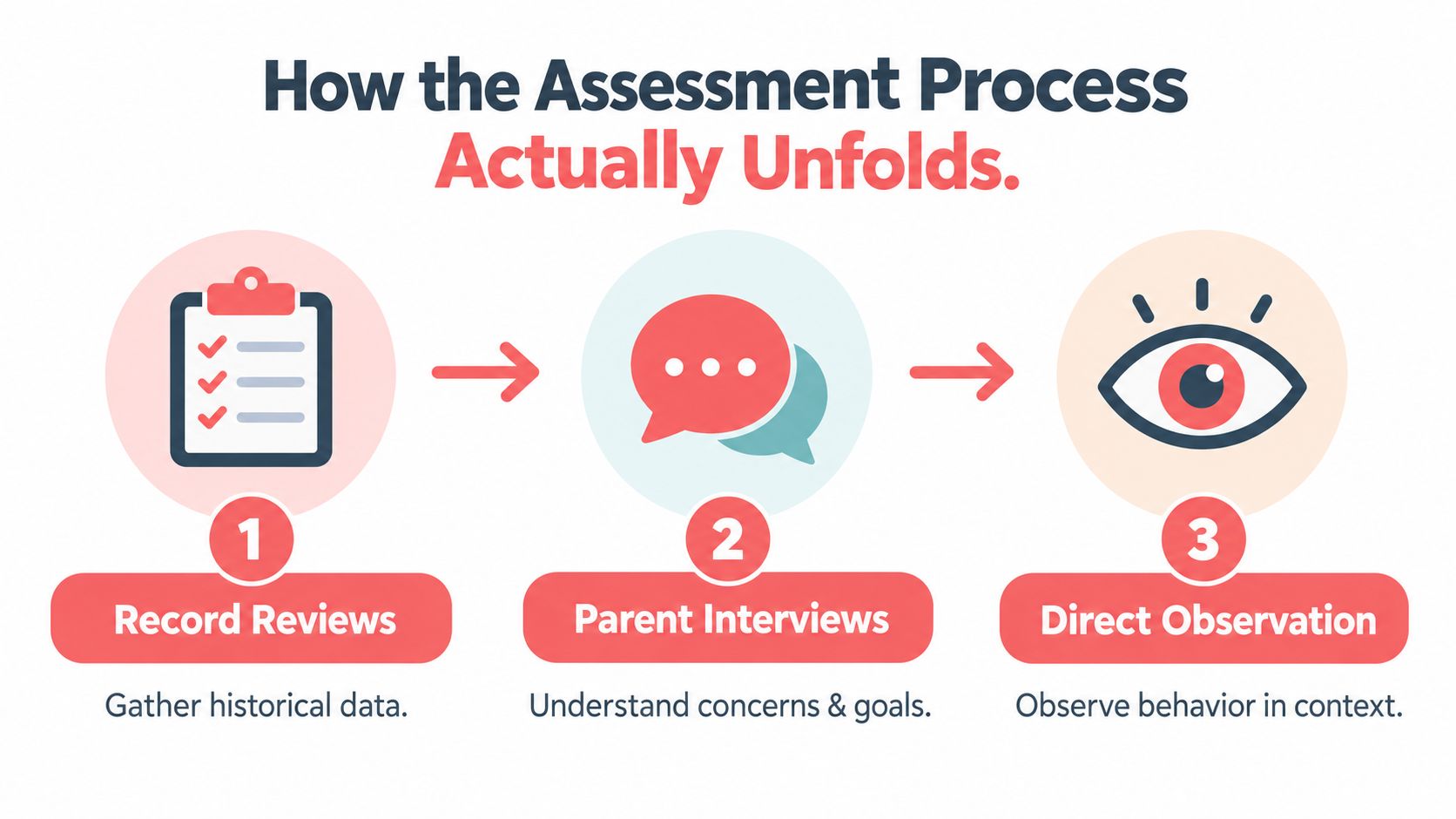
Most families feel calmer when they know the order of things. The process usually moves in three parts, and each part gives the BCBA a different kind of information. The assessment works best when parents are included from the beginning, because no one sees your child's day-to-day life the way you do.
First comes the history and parent input
This part often includes intake forms, interviews, and review of records. The BCBA asks about developmental history, medical factors, communication, sleep, school routines, and the things your family is already trying at home. That matters because behavior never happens in a vacuum, and the assessment should reflect what your child's life looks like.
Then comes direct observation
The team watches your child in action, sometimes in more than one session and sometimes in more than one setting. They may play, prompt, present simple tasks, or watch how your child responds to transitions, demands, and social attention. Parents are usually present or nearby, which helps the child feel safer and keeps the process open instead of mysterious.
Finally comes the report and feedback conversation
The BCBA brings together what was learned from interviews, observation, and any test scores or rating scales. You should leave with a written summary and a clear explanation of what it means, not just a packet of numbers. The report should answer the practical question every parent has, which is what to do next and how the plan will help daily life feel more manageable.
When families want a preview of what that first appointment often feels like, FriendlyABA's guide on what to expect during your first ABA assessment is a helpful starting point.
Comparing the Common ABA Assessment Tools
Parents often hear several tool names in one report and worry they're supposed to know what each one means. You don't need to memorize the acronyms. You just need to know what kind of life skills each tool is trying to capture, and how the BCBA uses that information to shape goals.
What each tool is usually used for
VB-MAPP is often used as a verbal behavior roadmap for early learners who are building communication milestones. It can also include a Barriers Assessment, which helps identify things that may be getting in the way of progress, like problem behavior or skill gaps that slow learning.
ABLLS-R is broader and more detailed. It helps the team look at many foundational skills across language, social behavior, self-help, and academics, which makes it useful when you want a more granular picture of where skills are strong and where they still need support.
AFLS looks at functional life skills, especially independence at home, at school, and in the community. It's often a good fit when the big question is how a child handles daily living skills, routines, and transition toward more independence.
Plain-spoken takeaway: The tool is only the starting point. The BCBA still has to decide what matters most for your child's real routines.
| Tool | Main Focus | Best Suited For |
|---|---|---|
| VB-MAPP | Early communication and learning milestones | Children building early language and learning skills |
| ABLLS-R | Broad, detailed skill tracking | Families who want a granular look at many foundational skills |
| AFLS | Daily living and independence skills | Children and teens working on home, school, and community routines |
Most BCBAs don't use one tool in isolation. They combine assessment results with observation, caregiver input, and real-life samples of what the child does during the day. That's how a report moves from test language to something a parent can use.
Understanding Functional Behavior Assessments
A functional behavior assessment, or FBA, asks a simple question that matters a lot: what is the behavior doing for the child? The answer is usually more useful than the behavior's appearance. Two children can scream in the same classroom and need completely different supports.
Why the “why” matters more than the behavior's shape
A child may scream to get attention, to escape a hard demand, to reach a toy, or because the behavior itself feels regulating in some way. If the team guesses wrong, the plan can miss the mark. A child who screams to avoid math needs a different response than a child who screams because they've learned that loud behavior brings an adult over fast.
That's why clinicians look at ABC data, which stands for antecedent, behavior, consequence. They watch what happens right before the behavior, what the behavior looks like, and what happens right after it. The FBA may also include caregiver interviews, record review, and structured tools, so the team can form a reasonable hypothesis instead of a guess.
What parents usually see during an FBA
You'll often notice detailed questions about routines, triggers, and what adults do after the behavior starts. Those questions can feel repetitive, but they matter because the same behavior can mean different things in different settings. A child may bolt from the dinner table because they're avoiding a demand, while the same child may bolt from the playground because they want a favorite swing.
The FBA doesn't compete with the skills assessment. It completes the picture. One tells the team what your child can do and is learning to do, and the other helps explain what gets in the way when life becomes hard.
If you want a parent-friendly look at what happens after an FBA, FriendlyABA's overview of functional communication training helps connect behavior support to everyday communication.
Why Preference and Motivational Assessments Matter
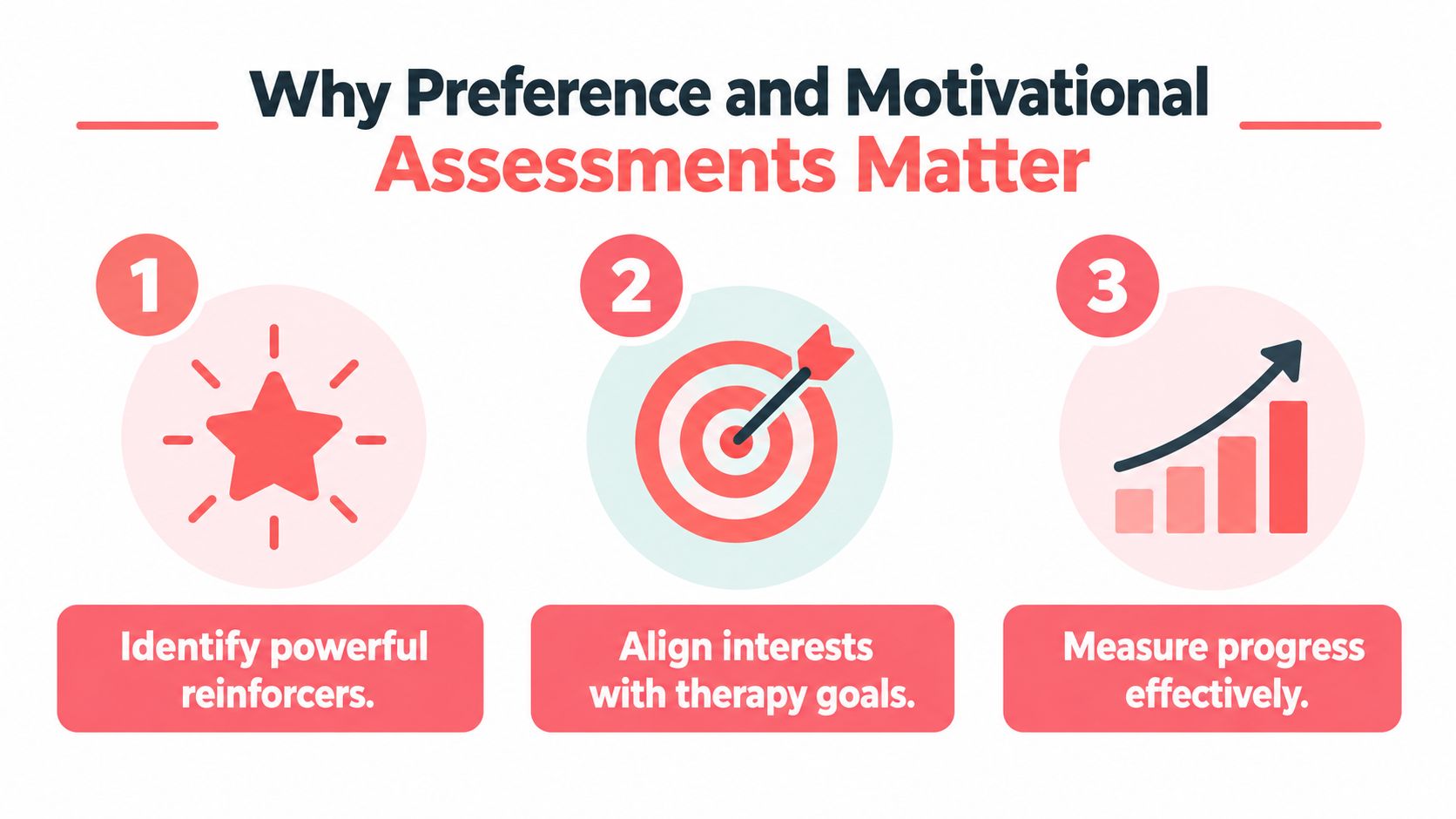
A child learns faster when the work matters to them. That's why preference and motivational assessments sit at the center of a good ABA plan, not on the side of it. The BCBA needs to know what your child will work for today, not what looked exciting last month.
How clinicians figure out what is motivating
One common method is MSWO, or multiple stimulus without replacement. In plain language, that means the therapist shows several items and watches which ones your child chooses first and keeps choosing. A paired stimulus approach puts two items side by side so the child's choices can be compared more directly.
Free operant observation is simpler still. The therapist watches what your child naturally goes toward when options are available. Some teams also use caregiver checklists, because parents often know what lights their child up in a way a short session can't capture.
Why this changes the therapy plan
Those results help the BCBA decide what to use for teaching, what to save as a break item, and what to build into a token system. They also help with generalization at home, because a reinforcer that works in clinic should still make sense during chores, homework, or sibling time if the goal is to keep skills useful beyond one room.
Motivation isn't fixed. It changes with sleep, hunger, novelty, and routine, so the team needs to keep checking it over time. That's one reason a good plan stays flexible, because the thing that helps your child engage today might not work the same way next month.
Turning Assessment Results Into a Therapy Plan
A strong treatment plan starts with the assessment findings, not with a canned template. The BCBA takes the skills picture, the FBA, and the preference information, then turns them into goals that a family can understand and a team can measure. That's where assessment stops being a report and starts becoming a working plan.
What a usable plan usually contains
A good plan should include baseline information, which is the starting point. It should also include measurable goals, teaching procedures, how progress will be recorded, and what generalization should look like across home, school, and community settings. If a child is learning to ask for help, for example, the plan should show how that skill will be taught, what counts as success, and where the team expects to see it outside therapy.
| Treatment Plan Component | Source Assessment | Example |
|---|---|---|
| Baseline | Skills assessment | Child requests help independently in only a few situations |
| Goal | Skills assessment and family priorities | Child uses a functional request during meals, play, and schoolwork |
| Behavior support goal | FBA | Reduce escape-based outbursts during difficult tasks |
| Teaching procedure | BCBA observation and clinical judgment | Prompting, reinforcement, and planned practice |
| Generalization target | Family and school input | Use the same skill at home, in class, and in the community |
Parents are part of the plan, not outside it
Caregivers should be able to see how their priorities made it into the written goals. They should also know how progress will be reviewed and how changes get made when a child stalls or grows into a new stage. FriendlyABA's parent training resource fits naturally here, because caregiver coaching is often what helps skills carry into real life.
The report should be readable enough that you can explain it to a grandparent, a teacher, or a babysitter without translating every other sentence.
The best plans don't sit in a binder. They get updated as the child changes, because an assessment is a living reference, not a one-time document.
Common Parent Worries and Reassuring Truths
The two worries I hear most often are simple and honest. Parents worry their child will be overwhelmed, and they worry the results will be used to define their child instead of help them. Both concerns make sense, and both deserve a straight answer.
Assessment day is usually gentler than parents expect
A good BCBA plans for breaks, comfort items, and a pace that matches the child in front of them. There's usually play mixed in with more structured tasks, and familiar caregivers are welcome because your presence often helps your child settle. The goal is not to push a child through discomfort, it's to learn how they show us what they need when life asks something of them.
A score is not a child
No single number explains your child's personality, potential, or future. Test results can be useful, but they're only one part of the picture, and they should always be interpreted alongside what you and the team see in everyday life. A child who struggles in one setting may show much stronger skills somewhere else, and the report should reflect that.
Another myth is that the assessment is a gatekeeping event, a one-time judgment that decides everything forever. That's not how good ABA should work. Assessment is ongoing, collaborative, and updated as children grow, because families change, skills change, and goals change too.
When the BCBA and parents work as partners, the child gets a better plan and the family gets a voice they can feel in the room. That's the standard families should expect.
If you're trying to make sense of an assessment report, FriendlyABA can help you turn the findings into clear next steps for home, school, and community routines. Visit FriendlyABA to book a consultation and talk through your child's needs with a BCBA who can walk you through the process calmly and plainly.
Our Latest Insights





You don't have to figure it out alone
Whether you're exploring ABA therapy for the first time or searching for a provider who truly feels like the right fit, we're here to help.