



Cost of ABA Therapy: A Parent's Financial Guide
Understand the true cost of ABA therapy. Learn how insurance, Medicaid, and treatment intensity affect your family's out-of-pocket expenses and budget.

If you've just gotten an ABA estimate and felt your stomach drop, you're not alone. A parent often sees a big hourly number, multiplies it by the number of therapy hours, and suddenly the whole thing looks impossible.
The hard part is that the cost of ABA therapy is rarely the number on the first line of the bill. The question that matters is what your family will owe after insurance rules, authorizations, deductibles, and coverage limits are applied.
Table of Contents
- Understanding Your Real Financial Exposure
- Direct hours are only part of the picture
- Why the setting changes the bill
Understanding Your Real Financial Exposure
A parent can do everything right, ask for help early, and still feel shocked by the first estimate. A clinic may quote one rate, a website may show another, and neither one tells you what will actually reach your kitchen table after the claim is processed.
Practical rule: the bill you see is not always the bill you pay.
That gap matters because consumer articles often multiply an hourly rate by weekly hours, which can mislead families. The amount billed is different from the amount owed after deductibles, coinsurance, copayments, annual limits, denials, and coordination with Medicaid or school-based services, as noted in the Wisconsin legislative analysis. A family can be approved for therapy and still face very different out-of-pocket costs depending on the plan design.
A simple way to sort this out is to separate the provider's sticker price from your financial exposure. The sticker price is the listed charge. Your financial exposure is what remains after the payer steps in. It depends on whether you still have a deductible to meet, whether coinsurance applies, whether your plan has an out-of-pocket maximum, and whether the service is in-network.
If you are still choosing a provider, compare options that fit your family rather than chasing a national average. This ABA provider guide can help you think through fit, setting, and service access before the billing conversation gets too deep.
The most reassuring part is this. You do not need to solve the whole financial puzzle from memory. You need a benefits check, an itemized estimate, and a clear explanation of which costs are billed, which costs are allowed, and which costs are yours.
How Treatment Intensity and Staffing Drive the Sticker Price
ABA rarely has one simple price because the service itself is built in different ways. A plan with many direct therapy hours will look very different from one that includes more BCBA oversight, caregiver training, assessment time, or community-based work.
Direct hours are only part of the picture
In ABA, a BCBA is a Board Certified Behavior Analyst, the clinician who designs and supervises treatment, while an RBT is a Registered Behavior Technician who usually delivers many of the direct sessions. That staffing mix affects the bill because direct service, supervision, and planning time are priced differently.
A peer-reviewed review reported that behavioral treatments for autism, including ABA, typically cost between $10,000 and $100,000 per child annually, with variation driven by symptom severity and state of residence, and it shows how quickly the math changes as weekly intensity rises (peer-reviewed review). At $60 per hour, 10 hours per week for 52 weeks totals about $31,200 before insurance, while 20 hours per week totals approximately $62,400. At $125 per hour, the same schedules total about $65,000 and $130,000 (peer-reviewed review).
| Weekly Hours | Estimated Annual Cost $60/hr | Estimated Annual Cost $125/hr |
|---|---|---|
| 10 | $31,200 | $65,000 |
| 20 | $62,400 | $130,000 |
Why the setting changes the bill
Home sessions, school support, and community practice can all fit a child's treatment needs, but the delivery costs are not the same. Travel, supervision time, and the staffing mix needed for the plan can raise the gross charge, especially when the service is intensive or highly individualized. If you are comparing service locations, this home-based ABA overview gives a clear starting point for thinking about how setting affects cost.
A treatment plan should match the child's needs, not a generic hour count.
A public-sector economic evaluation modeled annual ABA-based treatment cost at about £36,682 per child and found that the cost was higher than usual care but paired with greater measured benefits (economic evaluation summary). That kind of comparison helps families see why the sticker price is only part of the story. The plan design matters just as much as the number on the invoice.
Navigating Private Insurance and Out-of-Pocket Maximums
Private insurance often confuses families because the bill from the provider is only half the picture. The other half is the insurer's rules, and those rules decide what you actually pay.
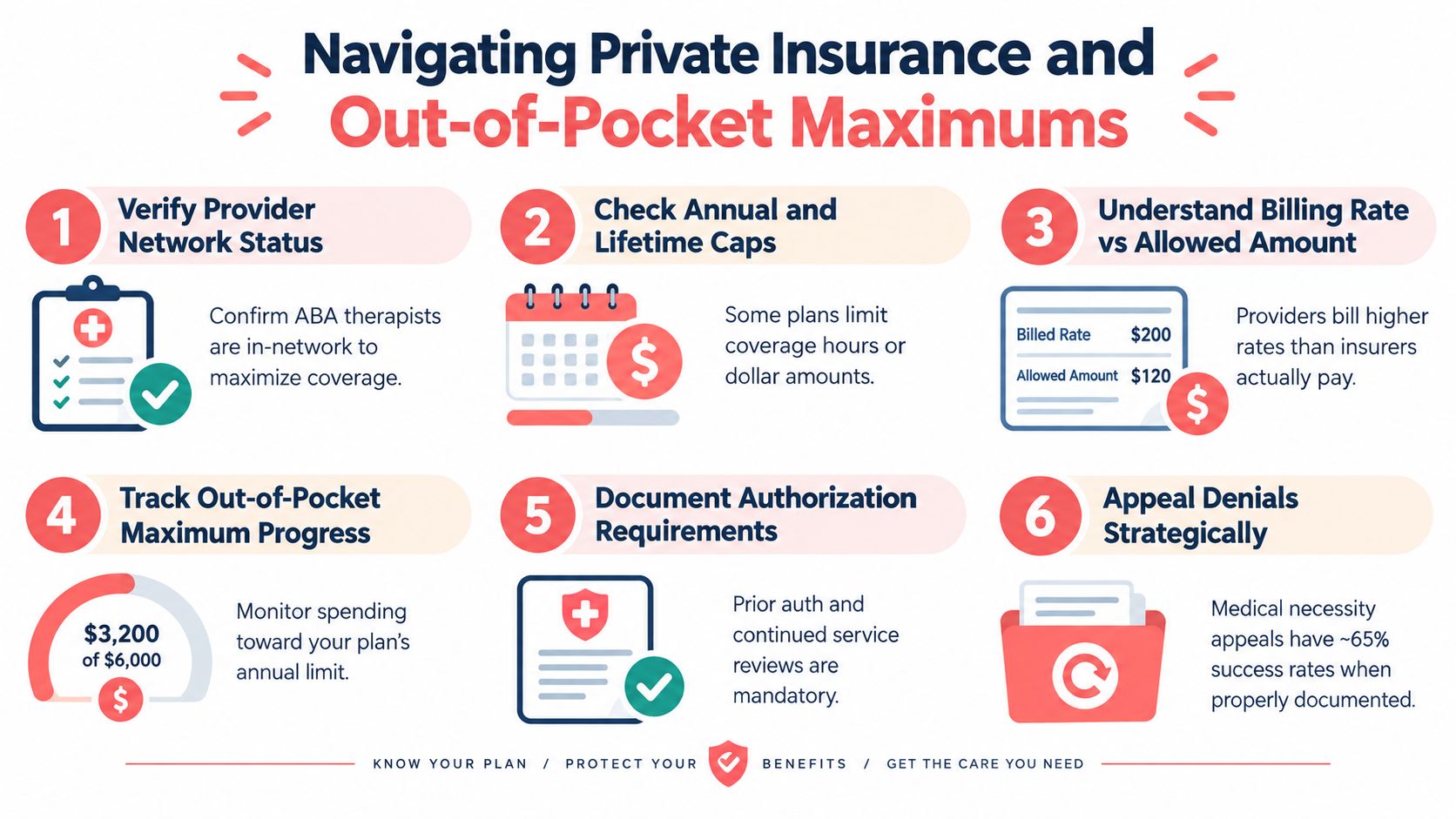
The first step is to separate the sticker price from the plan terms. Before estimating out-of-pocket cost, parents should verify the deductible, copay or coinsurance, annual visit or hour limits, autism-specific exclusions, network requirements, prior-authorization rules, and whether the plan requires a prescription or medical-necessity letter (Autism Speaks).
What to ask before therapy starts
Call the insurer and ask for written answers if possible. If your employer has a benefits team, ask them too, because they can often clarify how the plan is set up.
- Is the provider in-network? In-network care usually applies to your deductible and out-of-pocket maximum differently than out-of-network care.
- What is the allowed amount? This is the insurer's figure, not always the provider's posted rate.
- Are ABA services capped by hour, visit, or dollar amount? Some plans include limits that do not show up clearly in a summary page.
- Is prior authorization required? If so, ask what paperwork they need and how long approval lasts.
- Does the plan require medical-necessity paperwork? Some plans want a diagnosis, a recommendation, or both.
Why this step saves families from surprises
A plan can look generous on paper and still leave families with meaningful costs. The same Missouri insurance analysis cited earlier described a law requiring coverage of medically necessary autism treatment, including ABA, for children up to age 18, with the original ABA benefit capped at $40,000 per year and adjusted annually for inflation. That kind of rule shows why the family's real exposure depends on more than the hourly rate alone.
Out-of-pocket maximums matter here. Once your share of covered costs reaches that limit, the plan's contribution usually changes, but only for covered services and only after the insurer applies its rules. That is why two families can see the same therapy schedule and still face very different bills, depending on deductibles, network status, and prior authorization. The An infographic titled Navigating Private Insurance and Out-of-Pocket Maximums detailing six steps to manage therapy healthcare costs. is a useful reminder to look at the full path from claim to payment, not just the provider's rate.
Medicaid Coverage and the Federal EPSDT Benefit
A family can be staring at a therapy bill and still miss the deeper question. With Medicaid, the first thing to understand is EPSDT, short for Early and Periodic Screening, Diagnostic, and Treatment.
Federal Medicaid guidance says children from birth through age 21 must receive medically necessary services available under the Medicaid state plan to treat autism spectrum disorder, as long as the service meets the state's medical-necessity rules and any required referral or prior authorization steps (federal Medicaid guidance). That creates a strong coverage foundation, but families still have to clear the paperwork that controls how the benefit is used.
What families often miss
Medicaid does not work the same way in every state. Federal guidance allows states to cover autism-related services through different pathways, and each state can set its own service definitions, provider requirements, and utilization controls (Medicaid state-plan record). Two children with the same diagnosis can therefore face very different authorizations, wait times, and billing rules.
Before therapy starts, parents should confirm three things.
- Is ABA covered under your child's specific Medicaid path? State plan language and managed care rules can change the answer.
- Is the provider enrolled and credentialed? A skilled clinician can still be outside the plan's network.
- Does the plan require prior authorization? If it does, ask how often it must be renewed and what progress notes are needed.
Why this matters for budgeting
The same Missouri insurance analysis showed that average monthly ABA claim costs for children 18 and younger ranged from $126 in the individual market to $169 in the small-group market in 2013, and later 2015 figures ranged from $128 in the small-group market to $309 in the individual market, while autism-related claims represented about 0.25% of total claim costs (Missouri insurance analysis). Those figures help separate what insurers process from what families actually feel at home.
For Medicaid families, the biggest cost issue is often not the therapy rate itself. It is whether the provider is properly enrolled, the child meets the program rules, and the authorization paperwork is complete before the first session begins.
The Long-Term Economic Value of Early Intervention
A family can feel every ABA bill in the present and still miss the bigger financial picture. The long-term value depends on whether a child learns skills that carry outside the therapy room and into daily life.

Generalization is where value shows up
Generalization means a child can use a skill in more than one place, with more than one person, and at more than one time. A child who can request help at home, in class, and at the store has a skill that travels. That matters financially because skills that hold up in everyday settings can reduce the need for more intensive support later.
A systematic review found that early intensive ABA-based interventions predicted significant cost savings compared with treatment as usual, mainly through reduced use of specialist schooling and residential care. The same evidence summary also modeled ABA-related savings of about $187,000 to $203,000 per child over ages 3 to 22 and $656,000 to $1.082 million over ages 3 to 55, while noting assumed initial annual therapy-cost differences of $33,000 to $50,000 (systematic review).
Why caregiver coaching changes the equation
Programs that include parent coaching and practice in natural settings are built to make skills stick beyond the session. When a BCBA and therapist help caregivers practice communication, routines, and behavior supports in real life, the child is more likely to use those skills outside the clinic.
That is why families should ask how a program handles school coordination, home routines, and community practice. The bill may feel heavier at the start, but a plan that builds independence can lower the need for more restrictive supports later.
The value of ABA is easier to measure when the goals are functional, not vague.
A useful financial conversation pairs cost with outcomes that can be seen and tracked, such as communication, adaptive routines, classroom participation, and caregiver implementation fidelity, reviewed at set intervals. That keeps the focus on whether the plan is helping the child move toward more independence, not just on how many hours were billed this month.
Preparing for Your First Financial Consultation
The first financial conversation should feel clear, not intimidating. A good ABA provider should be able to walk you through the services, the likely billing categories, and the places where your insurance or Medicaid plan changes what you may owe.
What to bring to the meeting
Bring the insurance card, the plan summary if you have it, and any letters about a diagnosis or prior authorization. Ask for an itemized estimate that separates direct therapy hours, BCBA supervision, assessment fees, and any travel or nonbillable charges.
A helpful budgeting formula is to estimate total annual exposure by adding authorized direct-service hours times the applicable reimbursement or self-pay rate, plus assessment and supervision charges, plus any nonbillable or travel-related costs, then subtracting insurer, Medicaid, or grant payments. The earlier economic evaluation framework uses the same kind of check, and the point is simple. Families need a way to compare a quoted plan with what they may pay in the end.
What to ask before signing anything
- What hours are authorized? Ask for the breakdown by service code, not just one total number.
- How often is supervision billed? BCBA oversight can change the budget significantly.
- Are assessments one-time or recurring? Re-evaluation can be a separate expense.
- Does the plan support insurance appeals? If a claim is denied, you want to know who helps gather documentation.
- How do school services interact with ABA? If your child has an IEP, ask whether school-based supports may reduce the private-service burden.
If you want a clearer sense of how BCBA oversight fits into the total, FriendlyABA's BCBA supervision explanation can help you prepare before the intake call.
FriendlyABA works with families through individualized assessment, BCBA-led planning, and therapy delivered in home, school, and community settings. If you are trying to understand what ABA might cost for your child and what coverage may apply, visit FriendlyABA to schedule a consultation and get a clearer picture of the clinical plan and the financial path forward.
Our Latest Insights











You don't have to figure it out alone
Whether you're exploring ABA therapy for the first time or searching for a provider who truly feels like the right fit, we're here to help.