


ABA Therapy Cost: What Families Actually Pay
Understand aba therapy cost with realistic ranges, insurance tips, and funding options. FriendlyABA helps parents navigate financial planning for ABA care.

Full-time ABA therapy typically costs between $50,000 and $150,000 per year before insurance. If your child is getting close to 20 to 40 hours a week, that kind of bill can feel impossible at first, especially when you're still trying to understand what ABA includes and what your plan might cover.
A lot of parents start with the same search, then end up with a pile of conflicting numbers. One page says one thing, another page says something else, and neither one tells you what your family will really pay once therapy begins. That's where the stress starts, because the biggest cost isn't just the hourly rate, it's the way hours, staffing, supervision, and insurance rules fit together.
Table of Contents
- The main cost drivers behind the quote
- Why setting and planning also matter
- What the infographic leaves out
Understanding What ABA Therapy Actually Costs
A parent often reaches the same moment after the intake call, the question becomes simple again, how much will this cost us? The answer depends on how much therapy your child needs, who provides it, and whether insurance pays part of the bill. Using common U.S. pricing as a guide, a child receiving 20 to 40 hours per week can still reach $50,000 to $150,000 per year before insurance adjustments, so families usually need a budget plan before services begin.
Why the headline number feels so high
Hourly rates can look manageable until they are spread across the week. Direct therapy is commonly billed at about $120 to $200 per hour, while BCBA supervision or assessment can run about $200 to $350 per hour (Alpaca Health). That difference matters because families are paying for more than one service, they are paying for teaching, oversight, and treatment planning.
Practical rule: when a quote sounds simple, ask what role each hour covers, direct therapy, supervision, assessment, or treatment planning.
A weekly example makes the math easier to see. If a child receives 25 hours of ABA in a week, even a blended rate quickly becomes a substantial monthly expense before insurance helps. The total rises further when the plan includes regular BCBA oversight, because the supervisory hours are part of the service, not an extra detail.
The role mix changes the total quickly. A child who needs more support from a Board Certified Behavior Analyst, or BCBA for short, will usually cost more than a program with fewer oversight hours. That does not mean the higher-cost plan is excessive, it usually means the service is more complex and more individualized.
What a parent should expect in plain terms
Some families hear one hourly price and assume that is the whole story. It is not. Direct RBT therapy, meaning Registered Behavior Technician sessions, is often priced lower, but the blended cost rises because families still need supervision, assessment, and treatment planning.
That is why a provider quote should always be read as a package, not a single number. If your child needs more support hours, more supervision, or more frequent plan updates, the total rises even when the direct therapy rate stays the same. FriendlyABA's approach reflects that reality, because real care includes ongoing review, not just time with a therapist.
What Factors Influence Your ABA Therapy Cost
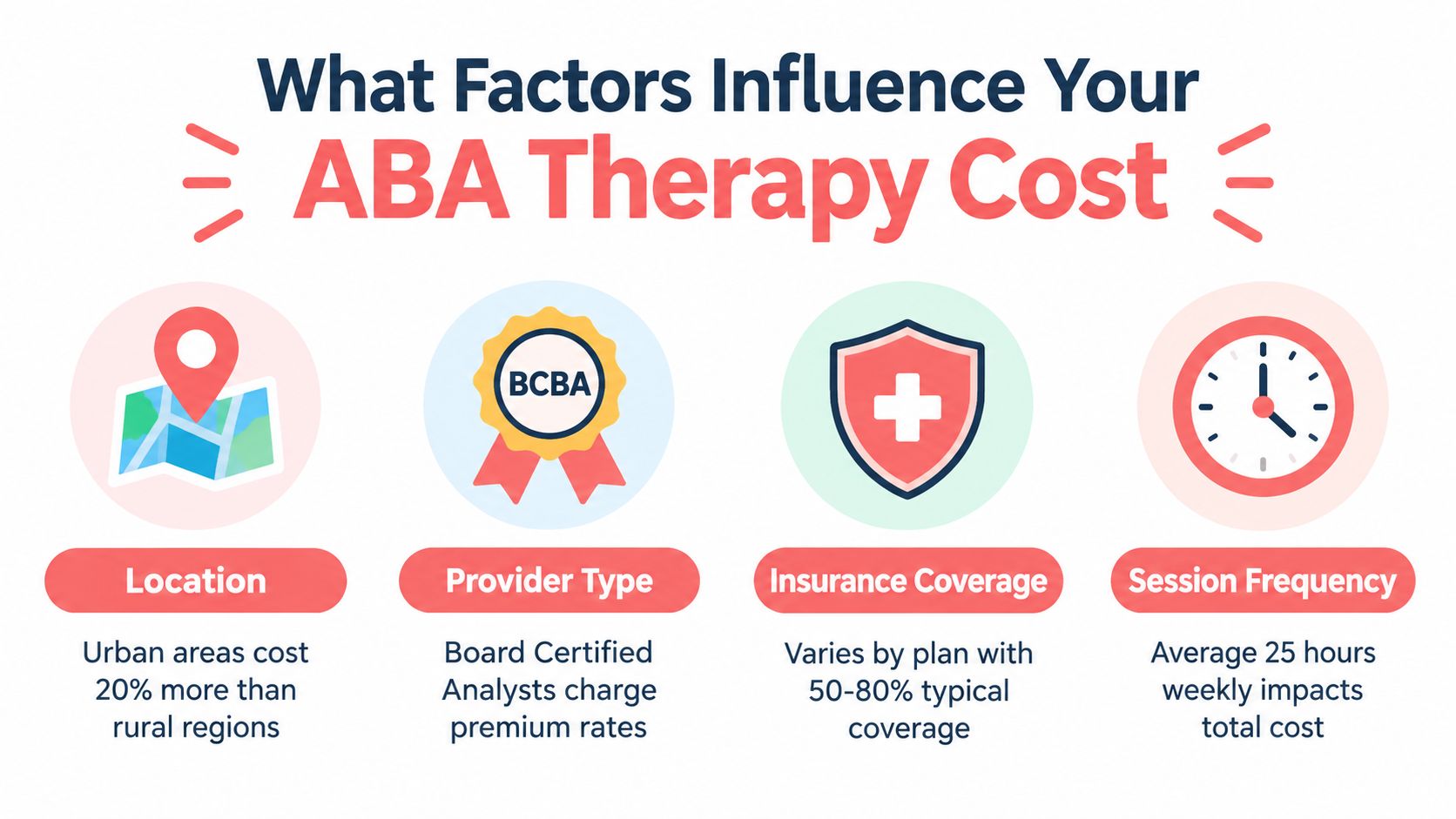
A family may see two ABA quotes that look similar at first glance, then discover the actual difference is in how the program is built. One plan may rely on more BCBA time, more direct therapy, or more caregiver coaching. Another may be lighter on supervision and easier to run within a budget. ABA pricing reflects staffing, supervision, travel, and administrative work, not just the minutes spent teaching.
The main cost drivers behind the quote
The biggest driver is usually service intensity. A BCBA recommends hours based on the child's needs, much like a tailor chooses fabric based on the final fit. A child with focused goals might need 15 hours a week, while a child who needs broader support may need 30 or more. That 15-hour gap alone can change the annual total by tens of thousands before insurance is applied.
The mix of staff roles also changes the price. A BCBA, who designs and supervises the program, costs more than a technician providing hands-on sessions. A PMC analysis found a weighted national mean of $94.72 per hour for BCBA or BCBA-D services versus $65.16 per hour for master's-, doctoral-level, or technician-level behavioral services, which shows how credential level changes the total.
Good question to ask: “Which parts of this plan are direct therapy hours, and which parts are supervision or treatment planning?”
Why setting and planning also matter
Location shapes price too. Providers in higher-cost markets often have higher service rates, while lower-cost regions may see smaller quotes. The bill can also rise if the program includes detailed assessment, frequent plan updates, or more caregiver coaching. Those services help the plan stay on track, but they also add to the financial picture.
If you are comparing providers, ask what is included in the rate and what appears separately. For home-based care, travel and scheduling can also affect pricing. FriendlyABA offers home-based ABA services, and that setting can fit families who want therapy built around daily routines at home.
What the infographic leaves out
Many cost charts oversimplify ABA by treating insurance as a fixed discount. Real life is messier. The total a family pays depends on how much a plan approves, which staff bill under which codes, and how much administrative work the provider must do to get services authorized and maintained. A quote is not just a number on a page. It is a package built from hours, staff roles, and the amount of support your child needs.
How Insurance Coverage Can Reduce Your Out-of-Pocket
A family can get an “ABA is covered” answer and still face a large bill. Deductibles, copays, prior authorization, and visit limits all shape what shows up on the final statement. The key question is how the plan pays, not just whether it pays.
What to ask before therapy starts
Start with a written checklist. Ask whether ABA is covered under your exact policy, whether the provider is in network, whether prior authorization is required, and what diagnosis or records the insurer needs before it approves services. Also ask which parts of care are billed as direct therapy, supervision, or treatment planning, because those pieces can carry different rules.
Request the billing details in writing too. Ask for the CPT codes the plan will reimburse, the authorized hours, and the provider credential requirements. If your child's program uses a mix of technician services and supervision, confirm how each service is processed so you know where cost-sharing begins.
Medicaid works differently, but the same idea applies. Under Medicaid's EPSDT rules, children under 21 can receive medically necessary services to correct or improve conditions, which may include ABA-related caregiver training and behavioral coaching when they fit Medicaid rules and come from qualified providers (Medicaid EPSDT toolkit). In plain terms, the benefit is built around medical need, not just the therapy label.
Practical rule: if a plan says “yes” to ABA in general, still ask how many hours, which codes, and which provider credentials it will reimburse.
Why state rules still need careful checking
Coverage can look broad on paper and still feel narrow once the claim is filed. Louisiana Medicaid's ABA fact sheet shows how approval often depends on diagnosis, functional impact, a qualified evaluation, and plan authorization before services begin (Louisiana Medicaid ABA fact sheet). That kind of checklist matters because families usually feel the cost only after a missing form or unclear approval slows payment.
If private insurance is involved, ask for the same details before the first session starts. A verbal “covered” answer does not tell you what the plan will pay, where cost-sharing begins, or whether the provider must meet specific billing rules. Those are the pieces that shape out-of-pocket cost.
A helpful way to sort it out is to treat the authorization letter like a budget map. It should show the approved hours, the service codes, the provider type, and any renewal steps. When those items are unclear, the family often ends up paying for avoidable gaps while paperwork gets fixed.
Comparing In-Home Versus Center-Based ABA Pricing
Where therapy happens can shape both the budget and the day-to-day experience. In-home sessions feel familiar because the therapist works inside the child's own routines, like mealtimes, dressing, or bedtime. Center-based therapy feels more structured and often gives children a place to practice social skills around peers.

The cost difference families usually notice
In-home ABA can cost more in some cases because the provider has to account for travel time and scheduling logistics. Center-based care may feel more predictable, but families still need to factor in their own transportation and time away from work or home responsibilities. The billed hourly rate may be similar in both settings, but the practical cost to the household can feel very different.
The setting itself doesn't decide whether the therapy is good. The right choice depends on what your child needs to learn and where those skills need to show up. If the goal is morning routines, mealtime behavior, or safe play in the home, an in-home format can make the learning feel more natural. If the goal is group participation or peer interaction, a center setting may be a stronger fit.
A simple way to compare options
A parent can think about the choice in three questions.
- Where do the hardest daily routines happen? If most challenges show up at home, home-based services may help the team work on the core problem in the actual environment.
- Where does your child need practice with peers? If social interaction is the main goal, a center can create more built-in opportunities.
- What would be hardest for your family to sustain? Drive time, missed work, parking, and sibling schedules all matter more than people expect.
A video tour or intake meeting can help families see the difference before committing. FriendlyABA's in-home ABA therapy page is a useful example of how providers explain that model to parents who want therapy woven into daily life.
The best setting is the one that matches your child's goals and your family's logistics. Price matters, but so does whether the therapy can happen consistently.
Exploring Additional Funding Resources and Grants
Insurance is only one piece of the funding picture. Some families also use grants, state programs, or school-based supports to reduce the amount they pay directly. Those options usually take more effort to find, but they can make a real difference when coverage leaves gaps.
Where to look beyond the main insurance plan
Start local. State agencies, nonprofit programs, and early intervention systems sometimes offer support that overlaps with ABA services, especially for children who need help with communication, behavior, or daily routines. A pediatrician or diagnostician may also know which public programs or community resources are active in your area.
If you're trying to stretch the budget, it helps to treat funding like a layered plan instead of a single answer. One source may cover assessment. Another may help with parent coaching. Another may reduce the number of private-pay hours you need each month. That kind of patchwork can still be useful if each piece is coordinated carefully.
Families sometimes overlook parent training because it sounds secondary, but it can be one of the most practical uses of therapy time. Parent training resources are worth reviewing because caregiver coaching often helps families use skills outside the session itself. That doesn't replace direct therapy, but it can help make the hours you're already paying for more useful in daily life.
What to gather before applying
Grant and scholarship applications often ask for similar documents. A diagnosis report, proof of income, insurance summary, treatment recommendations, and a short family statement are common places to start. If a program asks for service plans or authorization letters, keep those documents in one folder so you can reuse them.
Practical rule: apply early, even if the deadline feels far away, because many assistance programs have limited funds and a long review process.
It also helps to ask providers which documentation they can supply quickly. A clinic that already understands ABA billing and authorization can save your family time when you're applying for outside support. That matters because the more organized your paperwork is, the less likely you are to lose momentum while waiting on a decision.
Planning for the Long Term with FriendlyABA
The financial side of ABA looks intimidating when you only see the headline numbers. It looks more manageable when you break it into pieces, insurance, service intensity, setting, and the support systems around the therapy. That's why good planning matters as much as the therapy itself.
Thinking beyond the first bill
A program should be built around what your child needs and what your family can realistically sustain. Intensive service can be appropriate when the assessment supports it, but the plan also has to make sense with work schedules, transportation, and insurance rules. Families do better when they know how the program will be monitored, adjusted, and documented over time.
International cost-effectiveness modeling shows why this issue isn't just about price tags. One PLOS One analysis estimated annual program costs at £36,682, with incremental costs of £46,103 and 0.24 QALYs in a pessimistic scenario, versus £39,233 and 0.84 QALYs in an optimistic scenario, which means the cost-benefit picture changes sharply depending on how outcomes generalize beyond therapy settings (PLOS One analysis). In plain English, the long-term value depends on how well skills carry over into real life.
What a good provider should help you do
A solid ABA team should help you understand the authorization process, the staffing structure, and the parts of the plan that affect your bill. That includes explaining assessment needs, parent coaching, and how progress is reviewed. The more clearly those pieces are laid out, the easier it is to plan ahead.
FriendlyABA works with families through BCBAs and therapists in home, school, and community settings, with a focus on small moments, big milestones. That matters because financial sustainability is easier when the care plan is tied to everyday routines instead of random hours on a calendar. It also helps families see where their money is going and why.
Bottom line: the right ABA plan is one your child can use and your family can keep supporting.
If you're trying to figure out what ABA therapy cost would look like for your child, the next step is a conversation, not a guess. Reach out, review the coverage details, and build a plan that fits both your child's needs and your family's budget.
FriendlyABA offers individualized ABA services in home, school, and community settings, with BCBA-led planning and caregiver collaboration built into the process. If you want help understanding your options and what your insurance may cover, visit FriendlyABA to book a consultation and talk through the next step for your family.
Our Latest Insights





You don't have to figure it out alone
Whether you're exploring ABA therapy for the first time or searching for a provider who truly feels like the right fit, we're here to help.