


Discrete Trial Training Examples: 7 Skills to Practice
Explore seven discrete trial training examples with step-by-step breakdowns and easy home tips from FriendlyABA's BCBAs.

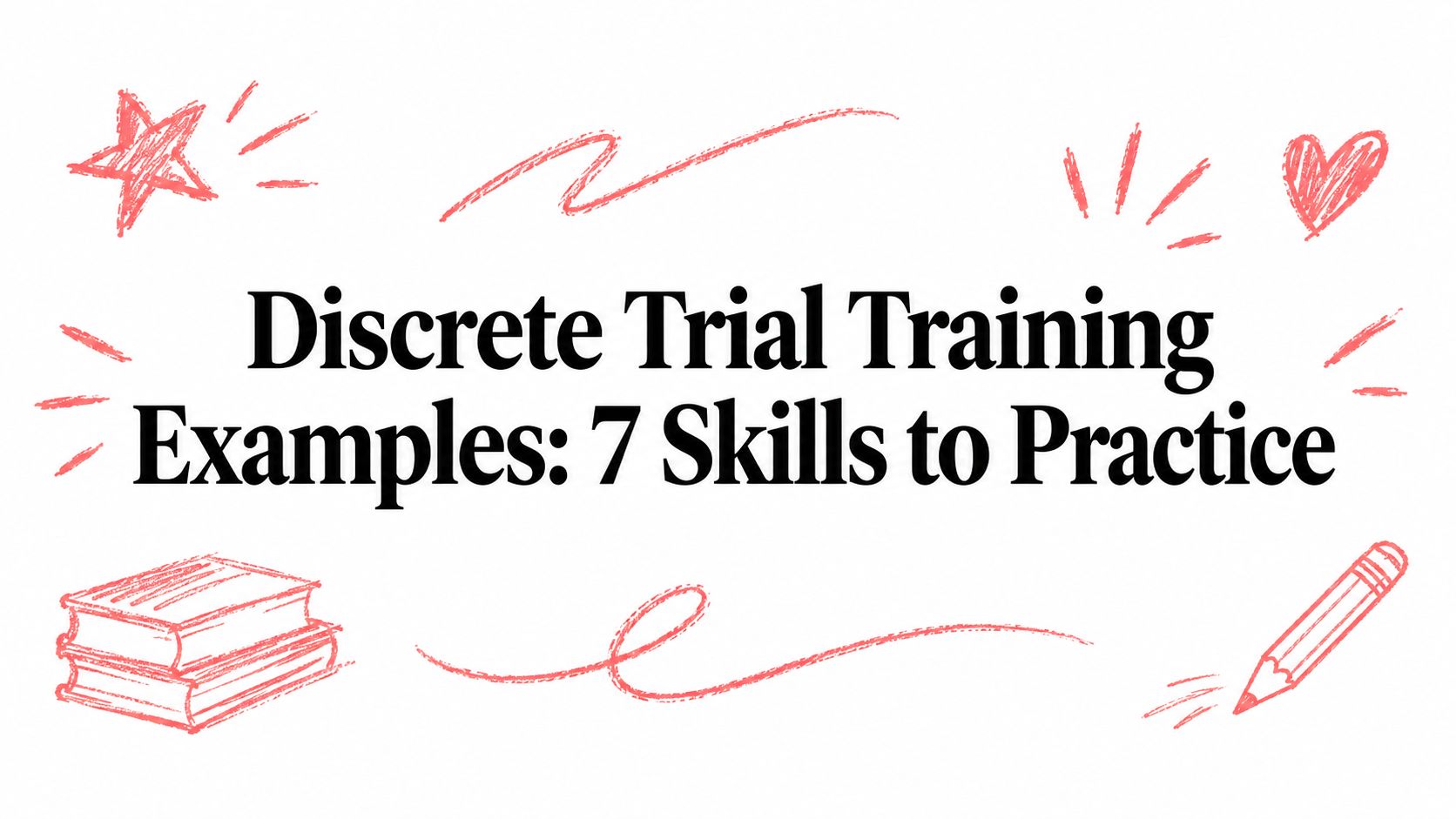
You're sitting at the kitchen table while a therapist holds up two cups and says, “Show me cup.” Your child looks at the cups, glances toward you, and you wonder what exactly is happening. This is a discrete trial, a short teaching opportunity with a clear beginning and end. The therapist gives one instruction, waits for a response, and provides a warm, meaningful consequence, such as praise, access to a favorite toy, or a brief break.
Discrete trial training (DTT) breaks learning into small, observable moments. Each trial usually includes an instruction, the child's response, reinforcement or gentle correction, and a brief pause before the next opportunity. A BCBA, or Board Certified Behavior Analyst, helps select goals, define what counts as success, and train therapists and caregivers to use the approach consistently.
The examples below use ordinary objects and familiar routines. You can practice a small version at home, while remembering that your child's individualized program should guide the exact prompts, goals, and reinforcement. Progress doesn't have to arrive in one big leap. At FriendlyABA, small moments are treated as meaningful steps toward bigger milestones.
Table of Contents
1. Receptive Identification of Objects
Receptive identification means understanding a spoken word and pointing to, touching, or picking up the matching item. Place two familiar objects in front of your child, such as a cup and a spoon. Say, “Show me cup,” then pause so your child has a chance to respond independently.
A correct response might be touching the cup, pointing to it, or handing it to you, depending on the agreed definition of success. Respond right away with specific praise, such as, “You found the cup!” If your child reaches for the spoon or doesn't respond, a therapist may use a gentle prompt, perhaps pointing toward the cup, and then gradually reduce that help.
Practical rule: Use the same short instruction while your child is learning, then vary people, objects, and settings once the response becomes reliable.
Make the trial fit real life
FriendlyABA BCBAs often begin with objects your child already enjoys. A favorite bubble bottle, snack container, or toy can make the activity feel more like play than testing. During breakfast, you might ask, “Show me spoon,” before handing over the spoon. During dressing, you might ask your child to show you a sock.
Try these parent-friendly adjustments:
- Choose motivating objects: Use a preferred snack or toy when appropriate, so your child has a reason to look and respond.
- Keep words consistent: Say “Show me bubbles” rather than changing the instruction every time.
- Celebrate attempts: Reinforce a reasonable approximation while your child is learning.
- Practice briefly: A short practice period, around 5 to 10 minutes, can fit more easily into family life than a long lesson.
A child may identify a dog picture from a set of three cards, select a bubble bottle from two toys, or point to a spoon during breakfast. The important next step is helping the skill travel beyond one table, one therapist, or one set of objects.
2. Expressive Labeling
“What's it?” is a small question with a broad purpose. Expressive labeling means naming or communicating about something your child sees, hears, or touches. A therapist might hold up a ball and say, “What is it?” The response could be the spoken word “ball,” a sign, a picture selection, or another communication form included in the child's plan.
Wait briefly after asking. Your child may need extra processing time, and immediately answering for them can remove the opportunity to respond. If your child says part of the word, signs, or selects the matching picture, respond warmly and reinforce the communication.
Build labels into ordinary routines
You can label a toy car during play, a banana at snack time, or a dog when the family pet enters the room. A child might say “car” when shown a toy truck, tap a banana picture on a communication board, or sign “dog” when the pet walks by. These responses can be meaningful even when spoken language isn't yet consistent.
Offer a clear model without turning every moment into a test. You might say, “Ball,” then give your child a chance to imitate. If your child is ready, present a choice such as, “Ball or block?” Avoid adding choices before your child understands the items or the response format.
- Follow interests: Favorite vehicles, animals, foods, or characters may create stronger motivation.
- Accept the planned response: A word, sign, gesture, or picture can all communicate meaningfully.
- Use natural language: Say “Bath time” during the routine and invite your child to join you.
- Reinforce communication: Give access to the named item or activity when that's the intended purpose.
For more ideas about teaching meaningful requests and responses, explore functional communication training for families. A BCBA can help decide whether the immediate goal should be naming, requesting, choosing, or responding to another person.
A labeling trial should support connection, not just correct answers. When your child learns that communication helps them share interests and access enjoyable experiences, the skill has a clearer place in daily life.
3. Motor Imitation
Motor imitation is copying another person's movement. Start with a simple action your child can see clearly. Face your child, clap your hands, and say, “Do this.” If your child claps, even imperfectly, provide immediate praise or another meaningful reinforcer.
A therapist may define the response in advance. For example, the child might need to move both hands together, or an approximation might count while the skill is emerging. If your child doesn't imitate, the therapist could model the action again, use a gesture, or provide carefully planned physical guidance. As success grows, the prompt should fade so your child performs the action more independently.

Turn imitation into shared play
Clapping, waving, stomping, touching your head, and stacking blocks are useful starting points. A child might wave goodbye at the front door after watching a parent, copy clapping during a warm-up game, or imitate stacking during floor play. Use exaggerated movements and a playful voice, but keep the instruction simple.
Try a mirror game, a short dance, or a familiar “Simon Says” routine. Start with actions your child already sometimes does, then introduce a small variation. Praise the attempt rather than demanding a perfect copy.
“Do what I do” works best when your child wants to stay connected to the game.
Imitation can support play, self-care, and participation in group activities because children often learn by watching other people. It doesn't need to look like a formal lesson. During bath time, you might tap the water and invite your child to copy. While getting dressed, you might raise your arms and make the next step part of a playful routine.
Caregivers often benefit from coaching so they know when to model, when to prompt, and when to pause. FriendlyABA's parent training for autism can help families practice these teaching moments in ways that fit their child's strengths and daily routines.
Here's another example of imitation in action:
4. Matching Identical Objects or Pictures
Matching begins with noticing that two items are the same. Place one toy car on the table, give your child another toy car, and say, “Match.” A correct response means placing the second car beside the sample. Reinforce the response immediately with specific praise, a preferred activity, or another consequence selected for that child.
Start with two items that look very different from each other, such as a spoon and a sock. Once the response is consistent, you can use more similar objects or pictures. The BCBA or therapist may also track whether the child responds independently, needs a prompt, or makes an error.
Use household objects
Matching can happen during activities you already do:
- Laundry: Pair a red sock with its identical partner.
- Play: Match a toy car to the same car in a car-themed activity.
- Home practice: Pair animal picture cards that show the same animal.
- Clean-up: Match container lids to their containers.
If your child reaches for the wrong item, use the least intrusive prompt that helps, such as pointing to the sample or moving the correct item closer. Then try to fade that help. Avoid adding several similar items too quickly, since unnecessary difficulty can make the activity frustrating.
A child who matches identical pictures is practicing visual discrimination, which can support later sorting, classroom work, and early reading-related activities. The skill should still remain functional and enjoyable. Pairing shoes by the door or finding the matching lid for a food container gives the response a purpose beyond a worksheet.
Keep the activity brief, vary the objects over time, and end with an easy success when possible. FriendlyABA's approach keeps the focus on small moments that build useful independence, not on making every practice opportunity look the same.
5. Following One-Step Directions
At clean-up time, hand your child a toy and say, “Put it in the basket.” Pause and watch. Placing the toy inside is the correct response, so you might say, “You put it away!” and give the planned reinforcement. This single exchange is a discrete trial: one clear instruction, one response, and immediate feedback.
Keep the words short and match them to the action you want. Try “Give me the towel,” “Sit here,” or “Shoes by the door.” A long explanation adds extra language for your child to process before the task is clear.
Build practice into ordinary routines
A point or gesture can support understanding. Point toward the basket while saying, “Put it in,” then wait briefly. If your child still does not respond, a therapist may model the action or guide the response, depending on the individualized plan. As your child succeeds, reduce the prompt, first using a smaller gesture and then giving only the spoken direction.
Useful home trials can fit naturally into the day:
- After play: “Blocks in.”
- Before leaving: “Shoes on.”
- During bath time: “Give me towel.”
- At school: “Sit here” when the group begins.
A BCBA, a behavior analyst who helps design and monitor ABA teaching programs, can help select directions that match your child's skills and interests. The team can also check whether attention, communication, sensory needs, or transitions are affecting the response.
Practice should feel respectful. Offer a choice or break after an easy success, such as choosing a book or toy after the cup is put away. These small moments turn one spoken direction into useful independence, following FriendlyABA's “small moments, big milestones” philosophy.
6. Identifying Colors and Shapes
At snack time, place a blue cup and a red cup in front of your child. Say, “Show me blue.” A correct response might be pointing to or touching the blue cup. Give immediate praise or another agreed reward. In the next trial, change the position of the cups, then ask again so your child responds to the color rather than its location.
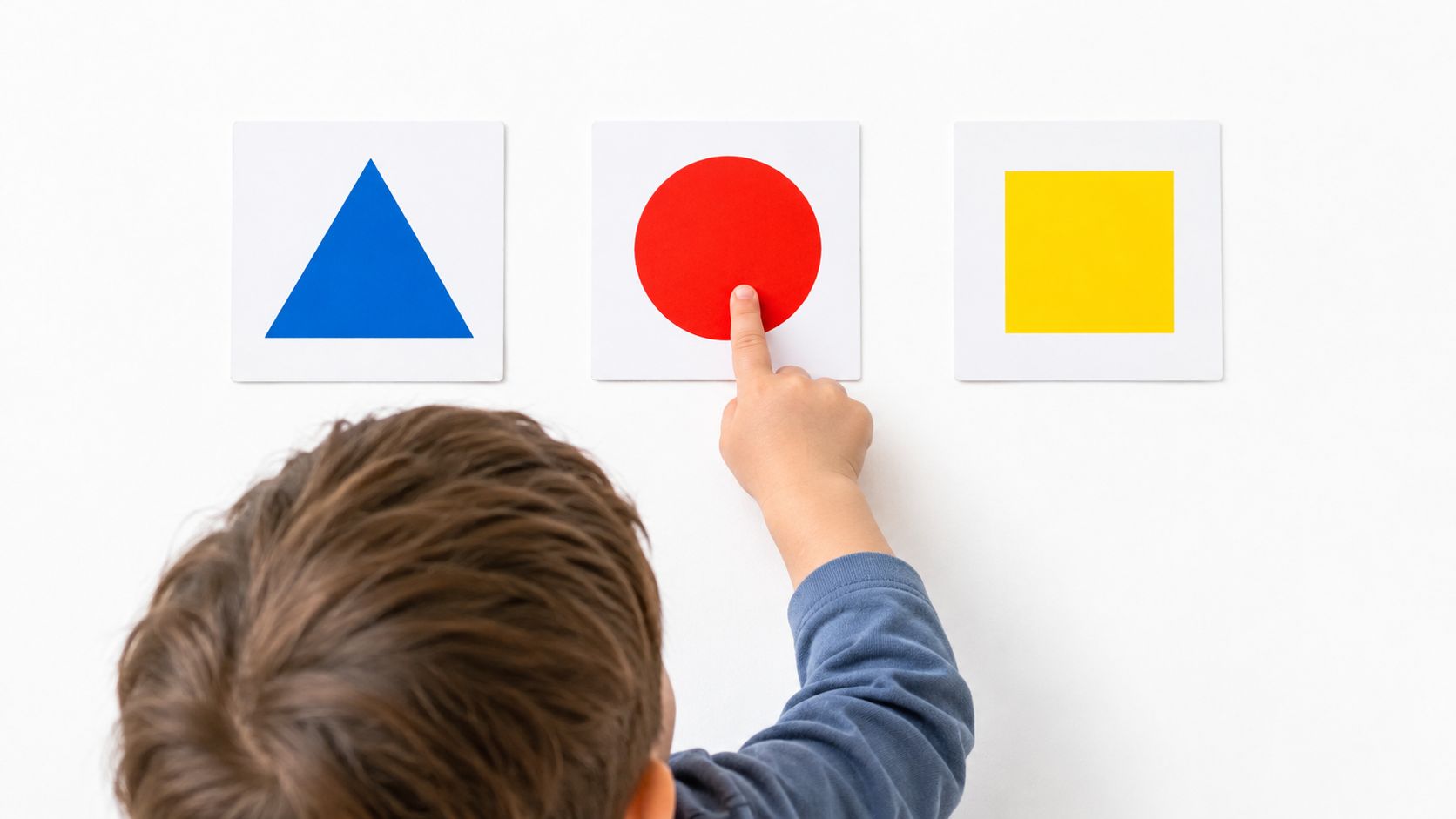
Color and shape identification helps with sorting, classroom directions, early academic tasks, and descriptive language. Understanding and naming are separate skills. A child may point to red before saying “red,” so a program can teach receptive identification first and expressive labeling later.
One trial, step by step
A therapist might present two cards and say, “Find the circle.” The correct response is selecting or touching the circle. If your child needs help, the therapist may point toward the circle, model the response, or guide the hand, according to the individualized plan. After success, the prompt is faded: use a smaller gesture, pause longer, or give only the spoken instruction. Reinforcement can also move from frequent tangible rewards to a natural result, such as continuing a favorite building activity.
Start with clear differences, such as red and blue or a circle and square. Use blocks, crayons, cups, snacks, or favorite characters. Keep the words tied to the action: “Touch blue,” “Find square,” or “Show me red.” Introduce new colors and shapes gradually, and accept pointing, touching, naming, or choosing a picture when that response matches the teaching goal.
At home, place colored blocks into separate bins during clean-up, find a square while building, or ask, “What color is the sky?” during a walk. A BCBA, a behavior analyst who designs and monitors ABA teaching programs, can help select targets and prompts that fit your child.
A skill learned with one red card may not appear with a red cup, shirt, or toy. Generalization in ABA means practicing the same skill with different people, materials, and settings. These small moments help turn recognition into a useful everyday milestone.
7. Sorting Objects by Category
During cleanup, place toy animals and vehicles near two bins. Say, “Put the animals here.” Your child picks up a dog and places it in the animal bin, then sorts a car into the vehicle bin. Praise the correct placement, celebrate together, or let your child continue the activity.
A category groups items by meaning, even when they look different. An elephant, dog, and fish belong with animals. A bus, car, and train belong with vehicles. This differs from matching, where the items usually share the same appearance.
Build the skill through small moments
Begin with two categories your child can tell apart. While unpacking groceries, sort fruit and vegetables. During play, place toy animals in one bin and toy cars in another. Laundry can become practice for separating clean and dirty clothing when that distinction makes sense for your child.
Use one clear instruction for each trial:
- Animals: “Put the dog with animals.”
- Vehicles: “Put the car with vehicles.”
- Food: “Apple goes with food.”
- Clothing: “Put the socks with clothes.”
A correct response means placing the item in the requested group. If your child hesitates, point to the matching bin, model one placement, or gently guide the response according to the teaching plan. After success, fade the prompt by using a smaller gesture, waiting longer, or giving only the spoken instruction.
Present an easy item next, then gradually add variety. A BCBA, a behavior analyst who designs and monitors ABA programs, can help choose categories, prompts, and reinforcement. Take turns too. You place one item, and your child places the next. This keeps practice social while strengthening language, problem solving, and participation in everyday routines. Small moments can support big milestones.
7-Item Discrete Trial Training Comparison
| Skill | Implementation Complexity 🔄 | Resource Requirements ⚡ | Expected Outcomes ⭐📊 | Ideal Use Cases 💡 | Key Advantages ⭐ |
|---|---|---|---|---|---|
| Receptive Identification ("Show Me the Cup") | Low, simple discrete trials, consistent prompts | Minimal, 2–3 familiar objects, short sessions | Improved receptive vocabulary; clear, trackable gains (⭐⭐⭐) | Early language building, home routines, preverbal children | Establishes word–object mapping; easy home practice |
| Expressive Labeling ("What Is It?") | Medium, prompts/models and fading required | Minimal, objects or AAC supports as needed | Increased expressive vocabulary and naming (⭐⭐⭐) | Vocabulary expansion, AAC integration, shared attention | Encourages verbal/sign output; supports social communication |
| Motor Imitation ("Do This With Me") | Low–Medium, model, prompt, fade; attention needed | Low, clinician/parent modeling, playful setup | Better social learning, play and self‑care foundation (⭐⭐) | Early social skill development, group/play routines | Engaging; transfers to play and daily sequences |
| Matching Identical Objects or Pictures | Low, clear visual discrimination trials | Minimal, pairs of identical items or cards | Improved visual discrimination and sorting skills (⭐⭐) | Pre‑academic readiness, matching tasks, household routines | Clear measurable progress; motivating puzzle‑like activity |
| Following One‑Step Directions ("Put It in the Basket") | Medium, consistent cues, wait time, prompt fading | Low, everyday objects, coordination with caregivers/teachers | Greater independence, classroom and safety skills (⭐⭐⭐) | Classroom routines, safety commands, daily chores | Directly improves independence and routine compliance |
| Identifying Colors and Shapes | Low, receptive & expressive variants, contrast sets | Minimal, colored items, shape cards | Builds academic vocabulary and sorting ability (⭐⭐) | School readiness, art/play, descriptive language activities | Easily integrated into play; supports later academics |
| Sorting Objects by Category ("Animals or Vehicles?") | Medium, requires conceptual grouping and labeling | Low–Moderate, mixed items, bins or cards | Enhanced classification, vocabulary, problem solving (⭐⭐) | When matching/labeling mastered; classroom prep, reasoning tasks | Develops higher‑order categorization and language skills |
Small Moments, Big Milestones: Where to Start at Home
You don't need to recreate a therapy table to begin. Choose one example from this list and connect it to a routine you already share, such as snack time, getting dressed, putting toys away, or preparing to leave the house. Use the same short words each time, give your child a chance to respond, and celebrate every meaningful attempt.
A discrete trial is most useful when the teaching moment is clear and the response is defined in advance. That doesn't mean home life needs to become rigid. A therapist may record whether a response was correct, incorrect, absent, or prompted, while a parent may notice that a child pointed to the right cup more independently today. Both observations can help the care team understand what to practice next.
Look beyond one successful response
A child may identify a picture at the table but not recognize the same item during breakfast. They may follow “put it in” with a therapist but need support when the instruction comes from a teacher or caregiver. Strong programs plan for maintenance and generalization, meaning the skill continues over time and appears with different people, materials, and settings.
DTT is a precise acquisition tool, but it doesn't have to stand alone. Some goals may fit structured trials, while requesting, conversation, peer play, and spontaneous communication may be better supported through motivation-based practice in ordinary routines. A BCBA can help decide whether to use table-based trials, embedded teaching during play, natural-environment teaching, or a combination.
Keep practice encouraging
Prompting is help, not failure. The point is to provide enough support for learning and then fade that support carefully. Reinforcement should matter to your child, whether it's praise, a preferred toy, a break, or access to a naturally rewarding activity.
Data can guide decisions, but your child's comfort, preferences, communication, and dignity matter too. If an activity causes repeated distress, pause and discuss it with the BCBA rather than increasing demands. Your observations at home can help the team adjust goals, materials, prompts, and routines.
Progress looks different for every child. One child may begin by touching a picture, another may use a sign, and another may respond with a spoken word. FriendlyABA's BCBAs can help tailor these skills to your child's goals, strengths, interests, and daily life, while coaching caregivers to support practice across home, school, and community settings.
You're welcome to book a consultation with FriendlyABA's BCBAs and talk through your questions at your own pace. The next milestone may begin with something as small as “Show me cup,” a shared clap, or one toy placed in the right basket.
FriendlyABA provides individualized ABA therapy, parent coaching, and support across home, school, and community settings, with BCBAs and trained therapists focused on practical skills such as communication, independence, play, and daily routines. To discuss discrete trial training examples that fit your child's needs, visit FriendlyABA and request a consultation.
Our Latest Insights







You don't have to figure it out alone
Whether you're exploring ABA therapy for the first time or searching for a provider who truly feels like the right fit, we're here to help.