


8 Daily Living Skills IEP Goals: Measurable Examples
Explore 8 daily living skills iep goals for dressing, hygiene, meals, routines, safety, and communication, with measurable criteria and progress ideas.

A morning routine can turn into a long chain of reminders: get dressed, use the bathroom, wash your hands, pack your bag, and get to the car. Your child may know parts of the routine but still need extensive prompting, become distressed when the order changes, or avoid the task altogether. By the time everyone leaves home, a skill that looked simple has created stress for the whole family.
Strong daily living skills IEP goals describe what your child will do, under what conditions, and how the team will observe progress. They don't just say “be more independent.” An IEP, or Individualized Education Program, is a school plan that documents specialized instruction, supports, and measurable annual goals. The examples below are starting points to personalize with your child's teachers, related-service providers, and caregivers.
A practical approach is to break each routine into steps, choose how prompts will gradually fade, record meaningful indicators, and practice in natural settings. FriendlyABA's BCBAs, or Board Certified Behavior Analysts, and trained therapists use individualized assessment, caregiver collaboration, and data-based adjustments across home, school, and community routines. The philosophy is simple: small moments can become big milestones, without assuming that every child will progress in the same way or on the same schedule.
Table of Contents
1. Independent Toileting Skills With Minimal Prompting
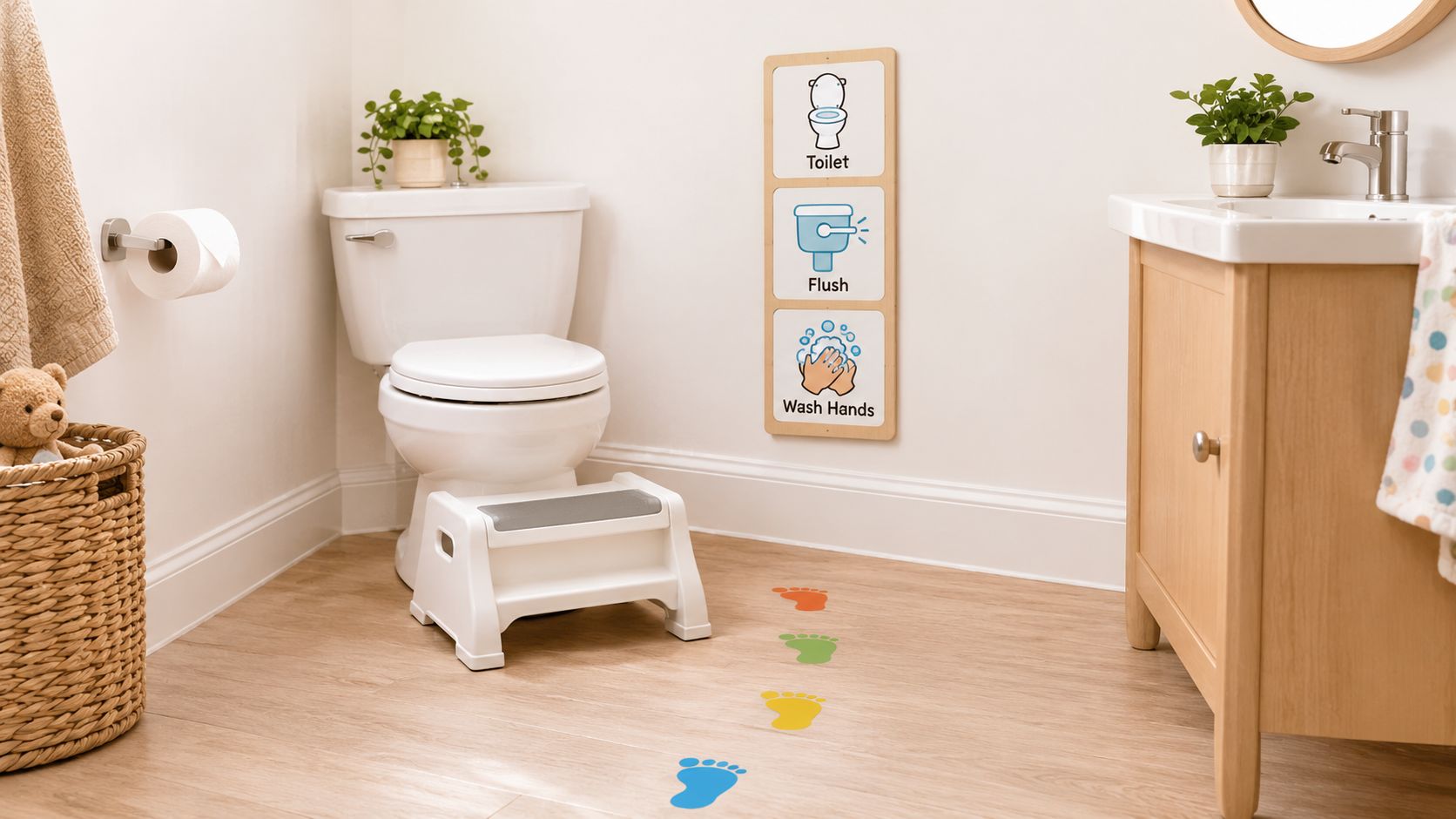
Toileting becomes easier to discuss when “use the bathroom independently” is separated into observable actions. Your child may need to notice the need to go, walk to the bathroom, manage clothing, sit safely, use toilet paper, flush, and wash their hands. A useful IEP goal identifies which steps are already present and which still require help.
For example, a team might describe a child using a visual bathroom schedule, completing the routine in the school restroom, and needing no more than a brief gesture for the next step. The wording should also identify whether the skill is measured at home, at school, or in both settings. A child who completes the routine only with a familiar adult may need a separate generalization target.
Practical rule: Measure the prompt, not just the finished routine. Moving from physical guidance to a gesture, from a gesture to a visual cue, and from a visual cue to independent initiation are meaningful changes.
A routine that can be taught in small steps
A task analysis breaks a large routine into teachable actions. The team can record whether each step is completed independently, with a visual prompt, with a verbal prompt, or with physical assistance. A mastery criterion might specify independent completion in 4 of 5 trials, a common practice example described in guidance on independent-functioning IEP goals.
A practical goal might read: “Given access to a visual bathroom schedule in the school restroom, the student will complete the identified toileting steps, including clothing management, wiping, flushing, and handwashing, with no more than a visual prompt in 4 of 5 opportunities, and will use the routine at home and school.”
Begin by observing natural bathroom patterns and teaching in the actual bathroom. Celebrate partial progress, such as sitting, flushing, or washing hands. Coordinate the visual schedule and language with school staff so your child doesn't encounter a completely different routine in each setting. A FriendlyABA BCBA can help determine the least intrusive support that still allows your child to succeed.
2. Eating and Mealtimes With Expanded Food Acceptance
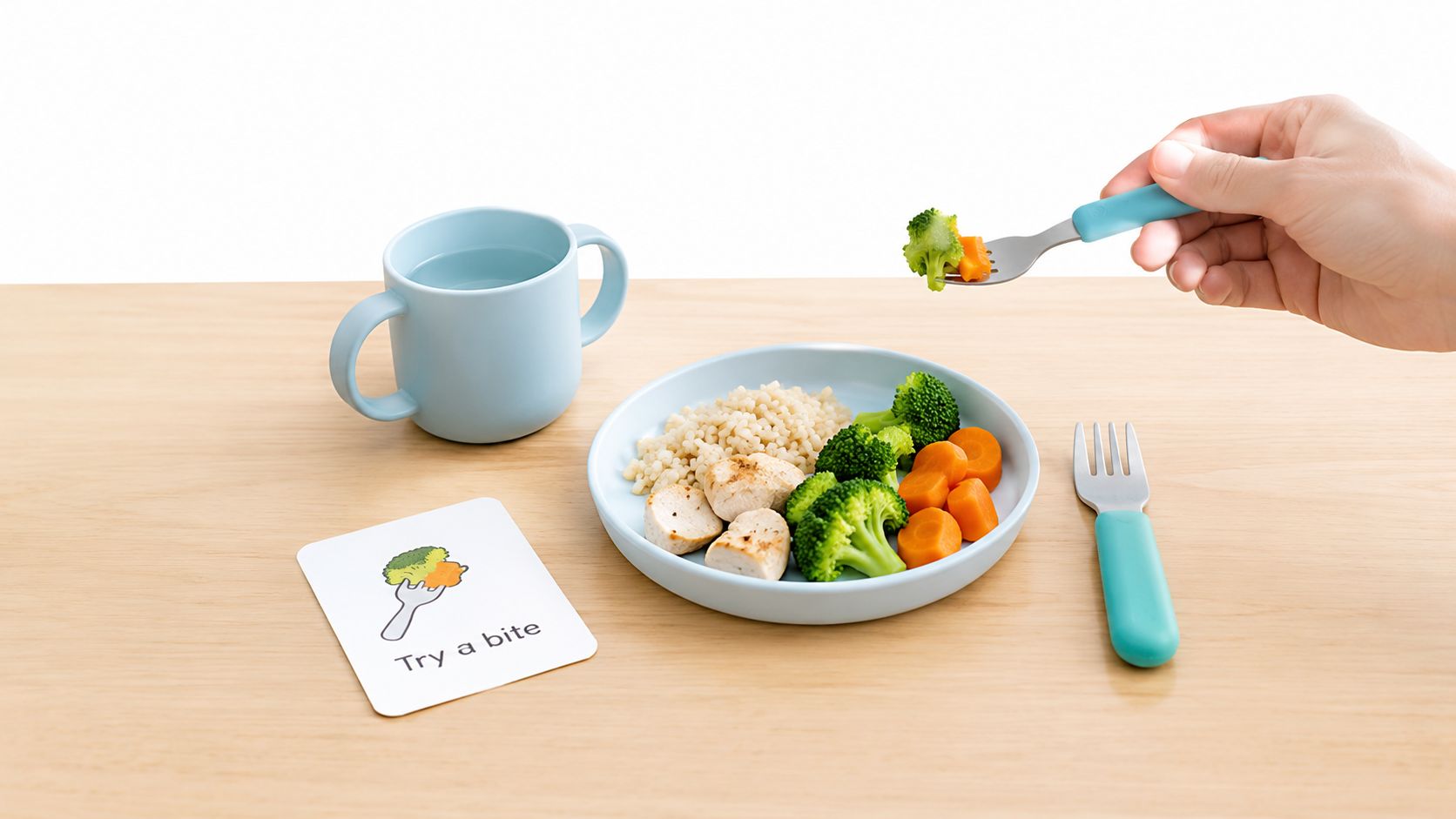
A mealtime goal shouldn't demand that a child abandon every preferred food. It should describe a meaningful, safe step, such as sitting at the table, tolerating a new food nearby, using a fork, opening a container, taking a small taste, or communicating “all done.” Food preferences and sensory responses can be genuine sources of discomfort, so the team should avoid treating distress as simple refusal.
An observable example might state: “During a family meal, when a preferred food and a small portion of a less familiar food are available, the student will remain seated, use an appropriate utensil, and communicate a break or all-done request with no more than one verbal prompt.” The criterion should reflect the child's baseline rather than an arbitrary expectation.
Build flexibility without pressure
Start with foods your child already accepts. Pairing a familiar item with a new one can make the setting more predictable, while praise can recognize looking, touching, smelling, tasting, or remaining calm near the food. The target isn't forced compliance. It's increased participation and communication around eating.
Helpful teaching choices include:
- Use safe anchors: Keep familiar foods available while introducing a small amount of another food.
- Reinforce effort: Praise brave exploration, utensil use, and appropriate requests, not only swallowing.
- Offer manageable choices: Let your child choose between two options rather than presenting an entire meal without support.
- Include preparation: Washing vegetables, stirring, or setting the table can create low-pressure contact with food.
- Coordinate care: Discuss pain, swallowing, allergies, gastrointestinal concerns, or significant sensory responses with the medical team and BCBA.
An assessment helps the team understand what happens before, during, and after mealtime behavior. FriendlyABA explains this process in its guide to Applied Behavior Analysis assessment. Caregivers can then share observations from home, while school staff can practice related skills during snack or lunch.
Progress may look like fewer escape behaviors, more functional communication, longer participation, or accepting a new texture in one setting. Those changes can be documented without promising that preferences will disappear.
3. Getting Dressed and Personal Grooming Independence
Getting dressed combines sequencing, motor planning, clothing tolerance, decision-making, and personal care. “Dress independently” may conceal several different needs. Your child might select appropriate clothing but struggle with fasteners, put on a shirt backward, tolerate socks only briefly, or complete dressing only when an adult gives continuous verbal directions.
A more useful goal names the routine and the support level. For example: “Given a two-choice clothing selection and a visual sequence, the student will select weather-appropriate clothing and complete the dressing steps, including pants, shirt, socks, and shoes, with no more than one gesture prompt in 4 of 5 school mornings.” The team can add a separate target for buttons or zippers if those skills require different teaching.
Make the sequence visible
Photos or simple drawings can show the order of the morning routine. Consistent phrases such as “socks, then shoes” reduce the amount of language your child must process. Limited choices, such as a red shirt or blue shirt, provide control without turning the entire closet into a decision-making task.
Grooming goals can be written in the same format. A tooth-brushing goal might specify the brush, toothpaste, timer, sequence, prompting level, and setting. It could also allow music, a preferred toothpaste, or a sensory accommodation. The purpose is functional participation, not forcing a particular style of behavior.
Practice when the family isn't rushing out the door. A caregiver can teach one part of the routine during a calm time, then gradually connect it to the full morning sequence. The team should record whether prompts are becoming less intrusive and whether the child can complete the routine in a different bathroom or with another caregiver.

4. Requesting Help and Communicating Needs Functionally
A container will not open, the worksheet feels difficult, or the bathroom is unfamiliar. In that moment, a child may leave, push materials away, or rely on an adult to guess what is wrong. A daily living goal can teach a clearer response, such as saying “help,” using a sign, selecting a picture, or activating an AAC device. AAC means augmentative and alternative communication, and it may be the child's most reliable communication system.
Start with the need, not the device. If a child requests help opening a snack container, the team can teach that request during snack, pause briefly, model the response, and provide useful assistance. Responding to an approximation gives the child a reason to communicate while the skill is developing.
A measurable IEP goal might read: “Given a closed container during snack at school, the student will use speech, a sign, or AAC to request help with no more than a verbal model in 4 of 5 opportunities across two consecutive weeks.” This goal identifies the observable behavior, prompting level, setting, and mastery criterion. The team can then add generalization, such as requesting help with clothing, classroom materials, or a different caregiver at home.
This structure works like a map. “Communicate needs” names the destination, while the behavior, prompt, setting, and criterion show the route adults can teach and measure.
Choose early targets linked to hunger, pain, toileting, safety, difficult tasks, or the need for a break. Keep the communication system available across home, school, and community settings. Teachers and caregivers should use the same symbols or device access, wait for an initiation, and honor appropriate requests such as “all done” or “break.”
Track how the child communicates: independently, after a gesture, or after a verbal model. A caregiver and the IEP team can review whether prompts are fading, requests are becoming more specific, and the skill appears with different people and materials. FriendlyABA's explanation of functional communication training describes how a BCBA may connect behavior with a more effective communication response. Small moments, such as fewer guesses or safer requests for assistance, can mark meaningful progress without requiring speech.
5. Washing Hands and Personal Hygiene Routines
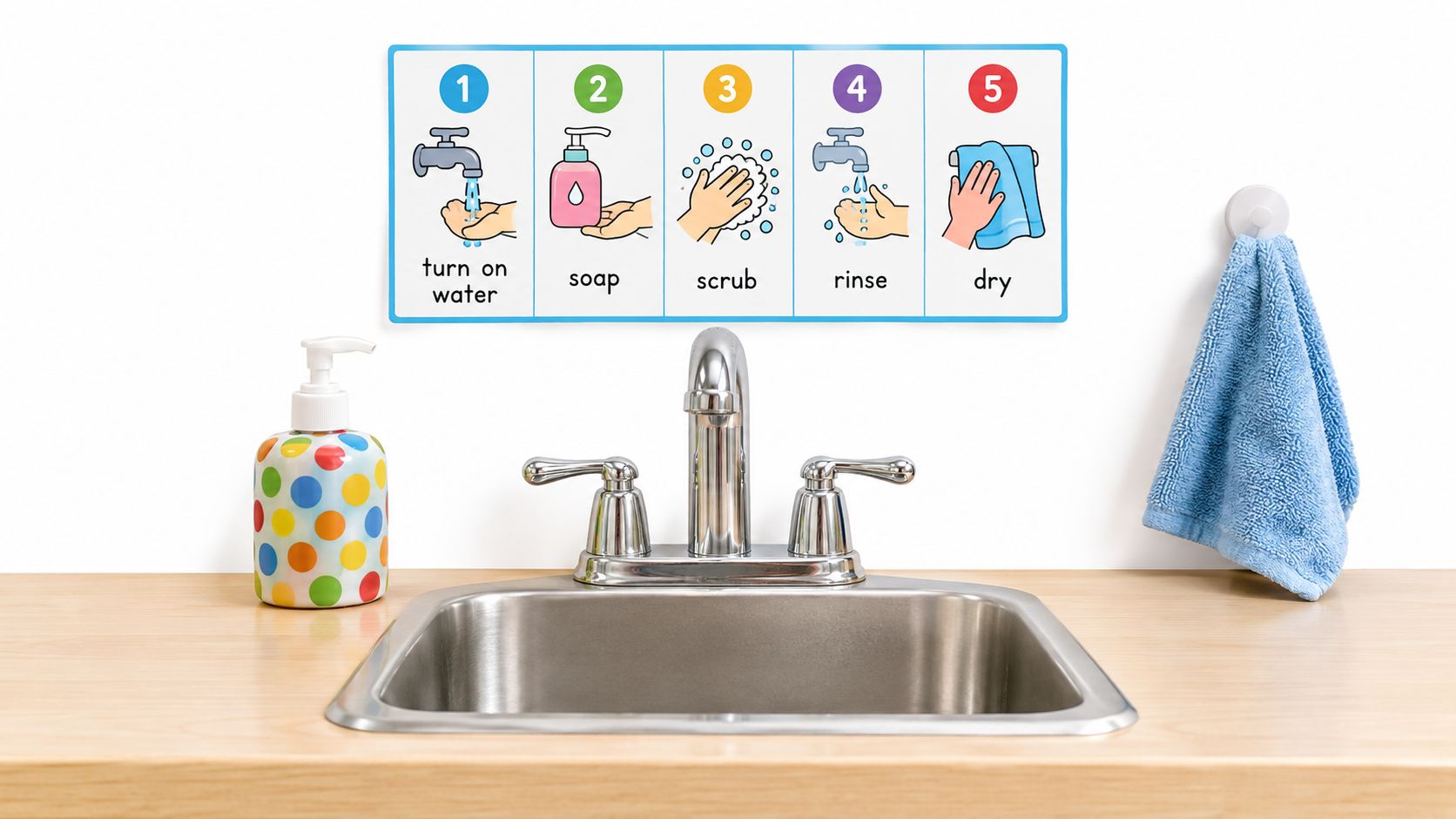
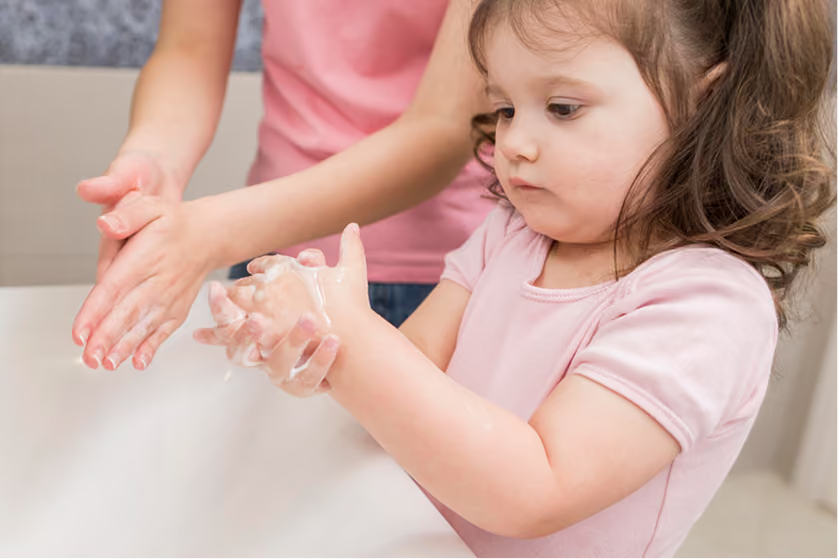
Handwashing is a short routine, but it includes several actions that may be difficult to sequence or tolerate. Your child may need to turn on the water, adjust the temperature, use soap, rub both hands, rinse, turn off the faucet, and dry. A hygiene goal can also include wiping the nose, washing the face, applying sanitizer when appropriate, or keeping hands away from dirty surfaces afterward.
A task analysis makes the routine visible to both the child and the adults teaching it. The IEP might state: “Given a visual handwashing sequence at the sink, the student will complete each identified step with no more than a gestural prompt before eating and after toileting.” The team should define how completion is counted and whether the child can demonstrate the skill in another restroom.
Respect sensory needs while teaching the routine
Water temperature, soap fragrance, faucet noise, and towel texture can affect participation. Start with the least aversive safe option, then build tolerance gradually. A visual chart, a short song, or a check-off system can make the sequence predictable without requiring repeated verbal instructions.
“Independent” should mean the child can use the skill with the supports named in the goal, not that adults remove every helpful accommodation.
Caregivers can practice during calm periods rather than waiting until everyone is hungry or late. School staff can use the same sequence at the classroom sink or cafeteria. If the child touches a contaminated surface immediately afterward, the team can teach a simple “hands down” or “move away” response as a related safety step.
Data can distinguish between completion and prompt level. A child who completes all steps after a visual cue is demonstrating a different level of independence from a child who needs hand-over-hand assistance. Both observations help the team choose the next teaching step.
6. Following Multi-Step Routines and Household Transitions
A child may know how to put on shoes, pack a bag, and walk to the car, yet still become stuck when those actions must happen in order. Morning arrival, bedtime, cleanup, and leaving for school combine task completion with a change in activity. An IEP goal can separate those demands so the team can teach and measure each one.
Use a real routine as the starting point. For example, a morning goal might ask the child to check a photo schedule, complete each pictured step, move to the next location after a timer, and request help when needed. The goal should describe observable behavior, such as starting the next step or using a break request, rather than “staying calm” or “being compliant.”
A useful goal discussion covers five parts:
- Prompting level: Does the child need a verbal cue, a visual reminder, a gesture, or physical assistance? The team can record the highest level used and plan how to fade it.
- Setting: Is the routine practiced in the bedroom, backpack area, bathroom, and car, or only in a therapy room?
- Mastery criterion: How will the team count completion, and how much support is allowed when deciding that the skill is learned?
- Generalization: Can the child follow the same sequence with a caregiver, teacher, or therapist, and handle a small change?
- Transition response: Does the child move to the next activity, finish the task, or communicate that help is needed?
Keep the order predictable with photos from the child's own home when possible. Name the next action using brief language such as “shoes, then car.” Prepare for changes with a change card or short warning. Reinforce independence by noticing schedule checks, unprompted starts, and recovery after a routine changes. Practice across adults so caregivers, teachers, and therapists use compatible cues.
A short routine log can show where the child gets stuck and which prompt helped. Parent training for autism can support consistent practice between sessions. FriendlyABA's small moments, big milestones philosophy fits this process: careful attention to one routine step can guide the next IEP conversation without promising a particular outcome.
7. Safety Awareness and Following Safety Rules
A child may run toward a street, touch a hot surface, leave a safe area, or enter water without permission before recognizing the danger. Safety instruction should begin with the risks that occur in the child's daily life and describe the response adults need to see.
A broad goal such as “improve safety awareness” gives the team little to measure. A clearer example is: “When approaching a designated curb with an adult, the student will stop, remain beside the adult, and wait for the crossing signal or adult direction before moving.” The team can then define the goal's parts:
- Observable behavior: stopping, staying beside the adult, and waiting.
- Prompting level: whether the student responds independently or needs a verbal cue, gesture, visual reminder, or physical guidance.
- Setting: a supervised curb, community walkway, school area, or another agreed practice location.
- Mastery criterion: how often the complete response must occur and what level of help is allowed.
- Generalization: whether the student uses the same response with different adults, in different places, and after a small change.
Practice should happen before danger appears. Street safety can be rehearsed at a safe curb with close supervision. A hot-surface rule can use demonstrations and a safe distance, never exposure to injury. Short language such as “stop,” “wait,” or “hot, don't touch” helps adults give the same message.
Start with the risks most relevant to the child. Practice when the child is calm, guide safely, and document any physical assistance so the team can plan to fade it. Continued adult supervision remains necessary while the skill develops.
A goal might measure stopping, waiting, staying within a defined distance, responding to a name, or requesting an adult. A FriendlyABA BCBA can help examine whether impulsivity, sensory seeking, escape, or communication difficulty affects the response. A brief log of prompts and settings can support the next IEP conversation. FriendlyABA's small moments, big milestones philosophy keeps attention on observable progress without promising a particular outcome.
8. Sleep Routines and Nighttime Independence
Nighttime independence affects the child's routine and the family's ability to rest. A sleep-related goal might address following a bedtime sequence, remaining in bed, requesting reassurance appropriately, returning to bed after waking, or fading adult presence. It should be written with care because sleep is connected to health, sensory needs, anxiety, and family circumstances.
A measurable example might state: “Given a visual bedtime schedule and the agreed bedroom supports, the student will complete the bedtime steps and remain in bed until the scheduled morning routine, using an available help or break signal when needed.” The team should clarify what counts as completion, what adult response is planned, and how the strategy will be coordinated with the child's pediatrician.
Use gradual changes and individualized supports
Start with the environment. Consider lighting, sound, temperature, bedding, clothing, and preferred calming activities. A visual sequence such as bath, pajamas, teeth, story, and bed can reduce uncertainty. If an adult currently stays beside the child, a BCBA may help the family design a gradual fading plan rather than making an abrupt change that increases distress.
The goal shouldn't punish a child for being awake or anxious. It should teach a predictable routine and a functional way to seek support. A caregiver can record when the routine begins, which steps require prompts, how the child communicates during the night, and what environmental factors appear relevant.
Work with the pediatrician when there may be medical, breathing, medication, or physiological concerns. A BCBA can address routines and learned patterns, but sleep support should fit the child's broader health needs. Progress may include starting bedtime with fewer reminders, staying in the bedroom longer, requesting help instead of escalating, or tolerating a new sleep setting. It may not look identical every night.
8-Point Comparison: Daily Living Skills IEP Goals
| Goal | Complexity 🔄 | Resources ⚡ | Expected outcomes 📊 | Ideal use cases 💡 | Key advantages ⭐ |
|---|---|---|---|---|---|
| Independent Toileting Skills with Minimal Prompting | High, multi-step sequencing & generalization 🔄🔄🔄 | Moderate–High: BCBA oversight, caregiver coaching, visual supports | Increased independence, fewer accidents, lower caregiver burden | Children ready to replace diapers/pull-ups; priority for family quality of life | High daily-life impact; visibly motivating progress, ⭐⭐⭐⭐⭐ |
| Eating and Mealtimes with Expanded Food Acceptance | Moderate, gradual food chaining, sensory work 🔄🔄 | Moderate: ABA therapist, possible OT, family practice time, reinforcement systems ⚡ | Improved nutrition, reduced mealtime conflict, greater variety | Children with limited repertoire or mealtime behaviors; nutrition concerns | Improves health and family meals; generalizes across settings, ⭐⭐⭐⭐ |
| Getting Dressed and Personal Grooming Independence | Moderate, sequencing plus fine-motor skills 🔄🔄 | Low–Moderate: visual schedules, practice, occasional OT for textures | Smoother mornings, increased autonomy, better peer acceptance | Children struggling with morning routines or fasteners | Daily visible independence gains; builds planning skills, ⭐⭐⭐⭐ |
| Requesting Help and Communicating Needs Functionally | High, requires consistency and generalization 🔄🔄🔄 | Moderate: AAC/sign training, team consistency, in‑context teaching ⚡ | Reduced frustration-related behaviors, improved safety, better relationships | Priority when communication limits safety or triggers behavior | Foundational skill that accelerates other goals, ⭐⭐⭐⭐⭐ |
| Washing Hands and Personal Hygiene Routines | Low–Moderate, step-wise task analysis 🔄🔄 | Low: visual step charts, in-situ repetition, minor sensory accommodations | Better health, routine independence, reduced illness spread | Children who avoid sinks or need hygiene prompting | Low-cost, high-value health benefit; pairs with toileting, ⭐⭐⭐⭐ |
| Following Multi-Step Routines and Household Transitions | Moderate, sequencing + flexibility training 🔄🔄 | Moderate: visual schedules, timers, caregiver consistency ⚡ | Fewer transition meltdowns, more predictable days, school readiness | Children with transition resistance or chaotic routines | Reduces daily stress; routines become automatic over time, ⭐⭐⭐⭐ |
| Safety Awareness and Following Safety Rules | High, real-world practice and repeated coaching 🔄🔄🔄 | High: supervised practice in natural settings, role-play, frequent reinforcement | Reduced injury risk, greater community independence, caregiver confidence | Essential when child lacks danger recognition or impulse control | Critical for safety and community inclusion, ⭐⭐⭐⭐⭐ |
| Sleep Routines and Nighttime Independence | High, environmental + behavioral changes, slow progress 🔄🔄🔄 | Moderate–High: consistent routines, environmental tools, cross‑team planning ⚡ | Improved sleep quality, better daytime behavior, reduced caregiver exhaustion | Families with chronic night wakings or co-sleeping dependence | Large downstream effects on daytime functioning; durable benefits, ⭐⭐⭐⭐ |
Turn Small Steps Into Clear IEP Progress
A strong daily living skills IEP goal gives adults a shared description of what to teach and what to observe. It also gives your child a fairer target than a broad demand for independence. Before an IEP meeting, read each proposed goal through five practical questions.
Is the behavior observable? “Improve self-care” is difficult to measure. “Complete the handwashing sequence” is clearer because the team can identify the steps and record what happened. Observable language also helps caregivers and teachers discuss the same behavior without relying on impressions such as “had a good day.”
Is the support level defined? A child may complete a task with physical assistance, a verbal direction, a gesture, a visual schedule, or no prompt. Those are different levels of performance. Ask whether the goal says what support is allowed and whether it includes a plan to fade prompts carefully.
Is the criterion measurable? A goal can use opportunities, accuracy, duration, frequency, or consecutive observations, depending on the skill. Practice examples for adaptive goals often use performance such as 80% to 90% accuracy across 4 of 5 opportunities, with a baseline that makes the change meaningful, as described in guidance on SMART-style adaptive goals. The right criterion should come from your child's current performance, not from a number selected without context.
Does the goal include generalization or maintenance? A child may wash hands in a therapy bathroom but not in the school cafeteria. The goal can name more than one setting, caregiver, material, or routine. Maintenance means checking whether the skill continues after teaching becomes less intensive.
Is the skill meaningful to the child and family? Daily living goals should support participation, communication, safety, comfort, and self-direction. They shouldn't exist only because a skill is easy for adults to count. Your family's priorities belong in the conversation.
Research also shows why these conversations matter. In a large analysis of 448,533 IEP goals, communication was the most prevalent subject, with 95,980 goals, or 21.4% of all goals, while behavior goals were more common for students with developmental delay and other health impairments. The same dataset found that behavior goals peaked in likelihood in 8th grade, at about 3 percentage points above the baseline pattern, which helps explain why independent functioning may be written alongside communication and behavior targets when students need to generalize routines across settings. These findings are reported in the analysis of instructional content and self-determination in IEP annual goals.
Independent living can also be overlooked during transition planning. A study of 44 autistic high school students aged 14 to 18 found that fewer than half had independent-living goals, with 10 students, or 23%, having those goals in their IEPs. The sample included study strategy goals for 21 students, or 48%, technology-use goals for 10 students, or 23%, employment goals for 19 students, or 43%, and postsecondary education preparation goals for 19 students, or 41%. The results appear in this occupational therapy study of special education services in high school.
Transition planning doesn't have to wait until the final school years. Federal guidance says planning must begin no later than the first IEP in effect when a student turns 16, although a team can begin earlier when appropriate, and it identifies daily living areas such as housekeeping, medication, self-management, transportation and mobility, self-advocacy, and self-awareness. You can review public transition-planning guidance when asking how current routines connect to adult independence. Another public school guide says transition goals formally become part of the IEP Transition Plan in Grade 8 or age 14, whichever comes first, and a related checklist is intended for transition-age students ages 14 to 22, as described by Fairfax County Public Schools transition resources.
Bring one priority routine, your current baseline observations, and your child's preferred communication supports to the IEP team. A short record of what happens before the task, the steps your child completes, the prompts adults use, and what changes across settings can make the meeting more practical. You can also invite your FriendlyABA BCBA to discuss assessment findings, caregiver coaching, and ways to align home, school, and community practice.
Progress doesn't have to mean perfect independence. It may mean fewer prompts, more self-initiation, safer participation, a clearer request for help, a completed step in a new setting, or successful use of a visual support. FriendlyABA's individualized programs use ongoing observation, caregiver input, and data-based adjustments to keep goals connected to your child's strengths, preferences, and daily life.
FriendlyABA offers individualized ABA support in home, school, and community routines, along with BCBA-led assessment, caregiver coaching, and progress monitoring for daily living skills. Visit FriendlyABA to book a consultation and discuss practical goals for communication, self-care, transitions, safety, and independence.
Our Latest Insights


You don't have to figure it out alone
Whether you're exploring ABA therapy for the first time or searching for a provider who truly feels like the right fit, we're here to help.