


What Is Aba Therapist
What is aba therapist. Discover what an ABA therapist does, their qualifications, and how they support children with autism. A parent-friendly guide


An ABA therapist is a credentialed professional who uses evidence-based behavior science to help children with autism build communication, social, and daily living skills through positive, data-driven teaching. In many programs, that support comes through a team structure where a supervising clinician oversees care and a trained therapist provides direct sessions, which is why ABA can feel more complex than a simple weekly therapy appointment.
If you've just heard the words “your child may benefit from ABA,” you might be feeling a mix of relief, worry, and confusion all at once. That's very normal. Most parents aren't trying to become experts in behavior science overnight. You just want to understand who this person is, what they'll do with your child, and whether it will feel supportive and respectful.
The short answer is that an ABA therapist helps teach useful, everyday skills in a structured but child-centered way. That can mean helping a child ask for help instead of melting down, join a game with a sibling, follow a bedtime routine, or tolerate a transition without feeling overwhelmed. At FriendlyABA, we often describe this as small moments, big milestones because progress usually grows from many tiny, meaningful steps.
Table of Contents
- Questions worth asking in a first consultation
- What to expect in the first few weeks
- Green flags and gentle red flags
Understanding What an ABA Therapist Does
A lot of parents first hear “ABA” in a pediatrician's office or after an autism evaluation. The letters can sound technical, but the day-to-day work is easier to picture when you bring it back to real life.
The Behavior Analyst Certification Board describes Applied Behavior Analysis as a behavior-science approach that teaches individuals more effective ways of behaving through positive reinforcement and changes in the social consequences around behavior. It also notes that the BACB was created in 1998 to identify qualified practitioners and expand the quality and availability of services through a recognized credentialing system (BACB overview of behavior analysis).

What that looks like in real life
Say your child cries every time you turn off the tablet for dinner. An ABA therapist doesn't just tell your child to stop. They look at what's happening before, during, and after that moment. Then they teach a replacement skill, such as asking for “two more minutes,” using a visual countdown, or moving to the table with a favorite job like carrying napkins.
That's one reason ABA is different from general parenting advice or tutoring. It's individualized, observed, and adjusted based on how your child responds.
ABA should feel like teaching, not controlling. The purpose is to build skills that make daily life easier for your child and family.
A good ABA therapist is usually working on functional goals like:
- Communication: asking for help, requesting items, answering simple questions
- Social connection: taking turns, noticing peers, joining play
- Daily living: dressing, handwashing, mealtime routines, toileting steps
- Flexibility: handling transitions, waiting briefly, trying a new routine
Why so many families hear about ABA after an autism referral
ABA is closely tied to autism services. A 2024 NIH/PMC review reported that within BACB-reported data, autism was the primary area of professional emphasis for 71% of BCBAs, and 72% of respondents in related self-reporting identified autism spectrum disorders as their primary emphasis. That same review also discussed a systematic review of 770 study records that found positive and beneficial effects of ABA for children with autism across seven outcome areas (NIH review on ABA and autism emphasis).
That doesn't mean every ABA session looks the same. It means many therapists are specifically trained to support children with autism in the areas families often worry about most.
If you want a feel for how a family-centered provider approaches this work, FriendlyABA shares more about how our approach is built around individualized support.
Qualifications and Credentials You Should Know
One of the biggest points of confusion for parents is this. The person you see most often may not be the person designing the full treatment plan. In ABA, both roles matter.
The easiest way to think about it is that one person usually designs and supervises the program, and another person often implements much of the direct teaching.
The two roles most parents will meet
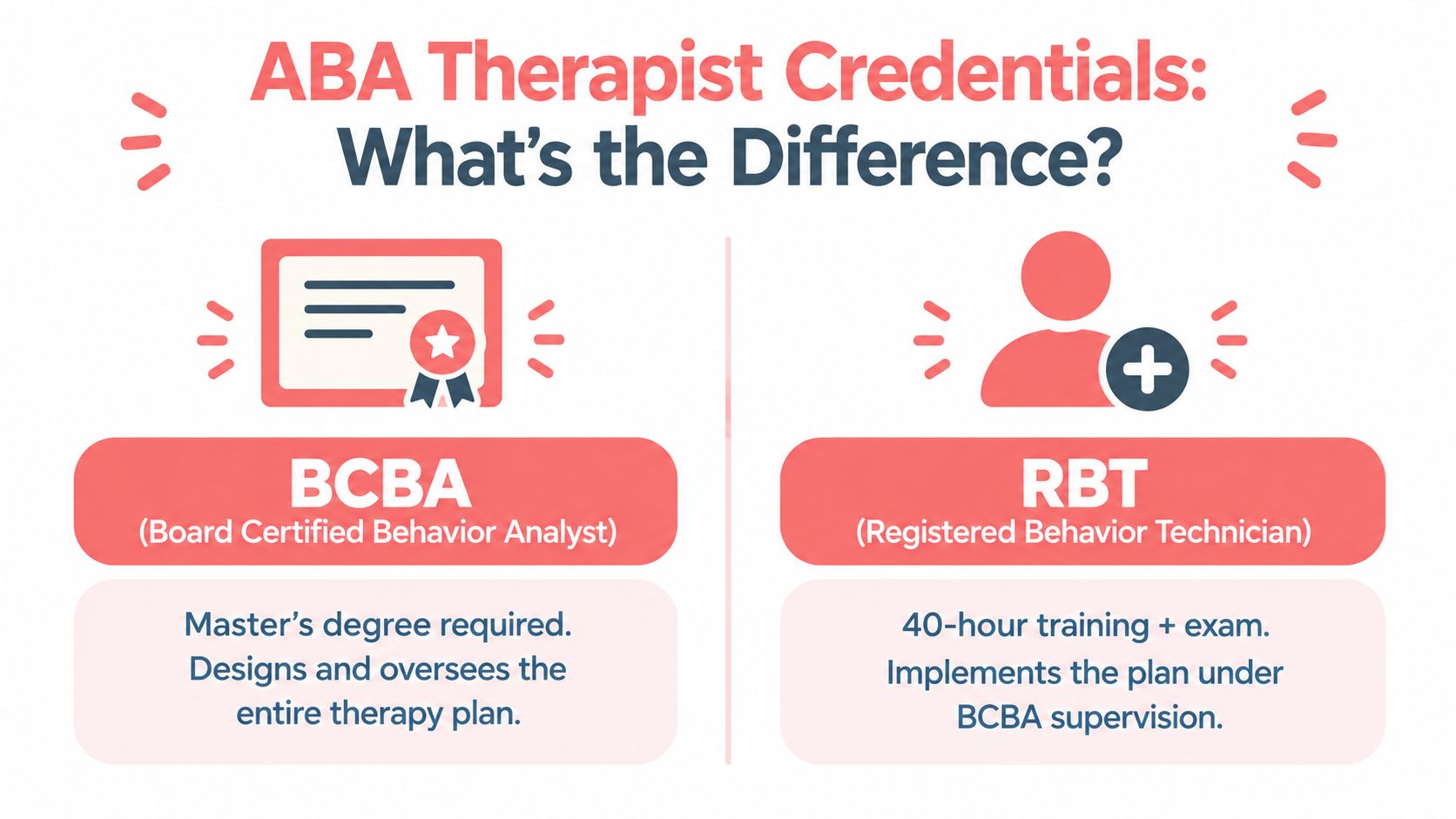
| Credential | What the role usually involves |
|---|---|
| BCBA | A Board Certified Behavior Analyst. This clinician assesses needs, builds goals, reviews progress, and supervises the therapy plan. |
| RBT | A Registered Behavior Technician. This paraprofessional works under close, ongoing supervision to carry out the plan directly with the child. |
That distinction matters because families sometimes use “ABA therapist” to mean anyone on the team. In everyday conversation, people may use the phrase broadly. In actual service delivery, though, the jobs are different.
What an RBT must have
The BACB states that an RBT is a paraprofessional certification in behavior analysis and that RBTs work under the close, ongoing supervision of a BCBA, BCaBA, or FL-CBA. The BACB also says RBT candidates must be at least 18 years old, have a high school diploma or equivalent, pass background checks, complete 40 hours of training, and pass an initial competency assessment and exam (BACB RBT certification information).
The training itself also has structure. The BACB's RBT training packet requires that the training total at least 40 hours, be completed within a 180-day window, and take no fewer than 5 days (BACB RBT 40-hour training packet).
So if you're wondering whether direct therapists are just “helpers” with no standard pathway, the answer is no. There is a defined entry process and a supervision requirement.
Parent shortcut: Ask, “Who is the BCBA on my child's case, and who will be the direct therapist I see most often?”
Where BCaBA fits in
You may also hear BCaBA, which stands for Board Certified Assistant Behavior Analyst. Families don't always encounter this credential, but it can be part of the supervision structure. The important question isn't memorizing every title. It's knowing who writes goals, who changes programs, and who is directly with your child.
At FriendlyABA, parents typically work with both credentialed supervisors and trained direct staff, so the plan doesn't depend on guesswork or one person working alone.
What Happens During a Typical ABA Session
Many parents worry that ABA will mean sitting at a table for an hour doing flashcards. Sometimes a child may practice at a table for a short stretch, but a typical session is often much more natural than that.
A first week session at home might start with your child choosing a toy, walking with the therapist to the kitchen for a snack routine, and practicing a simple request like “open” or pointing to a picture card. Then they may move to turn-taking with a ball, cleanup with support, and a short transition into a book or puzzle.

A session often follows your child's day
If the target skill is asking for help, the therapist may wait for a real moment when your child can't open a container. If the goal is smoother transitions, they may practice moving from play to handwashing with a visual cue and praise for each step.
That's why ABA can look a little like play, a little like teaching, and a little like coaching. The structure is there, but it's often tucked inside normal routines.
Here are a few things you might see:
- Prompting: the therapist gives just enough help for success, then fades that help over time
- Positive reinforcement: your child gets something meaningful after using a target skill, such as praise, a toy, or access to a preferred activity
- Small teaching steps: harder tasks are broken into manageable parts
- Data collection: the therapist notes what happened so the team can see patterns instead of relying on memory
Session goals usually focus on daily life
A 2023 meta-analysis reported medium effects for intellectual functioning (SMD 0.51, 95% CI 0.09–0.92) and adaptive behavior (SMD 0.37, 95% CI 0.03–0.70), while broader reviews also found gains in daily living skills, socialization, and receptive language. For families, that supports a practical view of ABA therapy. The aim isn't just getting through a session. It's helping skills carry into ordinary life (2023 meta-analysis on ABA outcomes).
A child might practice:
- asking for a break instead of dropping to the floor
- waiting for a sibling's turn
- putting shoes on in order
- joining circle time for a short period
- tolerating “all done” without panic
Later in the process, many parents want a visual overview of how the assessment and early sessions unfold. This guide on what to expect during your first ABA assessment can help make those first steps feel less foggy.
A short video can also make ABA feel more concrete than any definition on a page.
How Supervision and Data Tracking Keep Therapy on Track
Parents often assume the direct therapist is working independently. In a quality ABA program, that's not how it should work.
The therapist who spends time with your child is part of a supervised system. Practice guidance describes a general supervision standard of 1 to 2 hours for every 10 hours of direct treatment, with the supervising behavior analyst responsible for direct observation, performance monitoring, and making protocol changes based on data (CASP ABA practice guidelines).
Why that supervision matters
Think of supervision as the quality-control layer. If your child is making progress, the supervisor helps decide what to build next. If a strategy isn't clicking, the supervisor should notice that and adjust the plan.
Without that oversight, therapy can become repetitive or drift away from the child's actual needs.
Practical rule: Ask how often the supervising BCBA observes sessions, reviews data, and updates goals.
The BACB also describes a specific minimum supervision rule for RBTs. RBT supervision must be at least 5% of the hours spent providing behavior-analytic services in a calendar month, with at least two face-to-face contacts and at least one individual meeting (BACB 2026 RBT requirements).
What “data tracking” actually means
Data sounds intimidating, but it's usually very simple in practice. The therapist might count how many times your child asked for help, note whether they needed a prompt, or record how long a transition took.
That information helps answer questions like:
- Is the goal realistic right now?
- Is the prompt level too high or too low?
- Is the child doing the skill only with one therapist, or in other settings too?
- Is the plan helping, or does it need to change?
When parents hear “data-driven,” they sometimes picture a cold or robotic process. Good data collection should do the opposite. It protects your child from adults making assumptions and helps the team respond to what's happening.
Where ABA Therapy Takes Place and Who Delivers It
A lot of websites still make ABA sound like something that happens only in a clinic room, one child and one therapist, hour after hour. That's no longer the full picture.
Independent reporting from 2025 to 2026 points to a shift toward natural-environment delivery, caregiver coaching, and school integration, with growing attention to parent-mediated intervention, classroom carryover, telehealth support, and cross-setting coordination (2025 to 2026 ABA trends report).
Comparing settings side by side
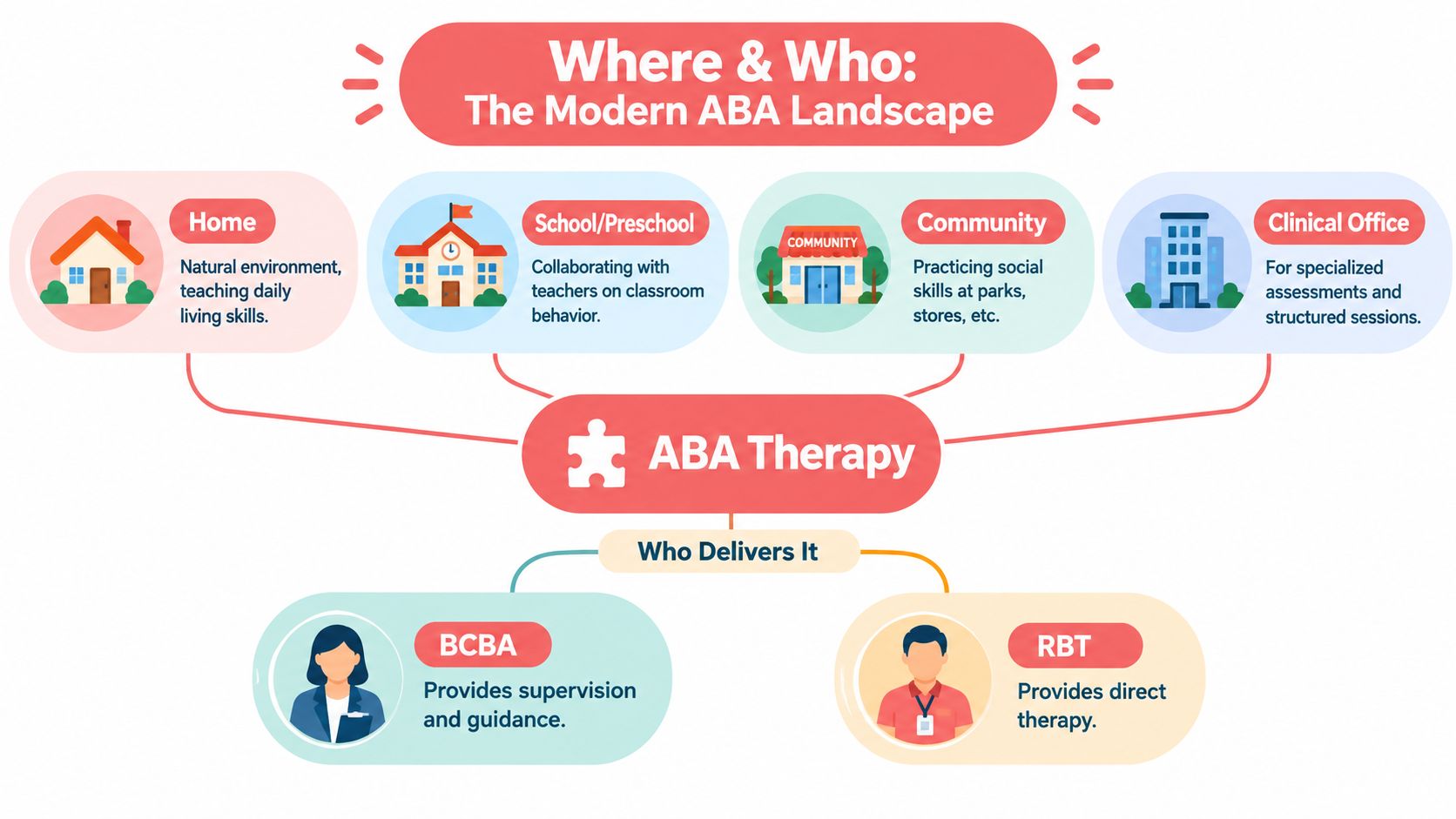
| Setting | What it can support |
|---|---|
| Home | routines, meals, dressing, play with siblings, transitions |
| School or preschool | classroom participation, peer interaction, following group routines |
| Community | waiting, safety, social practice, flexible behavior in real places |
| Clinic or office | assessments, some structured teaching, supervisor meetings |
The best setting depends on the child, the goals, and what the family needs. If a child struggles most during breakfast, after-school transitions, or playground interactions, therapy in those real settings often makes more sense than practicing only in an office.
Why the team structure affects access
There's another layer parents deserve to know about. ABA isn't only shaped by your child's needs. It's also shaped by workforce realities.
Industry reporting says there were 253,397 active RBTs and 83,586 certified BCBAs as of April 2026, yet providers still describe staffing scarcity as a retention problem because annual RBT turnover commonly exceeds 65% and can approach or surpass 100% at large organizations. That helps explain why families may face waitlists even when therapist headcount sounds high on paper (2026 ABA workforce reporting).
The answer to “what is an ABA therapist?” gets more realistic. Your child may have a direct therapist, but that person is part of a broader system involving supervision capacity, scheduling, caregiver availability, and setting coordination.
When therapy works well across home, school, and community, it usually means the adults are aligned, not just that one therapist had a good session.
Getting Started What Parents Should Expect Next
Once you understand the roles and structure, the next step is usually a consultation and assessment. This part can feel big, but it helps to treat it like a conversation, not a test your child has to pass.
The assessment process usually includes caregiver input, a review of your child's strengths and needs, and direct observation. The team is looking for meaningful starting points. Not perfection. Not a label on every behavior. Just a clear picture of what would help daily life feel smoother.
Questions worth asking in a first consultation
Bring your questions on paper if you need to. Parents often forget them in the moment.
A few useful ones are:
- Who will supervise my child's program? Ask for the credential and role of the BCBA.
- Who will provide direct therapy most often? This helps you understand whether an RBT or another team member will be in your home or school.
- How do you choose goals? You want goals tied to real life, not random tasks.
- How are parents included? Caregiver coaching matters because children live far more hours outside therapy than inside it.
- How do you handle progress reviews? Ask how often data is reviewed and when goals are adjusted.
What to expect in the first few weeks
The earliest sessions are often about pairing, trust, and observation. That means the therapist is building a positive relationship while learning what motivates your child, what routines are hard, and where early success is most likely.
You may not see dramatic changes right away. What you may see first is something quieter. Your child starts tolerating transitions a little better. They accept help more easily. They begin to understand the rhythm of sessions.
A few practical ways to support the process at home:
- Share what matters most. If mornings are the hardest part of your day, say so.
- Point out motivators. Favorite snacks, songs, toys, and routines can help teaching feel natural.
- Notice small wins. A new gesture, a calmer handoff, a smoother cleanup all count.
- Ask for carryover ideas. A good team should be able to give you simple strategies for home practice.
Green flags and gentle red flags
You don't need to know every clinical term to tell whether a provider feels organized and respectful.
Good signs often include:
- Clear role explanations
- Regular communication
- Goals that sound useful in everyday life
- Comfort with parent questions
- Visible supervision and updates
Some concerns to pause on:
- Vague answers about who supervises
- No clear explanation of how progress is tracked
- Goals that don't connect to your child's daily life
- Pressure to agree without understanding the plan
One practical resource some families use during this stage is FriendlyABA's parent goals guide, which can help you think through priorities before services begin. FriendlyABA provides direct ABA services in home, school, and community settings with BCBA supervision, RBT-delivered therapy, and caregiver coaching, so families can see how the team model works in everyday care.
Starting ABA doesn't mean handing your child over to a system you don't understand. It should feel like building a team around your child, one that listens, teaches with intention, and respects that families know their children best.
If you're sorting through referrals and trying to understand what an ABA therapist does, FriendlyABA can help you make sense of the process in plain language. Our team provides direct ABA services with BCBA oversight, RBT support, and caregiver collaboration focused on the everyday skills that matter most. You can learn more or schedule a consultation at FriendlyABA.
Our Latest Insights





You don't have to figure it out alone
Whether you're exploring ABA therapy for the first time or searching for a provider who truly feels like the right fit, we're here to help.