



How Much Does Applied Behavior Analysis Cost
Wondering how much does applied behavior analysis cost? Get a clear breakdown of ABA session rates, insurance, Medicaid, and ways to plan a realistic family

ABA cost is driven by hours per week and provider type, with national benchmarks of roughly $65 per hour for technicians and $95 per hour for BCBAs, so 20 weekly hours can mean about $60,000 to $100,000 a year before insurance adjustments. Your actual family responsibility may be much lower or higher, depending on the plan, network, authorization, and out-of-pocket rules.
A parent can receive an estimate, look at the total, and wonder whether it's normal. Maybe the document lists direct therapy, BCBA supervision, assessment, and parent training as separate charges. Maybe the insurer says ABA is covered, but no one has explained what “covered” means for the family budget.
The most useful way to think about how much applied behavior analysis costs is as a small equation:
weekly hours × rate × 52 weeks, adjusted for the insurer's allowed amount and the portion your family still owes.
That's why two children receiving ABA from the same provider can have very different financial responsibilities. The recommended hours may differ, the staff mix may differ, and one family may be in network while another faces out-of-network charges. Before the first session, ask for the three numbers that shape the estimate most: weekly hours, hourly rate, and your plan-specific out-of-pocket maximum.
Table of Contents
A First Conversation About ABA Costs
A parent sits at the kitchen table with a printed estimate beside a laptop. The number at the bottom looks enormous, but the document doesn't make clear whether it represents the provider's billed charge, the insurer's negotiated amount, or the family's expected payment. That confusion is common, and it doesn't mean you've missed something obvious.
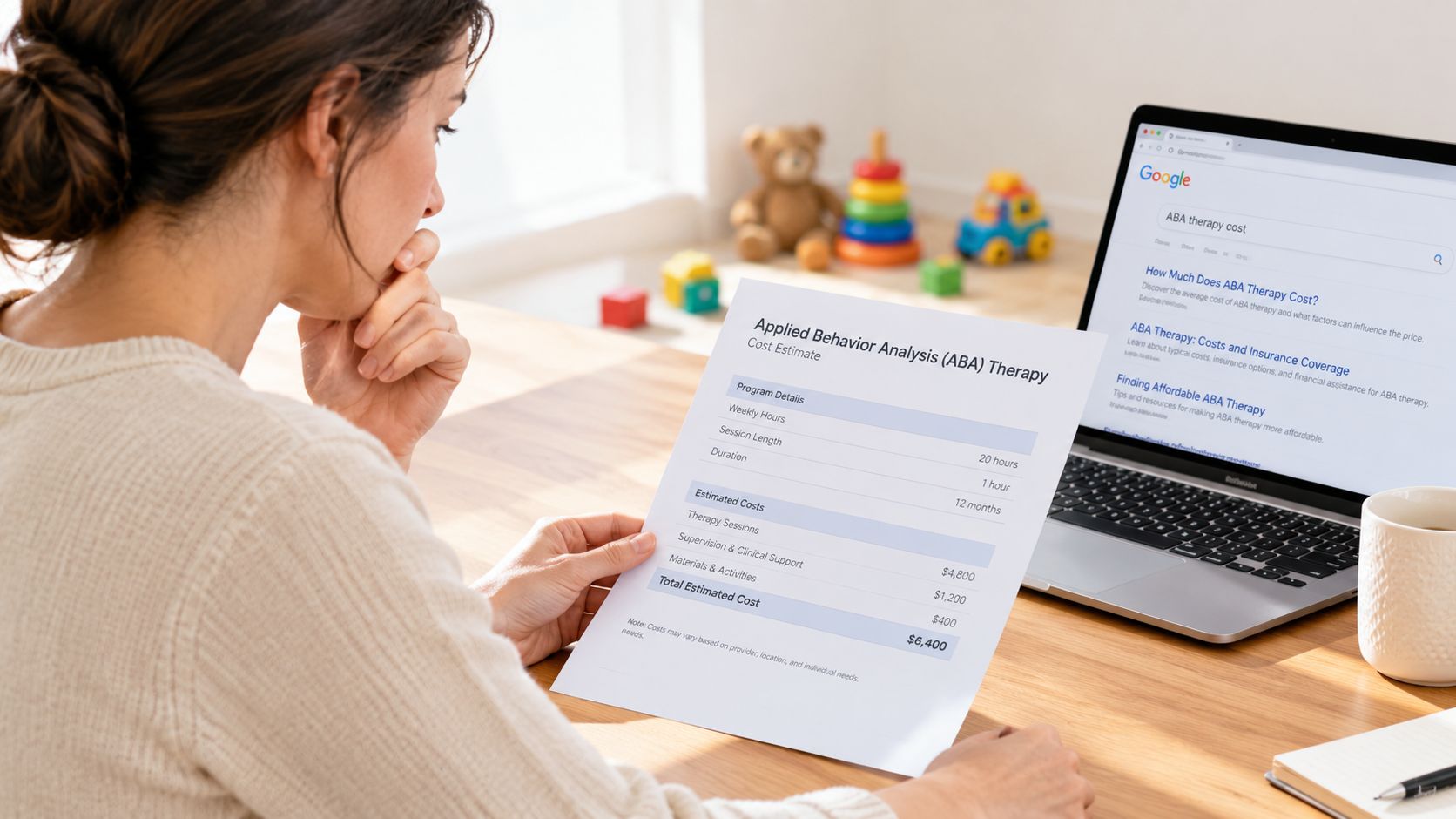
ABA programs can include direct sessions with a trained therapist, BCBA oversight, assessment, caregiver coaching, treatment-plan updates, and coordination with a school. Each part may have a different billing rule. A program may also use a lower-cost technician for much of the direct work while reserving BCBA time for clinical decisions and supervision.
Practical rule: A quoted hourly rate is a starting point, not a prediction of what your family will pay.
Suppose a provider recommends 20 hours each week. At a rate of $125 per hour, the gross annual example is approximately $130,000 before insurance, cancellations, assessments, caregiver training, or other adjustments, based on the calculation described in the RAND analysis of ABA reimbursement and treatment rates. That example shows why hours matter so much, but it isn't a universal price. Many programs combine staff types and bill assessment or supervision differently.
Your first financial conversation should happen before services begin. Ask the provider to separate the estimate into direct treatment, BCBA supervision, assessment, caregiver training, and any school or travel-related work. Then ask the insurer how each service is treated under your specific plan.
The number that matters at the end is not the largest number on the estimate. It's the amount your family may owe after the deductible, copayments, coinsurance, authorization limits, network rules, and annual out-of-pocket maximum are applied.
Who Provides ABA and Why That Changes the Rate
A $100 hourly line on an ABA estimate does not necessarily mean one person delivers every minute of care. Different credentials represent different responsibilities, and those responsibilities can carry different billed rates.
A Board Certified Behavior Analyst, or BCBA, designs and oversees treatment, reviews progress, trains caregivers and therapists, and changes goals when the data support an adjustment. A Registered Behavior Technician, or RBT, generally provides direct, structured practice with the child under the direction and supervision of a qualified clinician. FriendlyABA offers a plain-language explanation of what an ABA therapist does.
That staffing model may place a technician with your child for much of a session while the BCBA contributes assessment, clinical planning, supervision, and caregiver coaching. The estimate can therefore show several rates, even within one program.
The reimbursement review below found wide differences by provider type and payer:
| Provider type | Medicaid range | Commercial range |
|---|---|---|
| Technician-level or BCaBA services | $25 to $75 per hour | $24.64 to $160 per hour |
| Master's- or doctoral-level services | $55.50 to $125 per hour | $36.90 to $196.50 per hour |
These figures are reimbursement benchmarks from the federal review of ABA reimbursement data. They are not guaranteed self-pay prices or predictions of your family's bill. After state estimates were weighted by the number of children diagnosed with autism, the estimated national means were $65.16 per hour for technician-level services and $94.72 per hour for master's- or doctoral-level services.
How to read the estimate
Separate the estimate into these four service categories:
- Direct treatment: A technician or other therapist works with your child on communication, routines, play, learning, safety, or social participation.
- BCBA supervision: The BCBA observes, reviews data, updates treatment, and guides the direct-care team.
- Assessment: The provider gathers information about strengths, needs, priorities, and appropriate goals.
- Caregiver training: Parents learn practical strategies for meals, transitions, play, and other daily routines.
Ask which staff member performs each service, whether it is billed separately, and whether the insurer uses a different allowed amount for each one. Billed rates are the provider's starting figures. The insurer-allowed amount and your plan's cost-sharing rules determine how much of that figure can reach your family's budget.
How Treatment Intensity Drives the Total
A family comparing two ABA providers can start with the hourly rate and still miss the larger budget question: how many hours are recommended? Ten hours each week creates a very different gross total from 30 or 40 hours, even when the rate stays the same.
The federal benchmarks offer a planning example. At $65.16 per hour, 10 hours weekly equals approximately $33,900 per year, while 40 hours equals approximately $135,500. At $94.72 per hour, the comparable totals are approximately $49,300 and $196,200. These figures describe gross allowed-cost scenarios, not the amount a family automatically pays, as explained in the treatment-intensity reimbursement analysis.
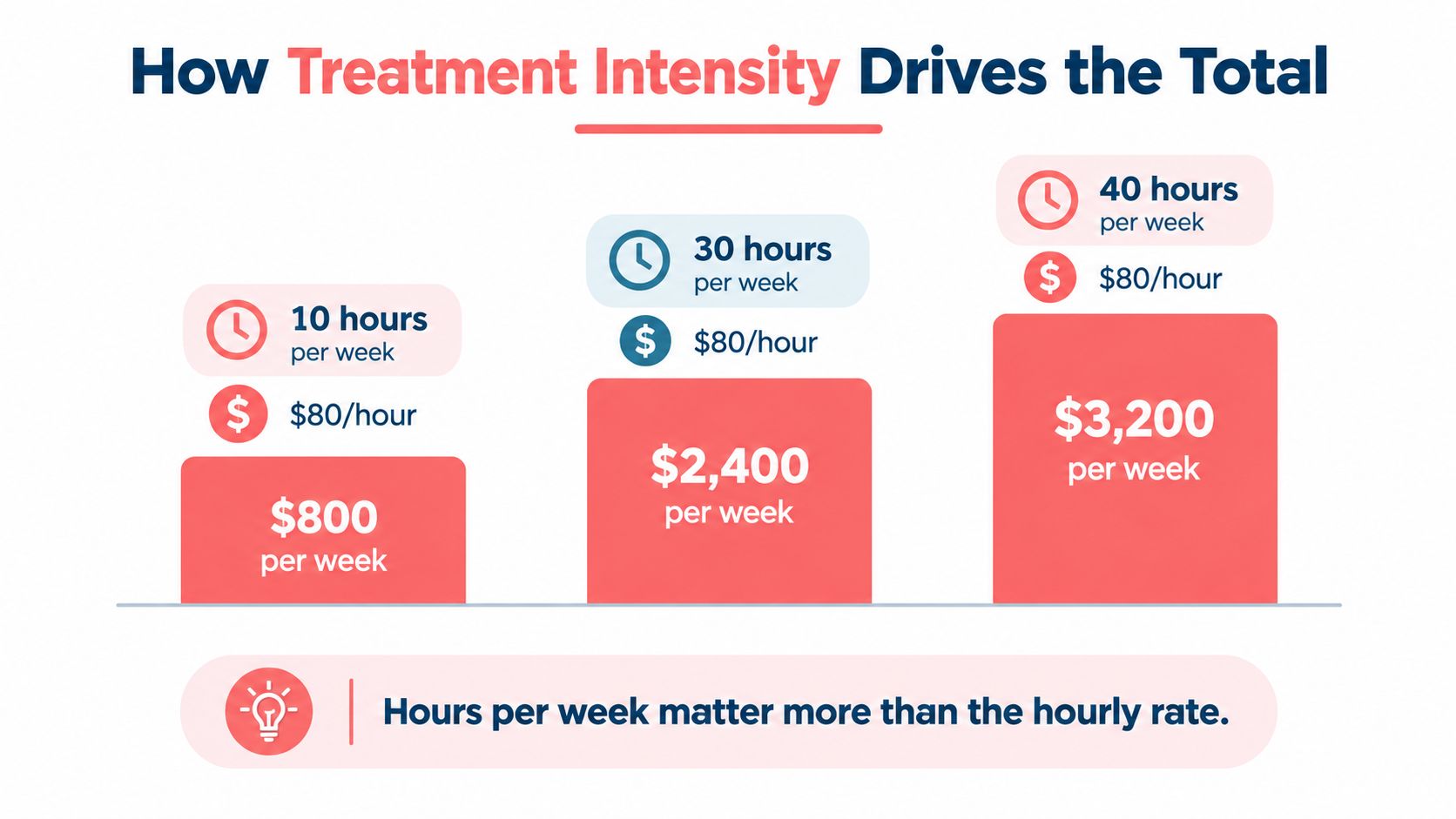
The same calculation works for schedules between those examples. At the technician-level mean, 20 hours per week implies about $67,800 annually before insurance. At the clinician-level mean, the same schedule implies about $98,900 annually, using the national means introduced earlier.
Match the schedule to the clinical recommendation
Programs may include roughly 30 to 40 direct-treatment hours per week. Less intensive models may provide about 10 to 25 hours weekly. These ranges describe planning options, not automatic prescriptions. A BCBA should connect the recommendation to the child's goals, daily routines, available settings, caregiver priorities, and response to treatment.
More direct hours can also increase related services. A larger schedule may require additional supervision, reassessment, caregiver coaching, documentation, and coordination with school staff. Those services may be billed separately or follow their own authorization rules, so the hourly figure alone does not show the full exposure.
Before comparing programs, record each option's authorized weekly hours and staff mix. Then separate the provider's billed rate from the insurer-allowed amount and your plan's cost-sharing rules. A lower rate may still produce a larger family budget if it comes with more hours or if supervision and other services fall outside the benefit.
Where Coverage Comes From and What It Really Pays
A family can hear “ABA is covered” and still face a large bill. The amount you owe depends on who pays the claim, the provider's billed rate, the insurer's allowed amount, and your cost-sharing rules. For each coverage path, record the allowed amount and what counts toward your out-of-pocket maximum before comparing estimates. FriendlyABA's breakdown of ABA therapy costs provides related context.
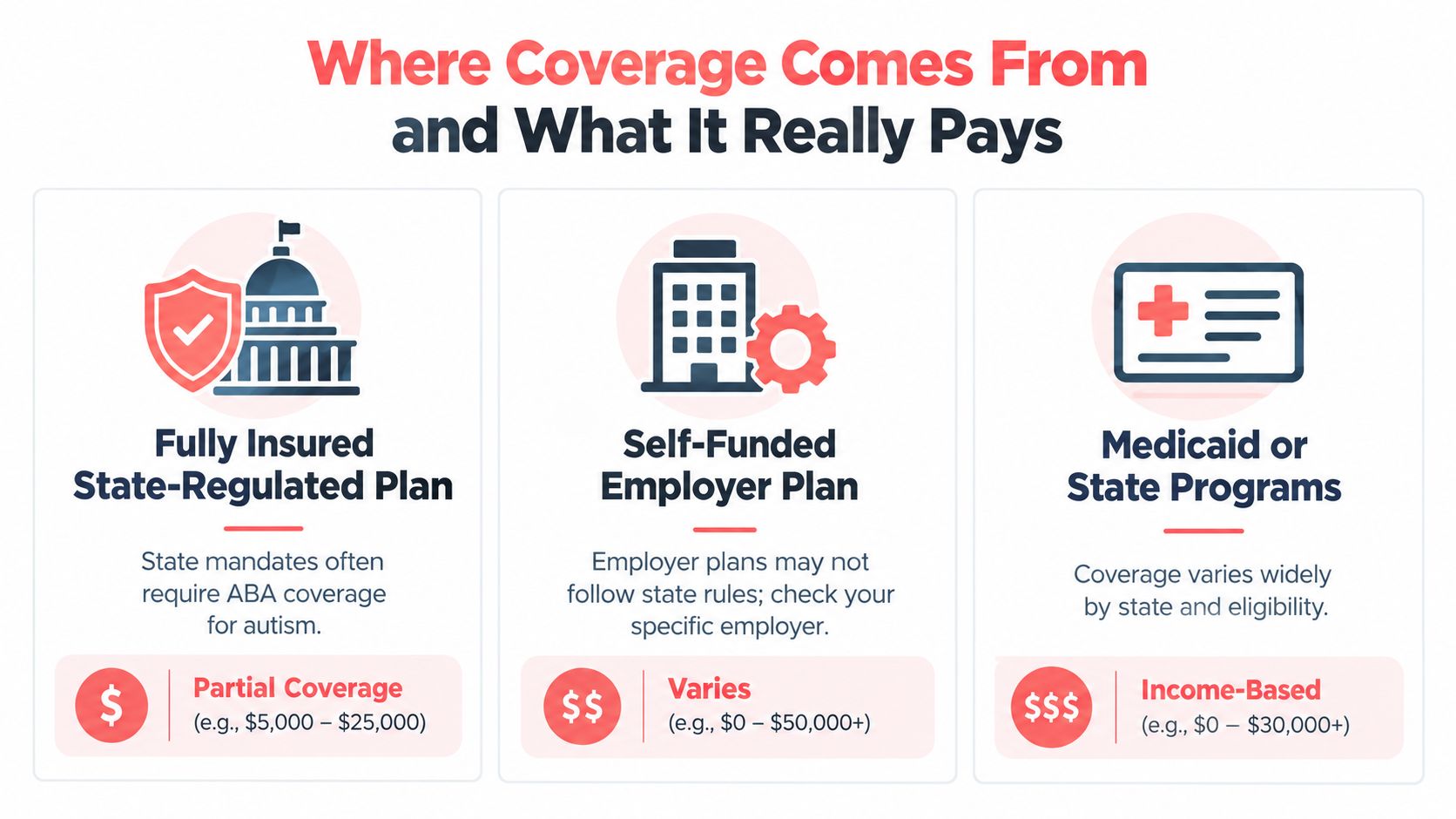
Four coverage paths
Fully insured state-regulated plans usually follow the autism coverage rules of the state regulating the policy. Those rules may address age, diagnosis, medical necessity, annual benefits, prior authorization, and network participation. Missouri, for example, requires insured coverage for ABA for children 18 and younger, with an initial annual ABA limit of $40,000, adjusted annually for inflation, according to the Missouri Department of Insurance. Check how the allowed amount, deductible, copay, or coinsurance affect your family's share.
Self-funded employer plans use employer plan assets and may not follow state insurance mandates in the same way. Ask the benefits administrator whether the plan is self-funded, whether it includes an autism benefit, and which authorization rules apply. Then confirm the allowed amount and how your deductible or coinsurance affects each claim.
Medicaid varies by state implementation, eligibility, provider participation, managed-care arrangements, and medical necessity. Caregiver training and behavioral coaching may fit within preventive-services benefits when qualified providers deliver them under applicable rules. The Medicaid ABA services toolkit can help families ask about provider enrollment, credentials, prior authorization, and whether these services have a separate cost to the family.
TRICARE uses its own reimbursement and authorization rules, so families should request the current allowed rates and covered services directly from the plan. A lower allowed amount does not automatically mean a lower bill. The provider must accept the plan's terms, and the family still needs to check deductibles, cost sharing, and limits.
The ceiling isn't the same as free care
For 2026 Marketplace plans, the federal in-network out-of-pocket ceiling is $10,600 for an individual and $21,200 for a family, according to the ABA family net-cost resource. Premiums, noncovered services, and out-of-network costs generally do not count toward that ceiling.
Arkansas shows why billing units matter. Its Medicaid program bills ABA by unit, counts only face-to-face time directly treating the child, and limits one clinician to 50 billable ABA treatment hours per week, as described in the Arkansas ABA billing document. Ask whether parent coaching, supervision, assessment, and coordination are covered separately.
Building Your Own Net-Cost Worksheet
A provider's headline rate cannot answer what your family will owe. Build the estimate from the plan documents and the explanation of benefits, or EOB. The EOB shows how the insurer processed a claim, including the allowed amount, plan payment, deductible application, coinsurance, and patient responsibility.
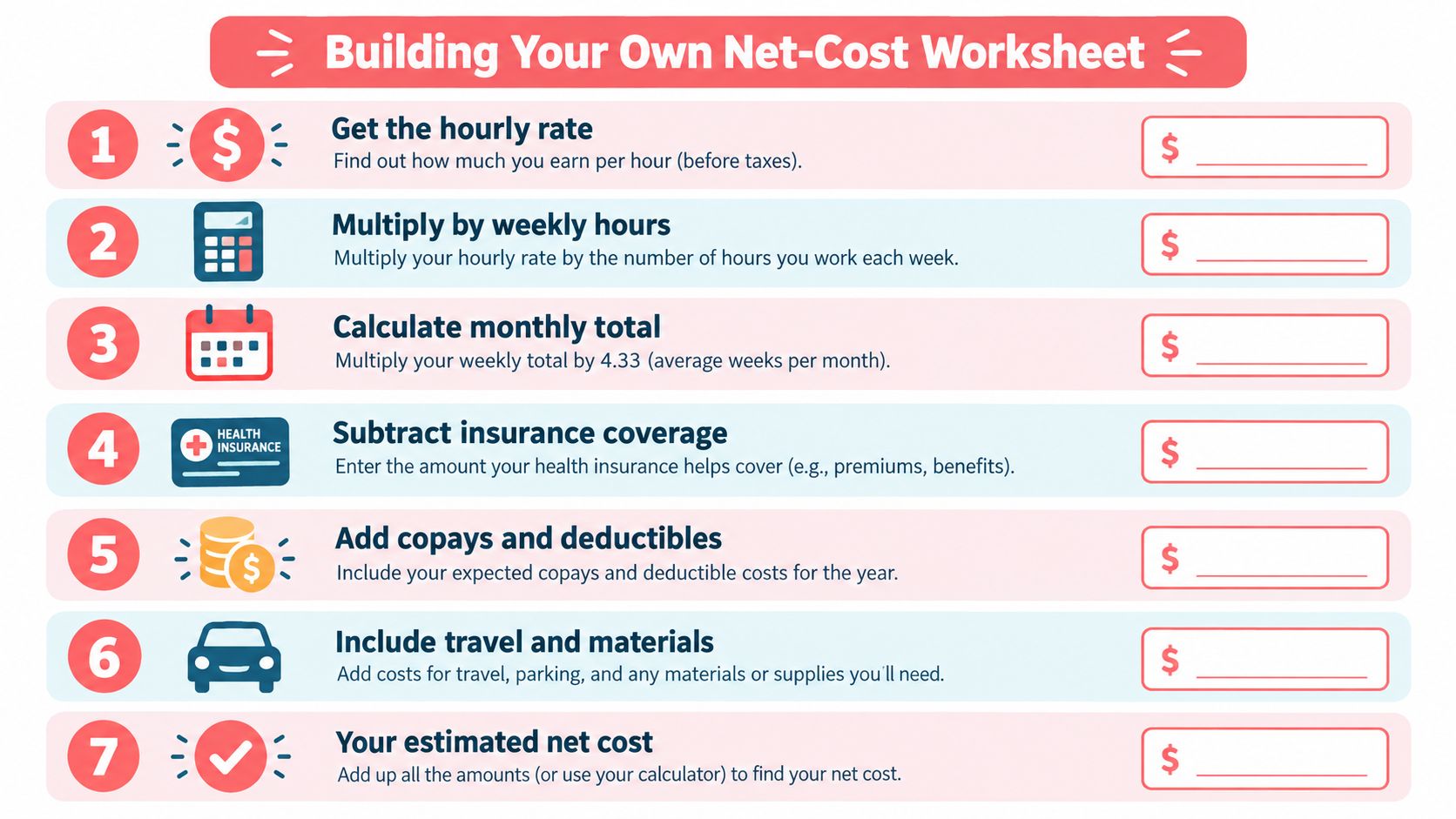
Use one page and write down these seven questions:
- What is the hourly rate by staff type? Ask for the direct therapist rate, BCBA rate, assessment rate, and caregiver-training rate.
- How many hours are expected each week? Record direct hours separately from supervision and coaching.
- What is the assessment fee? Ask whether the initial assessment and later reassessments are included or billed separately.
- What supervision ratio applies? Find out how much BCBA oversight is planned and whether it has a different authorization.
- Is prior authorization required? Ask who submits the request, how many hours are requested, and what happens if the insurer approves fewer hours.
- What is the annual in-network out-of-pocket maximum? Record the individual and family amounts that apply to your child.
- Are caregiver training and school coordination reimbursed? Verify whether these services are covered, excluded, or subject to separate limits.
A sample calculation
A 20-hour weekly plan at $120 per hour creates a gross annual example of $124,800 before insurance adjustments. That number is not the family bill. The insurer may apply a negotiated allowed amount, pay part of the claim, apply some costs to the deductible, and then charge coinsurance until the in-network out-of-pocket maximum is reached.
Your worksheet should therefore include two columns:
| Provider or plan figure | Family-specific question |
|---|---|
| Billed rate | What amount does the insurer allow? |
| Authorized hours | How many hours did the plan approve? |
| Deductible | How much remains this plan year? |
| Coinsurance | What percentage applies after the deductible? |
| Out-of-pocket maximum | Which services count toward it? |
| Extra services | Are assessment, coaching, travel, or coordination covered? |
The provider invoice tells you what was billed. The EOB tells you how the insurer processed the claim and what the plan says you owe. Keep both, and compare them when a statement arrives.
Bring this list to intake: rate by staff type, weekly hours, assessment charge, supervision, authorization, out-of-pocket maximum, and coverage for caregiver training or school coordination.
When the Lower Rate Still Costs More
A lower posted rate can look attractive and still create a larger family bill. An out-of-network provider may leave you responsible for a greater share, and a service excluded from the autism benefit may not receive the plan's negotiated protection. A program with a small authorized-hour limit may also fail to cover the schedule recommended by the clinical team.
The reverse can happen too. A higher in-network rate may be more manageable if the plan applies covered services to the family's in-network out-of-pocket maximum. The relevant comparison is not “Which provider charges less per hour?” It is “What will this plan allow, authorize, and count toward the amount our family can be required to pay?”
Keep program spending in perspective
Aggregate Medicaid spending can show that a program is growing, but it doesn't tell you what one family pays. The U.S. Department of Health and Human Services Office of Inspector General reported that Indiana fee-for-service Medicaid ABA payments rose from $14.4 million in 2017 to $101.8 million in 2020, an increase of approximately 607%, with the 2020 total second highest among states examined nationally, as reported in the Indiana Medicaid ABA review. That is program spending, not a typical family invoice.
Before signing a service agreement, ask harder questions if you see:
- Network uncertainty: The provider cannot confirm participation in your exact plan.
- Authorization gaps: The approved hours are lower than the recommended schedule.
- Benefit limits: An annual cap may be exhausted before the treatment year ends.
- Eligibility restrictions: Age, diagnosis, plan type, or medical-necessity rules may narrow coverage.
- Repeated denials: Claims or requests are denied without a clear correction or appeal path.
For questions about the BCBA's role in oversight and supervision, review FriendlyABA's BCBA supervision requirements resource. You should also ask the provider who handles denials, what records support an appeal, and how services continue while a decision is pending.
A 30-Day Plan and a Next Step With FriendlyABA
You don't need to solve the entire financial picture in one phone call. Give yourself a month and handle one group of tasks at a time.
Week one
Call the insurer and ask the seven worksheet questions. Confirm the plan type, network status, prior authorization rules, allowed provider types, deductible, coinsurance, out-of-pocket maximum, and coverage for caregiver training. Write down the representative's name, the date, and any reference number.
Week two
Gather the intake paperwork, diagnostic report, insurance card, relevant school documents, and any current therapy records. Make a short list of the routines that are hardest at home, school, or in the community. Specific examples help the BCBA understand which goals matter most to your family.
Week three
Meet with the BCBA for assessment and ask how the recommended weekly hours were selected. Ask how direct sessions, supervision, caregiver coaching, and school coordination fit together. A thoughtful plan should connect services to observable goals and your child's strengths, interests, and daily life.
Week four
Review the treatment plan and confirm that the documented authorization matches the recommended services. Ask when progress will be reviewed and how you'll receive updates. Parent coaching can help caregivers practice communication, transitions, daily-living, and safety strategies between sessions, making each authorized hour more connected to the child's everyday routines.
FriendlyABA provides home-based, school, and community ABA services, with BCBAs and trained therapists working alongside families on individualized goals, caregiver coaching, and progress monitoring. If you're trying to understand an estimate, bring your worksheet and plan documents to a consultation so a clinician can help you identify the questions that still need answers.
FriendlyABA can help families review the expected staff mix, weekly hours, assessment process, and caregiver-coaching schedule while they plan for ABA services. Visit FriendlyABA to book a consultation and begin the conversation with a real clinician instead of guessing from a single hourly rate.
Our Latest Insights















You don't have to figure it out alone
Whether you're exploring ABA therapy for the first time or searching for a provider who truly feels like the right fit, we're here to help.