


Token Economy in the Classroom: A Parent's Guide
Learn how a token economy in the classroom shapes student behavior, with practical tips for parents on rewards, consistency, and tracking progress at home.


A teacher says, “It's time to start,” but your child stays frozen at the desk. A transition begins, and a difficult behavior appears before your child can ask for help. You may be wondering whether a token board could make school feel more predictable without turning every moment into a struggle over rewards.
A token economy in the classroom can be a useful teaching tool when it's individualized, respectful, and carefully monitored. It isn't a sticker chart or a way to make a child comply. A well-designed system can support communication, independence, transitions, and participation while adults gradually help the child rely more on natural encouragement and meaningful success.
Table of Contents
- What a Token Economy Looks Like in Real Classrooms
- 1. Define observable target behaviors
- 2. Select a practical token
- 3. Build a preference-based backup menu
- 4. Make exchange rules visible
- 5. Plan data collection and fading
What a Token Economy Looks Like in Real Classrooms
During morning work, a teacher notices that a student with autism often looks at the worksheet but doesn't begin. The teacher has already learned that the student enjoys drawing after completing a short task. She places a small visual board on the desk, gives one star immediately after the student opens the worksheet and writes the first answer, and says, “You started your work. You earned a star.” After the student earns the agreed number of stars, the student chooses drawing time.
That star doesn't have much value by itself. It becomes meaningful because the student has learned that stars can be exchanged for something preferred. In ABA, or Applied Behavior Analysis, this is called a conditioned reinforcer. The token gains value through its connection to a preferred activity, item, privilege, or interaction.
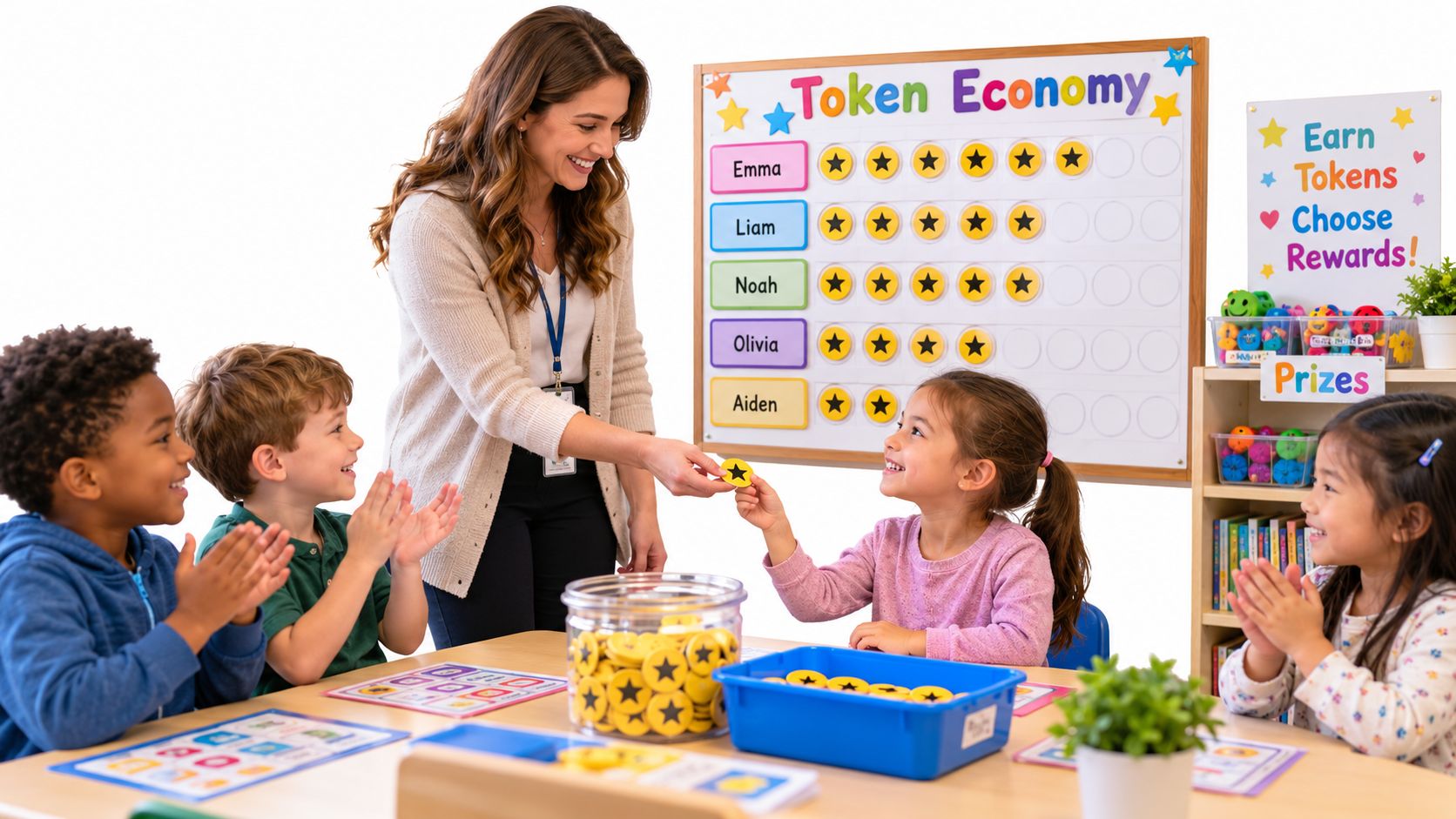
A token system might support several everyday moments:
- Beginning work: The child earns a token for opening materials and starting an assigned step.
- Transitioning: The child earns a token after moving safely and calmly to the next activity.
- Communicating: The child earns a token for saying, signing, pointing to, or using a device to request help.
- Participating: The child earns a token after completing a clearly defined part of group instruction.
The important detail is that the behavior must be observable. “Be good” is too vague. “Use the help card when the task feels difficult” gives the child and adults a clear target.
A helpful perspective: The token is not the final lesson. It's a temporary bridge between a behavior that's still developing and the natural benefits of using that skill.
A thoughtful token economy focuses on small moments that build larger abilities. Beginning one task can support independence. Requesting a break can replace distress or disruption. Completing a transition can open access to classroom activities and peer interaction. The system should make those steps easier to notice and reinforce, not reduce the child to a collection of points.
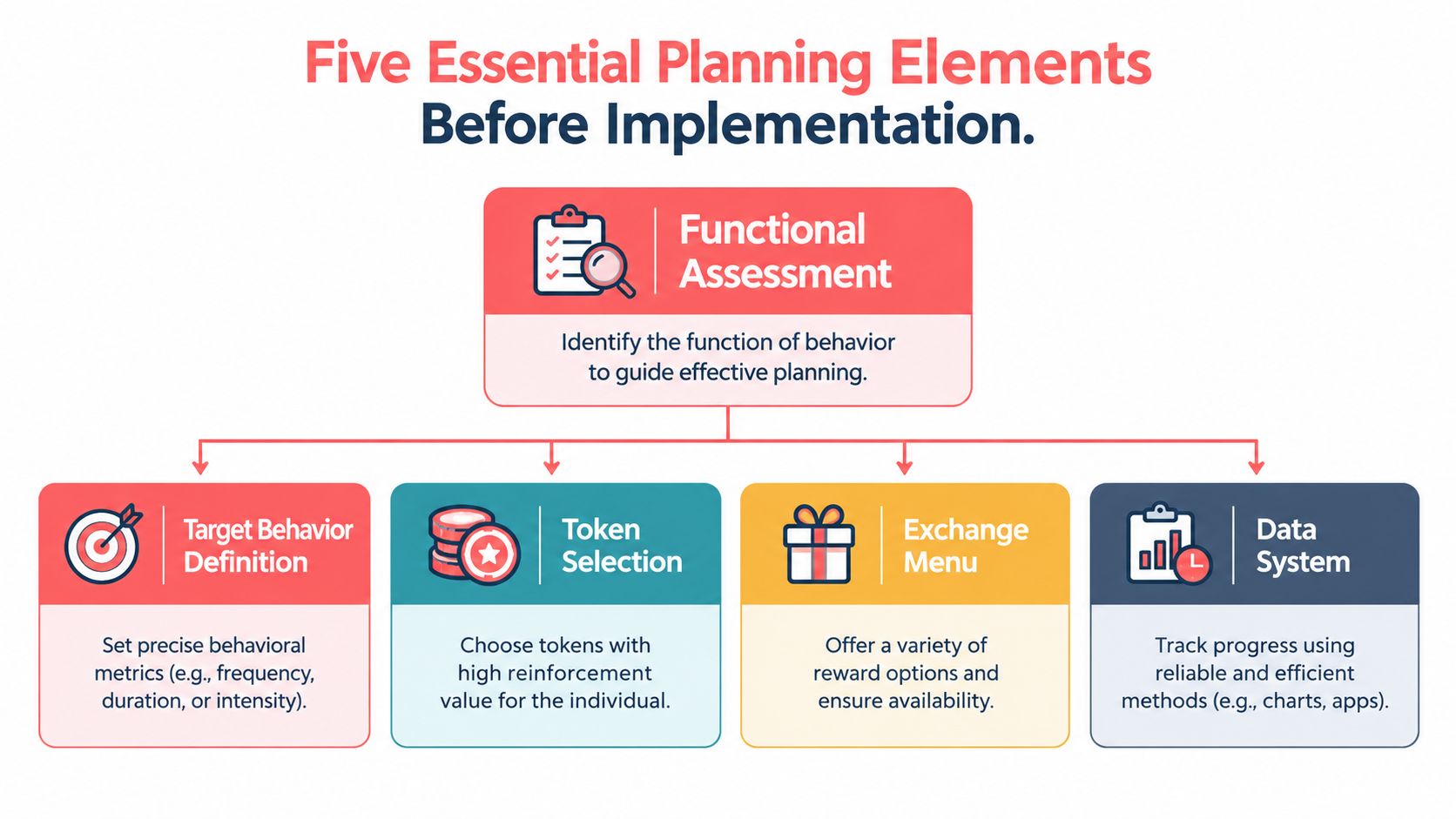
Five Essential Planning Elements Before Implementation Begins
A BCBA, or Board Certified Behavior Analyst, should help the school team design the system before tokens appear. The plan needs to fit the child, the classroom routine, the available staff, and the skills that matter in daily life. A useful assessment process is described in this guide to Applied Behavior Analysis assessment.
1. Define observable target behaviors
Start with one to four behaviors that adults can see or hear and record consistently. Examples include beginning an assigned task within two minutes, raising a hand, completing a transition, or using an appropriate request instead of disruption. The team should establish a baseline by recording how often or how long the behavior occurs across several sessions before deciding whether the plan is helping.
A target should describe what the child will do, not what adults hope the child will feel. “Stay focused” could mean many things. “Complete the first three problems after the direction is given” is easier to teach and measure.
2. Select a practical token
A token might be a sticker, chip, point, mark on a board, or another visual signal. It should be durable, portable, immediately deliverable, and difficult to copy or lose. Staff should have enough tokens available so reinforcement doesn't stop because the materials are inconvenient.
The best token is the one adults can deliver quickly during real instruction and the child can understand. A complicated system that interrupts lessons may not be sustainable.
3. Build a preference-based backup menu
The token only works if the exchange option matters to the child. A BCBA may conduct a preference assessment by offering choices, observing engagement, and asking the child or caregivers about current interests. The menu could include drawing, a brief preferred activity, a classroom job, a sensory option, access to a favorite item, or positive time with an adult.
Preferences change. A reward that worked recently may lose its appeal, so the team should check the menu periodically rather than assuming every child values the same option.
4. Make exchange rules visible
The child should know what earns a token, how many tokens are needed, when exchange happens, and how long the chosen reward lasts. Staff should teach these rules directly with modeling, visual supports, and practice. Children with different communication abilities may need pictures, gestures, demonstrations, or a first-then board instead of a lengthy verbal explanation.
The starting requirement should be realistic enough that the child contacts reinforcement quickly. Guidance from the University of Delaware token economy resource emphasizes immediate delivery, explicit instruction, consistent administration across staff, and recording procedures.
5. Plan data collection and fading
The plan should record target behaviors, competing behaviors, tokens earned, exchanges, and staff fidelity. Fidelity means checking whether adults delivered tokens at the agreed time and followed the same criteria. The team should also decide how it will gradually reduce token density and increase natural praise, choice, participation, and satisfaction from completing meaningful activities.
Setting Measurable Goals and Understanding Progress Data
Parents often hear, “The token system seems to be working,” and still wonder what that means. A stronger answer compares current performance with the child's own baseline. Children respond differently depending on the target, age, disability profile, reinforcer quality, classroom demands, and adult consistency, so there isn't one universal classroom success rate.
A systematic review examined 24 token-economy studies in general- and special-education classrooms from kindergarten through fifth grade between 2000 and 2019. It reported large effects across both classroom types, while also finding that token delivery, backup reinforcers, and exchange patterns differed by setting, as described in the published classroom review. Those findings support careful individualization rather than copying another classroom's chart.
Start with a baseline
Before implementation, staff might record how often a child begins work independently, how long a transition takes, or how frequently a child uses an appropriate request. Baseline data gives the team a comparison point and can reveal whether the selected target is specific enough.
A prospective goal could be 80% independent task initiation across three consecutive weeks, or a 30% reduction in disruption, when those criteria match the child's needs and are tracked consistently. The figures are examples of how to define success prospectively, not promises about what every child will achieve. The underlying guidance stresses that change should be judged against the individual child's baseline, with measurable criteria reviewed over time.
Review more than the token total
A token count alone can look positive while important skills remain unchanged. The team should examine whether the child is also participating in instruction, communicating needs, interacting with peers, and using the skill with different teachers or subjects.
A meaningful progress review asks, “Is this helping the child access the classroom?” not only, “How many tokens were earned?”
If progress stalls, the team might adjust the target definition, change the reinforcer menu, shorten the exchange requirement, improve prompts, or coach staff on delivery. A plan that needs revision isn't necessarily a failure. Data helps adults identify which part of the arrangement may not fit the child or the classroom.
The evidence base also deserves an honest description. One systematic evaluation concluded that token-economy research did not meet What Works Clearinghouse criteria for a best-practice designation. That mixed picture makes implementation quality, maintenance, generalization, and the child's experience especially important. Parents can ask to see simple graphs and hear what decision rules the team will use when performance improves, stays flat, or drops.
Recognizing High-Quality Token Systems versus Simple Reward Charts
A simple reward chart may show a row of empty spaces. A high-quality token economy explains exactly what fills each space, why the reward matters, how adults will deliver it, and what happens as the child becomes more independent.
The difference usually appears in the planning details.
| High-quality token system | Simple reward chart |
|---|---|
| Defines a behavior adults can observe | Uses broad language such as “behave” |
| Delivers feedback immediately | Adds points later or inconsistently |
| Uses a menu based on the child's preferences | Offers rewards chosen mainly by adults |
| Gives the child a realistic path to exchange | Sets a requirement the child rarely reaches |
| Includes student choice and private feedback | Publicly compares children |
| Plans to fade toward natural reinforcement | Continues tokens without a clear next step |
Common breakdowns are often practical rather than mysterious. Staff may use different definitions of the target behavior. A reward may no longer motivate the child. The exchange requirement may be too difficult. Adults may forget to pair the token with specific praise, or they may rely too heavily on fines and removal of earned tokens. A plain-language explanation of behavior functions can help the team consider what the child is communicating and what support the behavior may need.
Ask whether the system feels fair
A technically effective system can still be a poor educational fit if it causes shame, limits participation, or makes a child feel publicly ranked. Social validity means asking whether the goals, procedures, and outcomes are acceptable and meaningful to the people involved.
A registered-report review identified 113 token-economy studies, but only 29 studies, or 25.6%, systematically evaluated social validity. Students and parents generally viewed goals, procedures, and outcomes positively, while teacher perceptions were more mixed, especially when implementation was difficult or time-consuming, according to the review of social validity in token economies.
Parents can ask:
- Privacy: Does the child receive feedback privately or in a way that avoids public comparison?
- Voice: Did the child help choose targets, tokens, or backup reinforcers?
- Equity: Can the child access reinforcement despite communication, motor, attention, or executive-function differences?
- Cultural fit: Do the activities and privileges reflect the child's family and interests?
- Autonomy: Does the system teach useful choices and communication, or only quiet compliance?
- Maintenance: What will replace tokens when the child becomes more successful?
A strong team should be able to answer these questions without defensiveness. The purpose of reinforcement is to support participation and skill development while respecting the child's dignity.
How Parents Can Support Token Systems at Home and School
Parents don't need to recreate the classroom token board at home. The most helpful role is usually alignment. If school is teaching a child to request help, caregivers can practice that request during homework, dressing, meals, or play. If the classroom target is transitioning, home routines can include a visual warning, a clear next step, and praise for moving between activities.
Start with one shared behavior. Ask the teacher or BCBA to describe exactly what earns a token, what prompt the child may receive, and what adults should say. A consistent response across settings helps the child understand the skill, while the same token system in every environment isn't always necessary.
Questions for the school team
- Target: What specific behavior is being taught?
- Baseline: How often does the behavior happen without the system?
- Reinforcer: What does my child choose or show interest in?
- Timing: How quickly is the token delivered?
- Exchange: When can my child trade tokens, and what choices are available?
- Data: How often does the team review progress?
- Fading: What evidence will show that token delivery can decrease?
- Generalization: Is the skill being practiced with different adults, subjects, and settings?
Keep communication brief and useful. A weekly note might include the target behavior, a successful situation, a barrier, and a question for the team. Parents can also share changes in sleep, interests, communication, or routines that may affect motivation.
Caregiver training can make these strategies easier to use without turning family life into a therapy session. The focus should remain on functional communication, independence, and connection. Guidance on working collaboratively through parent training for autism can help families practice skills in ordinary routines.
Family-centered practice: Use tokens to notice progress, but keep your attention on what the child is learning to communicate, do, and enjoy.
If the child earns fewer tokens than classmates, ask whether an individualized system would be more supportive than a public classwide chart. Equity may require different targets, prompts, token schedules, or reward options. Fairness doesn't always mean giving every child the same system. It means giving each child a meaningful and accessible way to participate.
Moving Beyond Tokens Toward Lasting Independence
Tokens should function as a scaffold, not a permanent requirement. As the child begins a task more consistently, communicates needs, or transitions with less support, the team can gradually reduce how often tokens are delivered. Adults can continue using specific praise, genuine choices, access to meaningful activities, and the natural satisfaction of completing a task.
Fading shouldn't happen because a calendar says it's time. It should follow stable performance and include checks across teachers, subjects, home, and community settings. A child who succeeds only when a token is visible may need more practice generalizing the skill before reinforcement becomes less frequent.
A 2025 first-grade case study involving five students described barriers such as weak classroom control, competing behavior-management systems, and interruptions that made accurate data collection difficult. It also identified collaboration, adaptability, contextual fit, progress monitoring, and frequent access to reinforcers as helpful implementation features, as reported in the classroom fidelity study.
A thoughtful ABA team reviews progress with educators and caregivers, simplifies data collection when staff response effort is too high, and changes the plan when participation falls. The destination is not a full token board. It's a child who can communicate, take part, and build independence with support that fits real life.
If your child's classroom is considering a token economy, FriendlyABA can help your family coordinate individualized ABA support, caregiver coaching, and school-based strategies with experienced BCBAs and therapists. Visit FriendlyABA to book a consultation and discuss a plan centered on small moments, meaningful communication, and lasting independence.
Our Latest Insights







You don't have to figure it out alone
Whether you're exploring ABA therapy for the first time or searching for a provider who truly feels like the right fit, we're here to help.