


Social Skills Training Aba
Learn how social skills training ABA works, what sessions look like, group vs individual formats, and how skills generalize beyond the therapy room.

You're at the park, watching your child hover near a group of children who are building something together. They want to join, but they don't know how to enter the game, what to say, or what to do when the other children keep playing without responding. You may find yourself wondering whether to step in, wait, or gently guide them away before frustration takes over.
Social skills training in ABA gives those moments a practical structure. Instead of asking a child to “be more social,” a BCBA, or Board Certified Behavior Analyst, identifies a specific skill to teach, such as greeting a peer, asking to join, taking turns, noticing another person's reaction, or repairing a misunderstanding. The teaching is planned, practiced, and adjusted around your child's communication style, interests, strengths, and priorities.
Table of Contents
- Modeling shows the action
- Prompting provides just enough support
- Reinforcement makes practice worth repeating
- Role-play lowers the pressure
- Data keeps the plan honest
- Arrival and connection
- The target becomes visible
- Practice includes ordinary mistakes
- The caregiver debrief
What Social Skills Training in ABA Looks Like for Your Child
At the playground, the broad goal might be “make friends.” That goal matters, but it's too large to teach directly. A social skills program may begin with one small action: walking toward a peer, waiting for a natural pause, and saying, “Can I play?”
That skill may then be practiced with a therapist, a sibling, or a peer in a carefully supported activity. The therapist might model the words, offer a prompt when your child hesitates, and reinforce an attempt even when it isn't perfectly timed. Over time, the team can work on staying in the activity, responding to another child's ideas, and handling a “not right now” without leaving or becoming overwhelmed.
This is the practical focus of FriendlyABA's social skills development service. Social skills training isn't a mysterious clinical ritual or supervised free time with no clear purpose. It's planned teaching guided by a BCBA, with goals that describe observable actions rather than vague labels such as “poor social skills.”
What parents can expect to see
A session may include a predictable arrival routine, a visual schedule, a short warm-up, guided practice, and a preferred activity at the end. Your child may repeat the same interaction several times, but the therapist can change the materials, wording, setting, or partner so the skill doesn't become tied to one exact script.
You might hear language such as:
- Greeting: “Walk over, look toward your peer, and say hello.”
- Joining play: “Watch what they're doing, then ask to participate.”
- Turn-taking: “Give the game piece to your partner after your turn.”
- Conversation: “Answer the question, then ask a related question.”
- Repair: “Say, ‘I meant something different,’ or ask for clarification.”
The BCBA should also ask what you're seeing at home, school, family gatherings, and community activities. Perhaps your child talks freely about a favorite interest but rarely responds when another child changes the subject. Maybe they can take turns with an adult but struggle when a peer makes an unexpected move. Your observations help the team choose useful targets.
A meaningful goal is one that helps your child participate more comfortably and independently, not one chosen only because it looks typical from the outside.
The strongest evidence for peer-mediated social skills work centers on direct peer modeling, structured prompting, and active practice in inclusive settings. A systematic review found consistent improvements in social initiations, responses, and interactions for children with autism spectrum disorder, while a later review of primary-school studies found that most included experiments were effective, though follow-up and maintenance were not consistently assessed. The systematic review in Autism Research and Treatment supports a practical lesson: children need opportunities to use social skills with real people in the settings where those skills matter.
How ABA Actually Builds These Abilities
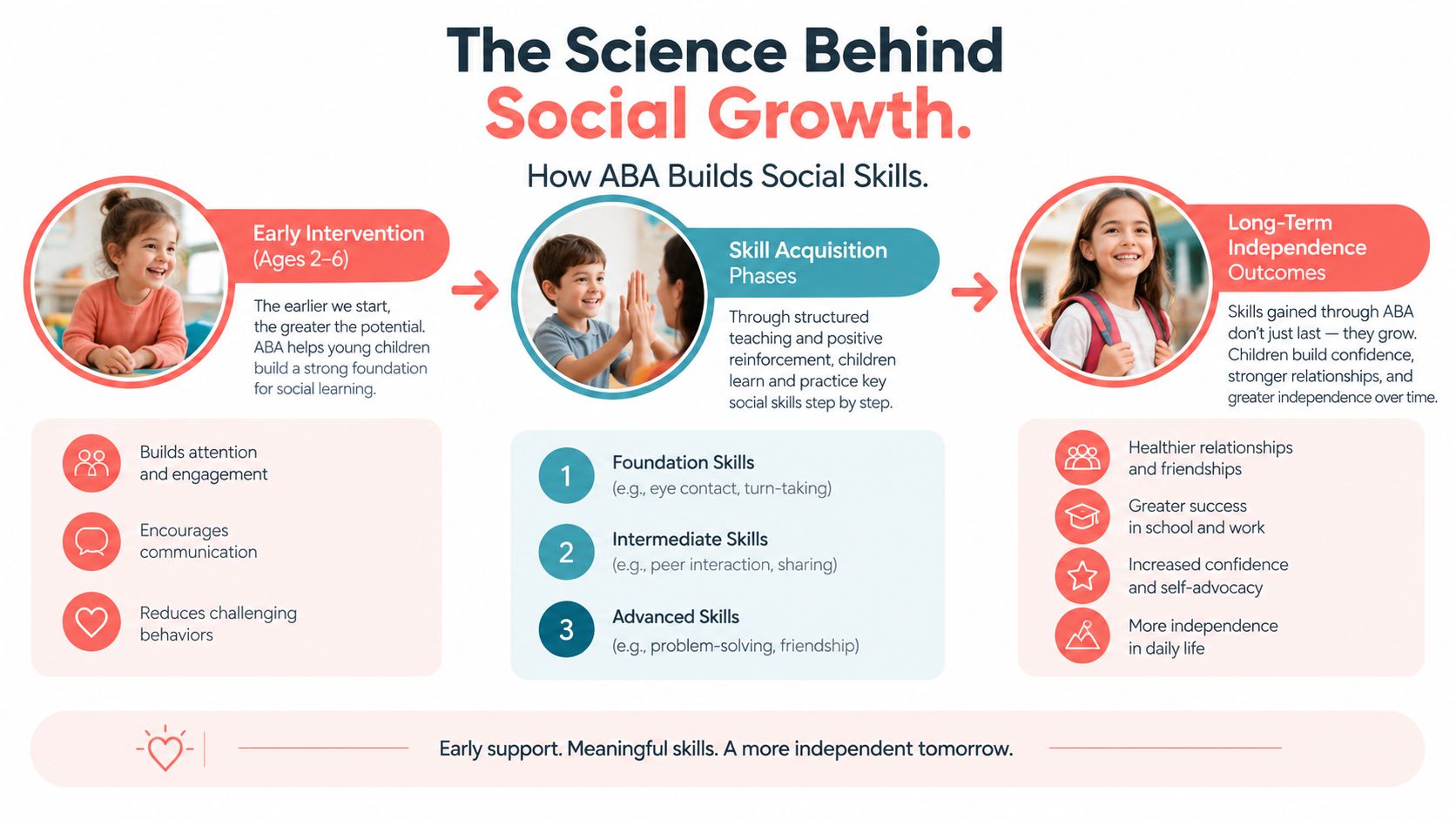
Let's use one example: your child is learning to start a conversation with a peer during a shared activity. The team won't expect your child to master the entire interaction at once. The BCBA may break it into noticing a peer, moving closer, using an opening phrase, listening to the response, and continuing for another exchange.
Modeling shows the action
The therapist first demonstrates the target. They might walk toward a peer, pause, and say, “What are you building?” Your child sees the words, body position, timing, and tone together.
Modeling can also use a peer, sibling, short video, picture sequence, or written script. The point is to make the expected behavior visible instead of relying on a verbal instruction such as “go talk to someone.”
Prompting provides just enough support
Your child may not respond independently right away. A therapist might begin with a gentle verbal cue, such as, “Ask what they're making,” or point toward the peer. If needed, the therapist may offer a more direct prompt.
A thoughtful program uses prompts that can fade. The team may move from a full verbal model to a partial phrase, then to a visual cue, and eventually to a pause that allows your child to initiate without help. Prompting should support independence, not create a permanent dependence on adult reminders.
Reinforcement makes practice worth repeating
When your child attempts the conversation, the therapist responds promptly and meaningfully. That could be specific praise, access to a preferred game, an opportunity to choose the next activity, or the natural reward of continuing an enjoyable interaction.
“Good job” is less useful than feedback connected to the action: “You asked what Maya was building, and she answered you.” The team should learn what your child actually values rather than assuming every child is motivated by the same reward.
Role-play lowers the pressure
Role-play lets your child rehearse before facing a less predictable moment. The therapist may pretend to be a peer, switch roles, or introduce a small change, such as giving a short answer instead of starting a long conversation.
The therapist can then provide immediate feedback and another opportunity. Errors aren't treated as failures. The adult adjusts the prompt, makes the step smaller, or changes the context so your child can experience a successful attempt.
Data keeps the plan honest
The therapist can record whether your child initiated, responded, needed a prompt, or continued the exchange. Data doesn't have to interrupt the interaction. It gives the BCBA information for deciding whether to keep practicing, change the prompt, vary the activity, or choose a different target.
A careful ABA assessment process combines direct observation with caregiver information and structured tasks. For parents, the important question is simple: can the team explain what skill is being taught, how independence is measured, and how your child's experience influences the next step?
Group Sessions, Individual Sessions, or Both
Individual and group sessions solve different problems. Choosing between them isn't a test of your parenting or a permanent decision about your child's care.
| Format | Individual Sessions | Group Sessions |
|---|---|---|
| Main setting | One child with a therapist | Several children with trained staff and peers |
| Primary value | Focused teaching, predictability, and close observation | Practice with real peer responses and shared activities |
| Common targets | Foundational communication, responding, coping with changes | Sharing, conversation, perspective-taking, cooperation, and friendship behaviors |
| Often useful for | Children new to social skills work or children who need a quieter starting point | Children ready to practice skills with peers in a supported setting |
| Parent experience | More detailed feedback on specific teaching steps | Feedback about participation, flexibility, and peer interaction |
Individual work can be a comfortable entry point for a child who becomes anxious around unfamiliar peers. The therapist can identify strengths, build trust, and practice a skill without the extra unpredictability of a group. A child might learn how to ask for a turn with an adult before trying that same phrase with another child.
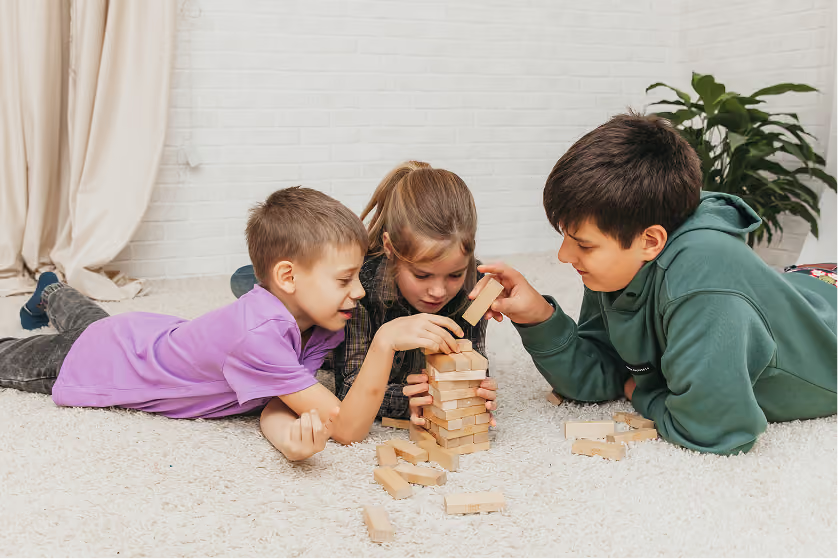
Group work adds something individual practice can't fully recreate. A peer may answer unexpectedly, change the rules, decline an invitation, or introduce a new idea. Staff can support the interaction while allowing children to experience the natural give-and-take of play.
“The right format can change as the child's confidence, communication, and tolerance for unpredictability change.”
FriendlyABA may combine both formats by building foundational skills individually and then adding supported group practice. A child might rehearse joining a game in a one-to-one session, practice it with a familiar peer, and later try it during a larger activity. The sequence should be individualized rather than based on an assumption that every child needs the same number or type of sessions.
A 2024 systematic review of social skills programs for autistic adolescents included 18 studies and reported an adjusted medium overall effect on socialization outcomes, g = 0.60, p < 0.001, while also noting that most programs had medium-to-low fidelity. The review in Frontiers in Psychiatry offers useful context for parents: positive results can occur, but implementation quality and fit matter.
A Real Session, Minute by Minute
Consider a session focused on turn-taking during a board activity. The exact schedule will vary by child and provider, but a well-organized session usually has a clear purpose even when it feels playful.
Arrival and connection
During roughly the first ten minutes, the therapist welcomes your child, checks in about the day, and reviews a visual schedule. The child may choose between two warm-up activities, play with a familiar toy, or talk about a preferred interest.
This opening helps the therapist see how your child is feeling and creates a predictable transition into learning. If your child arrives tired or upset, the team may adjust the pace rather than pushing immediately into a difficult demand.
The target becomes visible
The therapist introduces the turn-taking goal in plain language: “We're going to practice giving the game piece to the other person when your turn is finished.” They may demonstrate one round, use a visual card that says “my turn” and “your turn,” or narrate the sequence aloud.
If your child holds onto the piece, the therapist doesn't need to turn the moment into a correction. They can use the least support needed, perhaps pointing to the “your turn” card or saying, “Pass it to Sam.” When your child passes the piece, the therapist reinforces the action and keeps the game moving.
Practice includes ordinary mistakes
The role-play or game portion may include repeated turns, mild changes, and natural pauses. Your child might have to wait, accept another player's move, or ask for help when the rules become confusing.
The therapist gathers information while the activity continues. They may note whether your child waited independently, needed a prompt, responded to a peer, or returned to the game after a mistake. This is not a formal exam with a pass-or-fail score. It's a way to understand which part of the interaction is becoming easier and which part still needs support.
The caregiver debrief
At goodbye, the therapist should share a concise handoff. You may hear that your child passed the piece independently during familiar turns but needed help when the peer changed the order. The team might suggest one home practice, such as using a simple card game after dinner and praising the child for noticing whose turn comes next.
A useful debrief includes:
- One success: What did your child do with less support?
- One challenge: Which part of the interaction remained difficult?
- One home idea: What can you practice naturally without turning the evening into another therapy session?
Guided interaction should feel different from testing. Your child may laugh, pause, make mistakes, ask for a break, and try again. Those moments give the therapist information while preserving the relationship and the child's dignity.
Getting Skills to Travel Beyond the Therapy Room
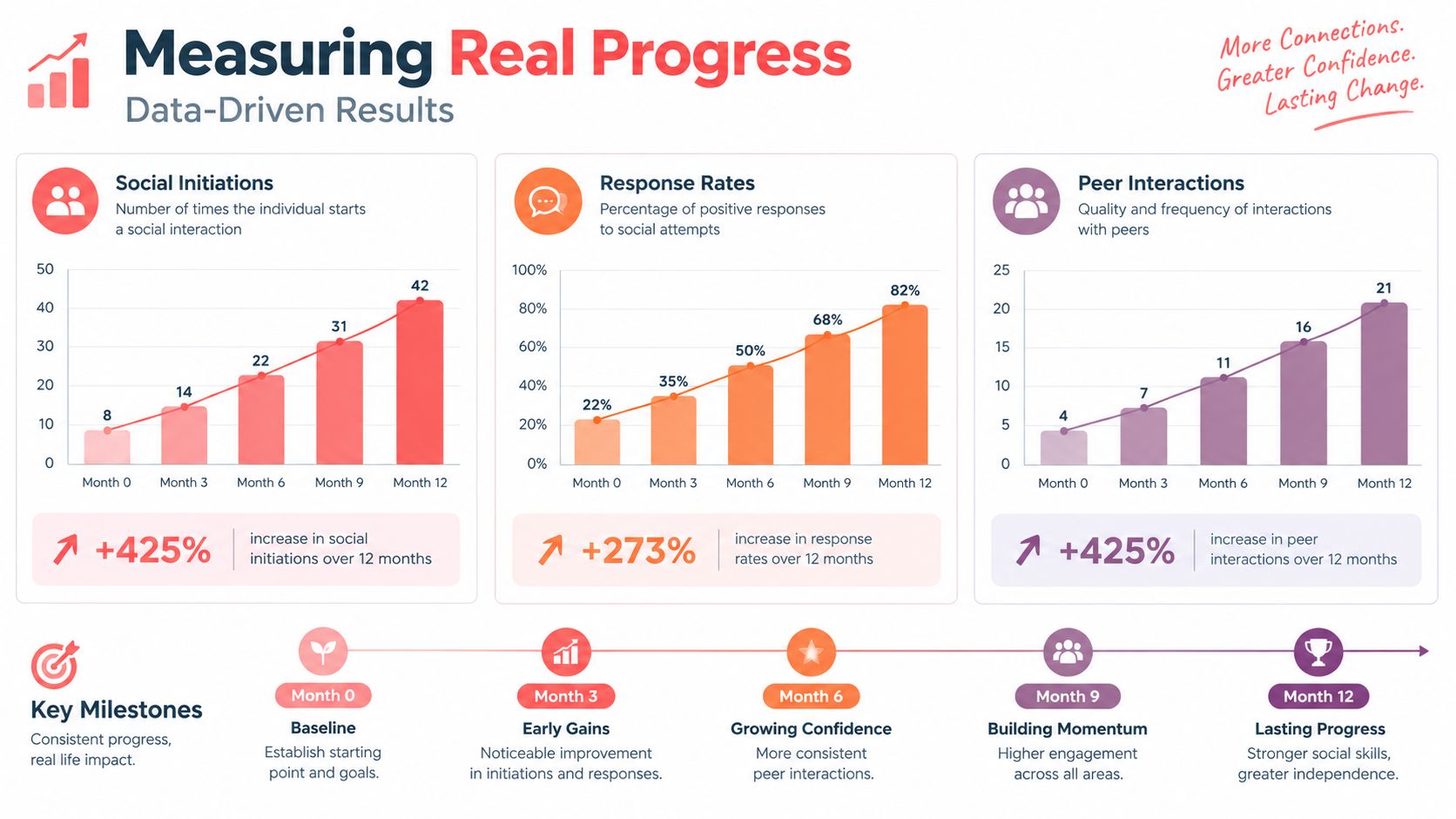
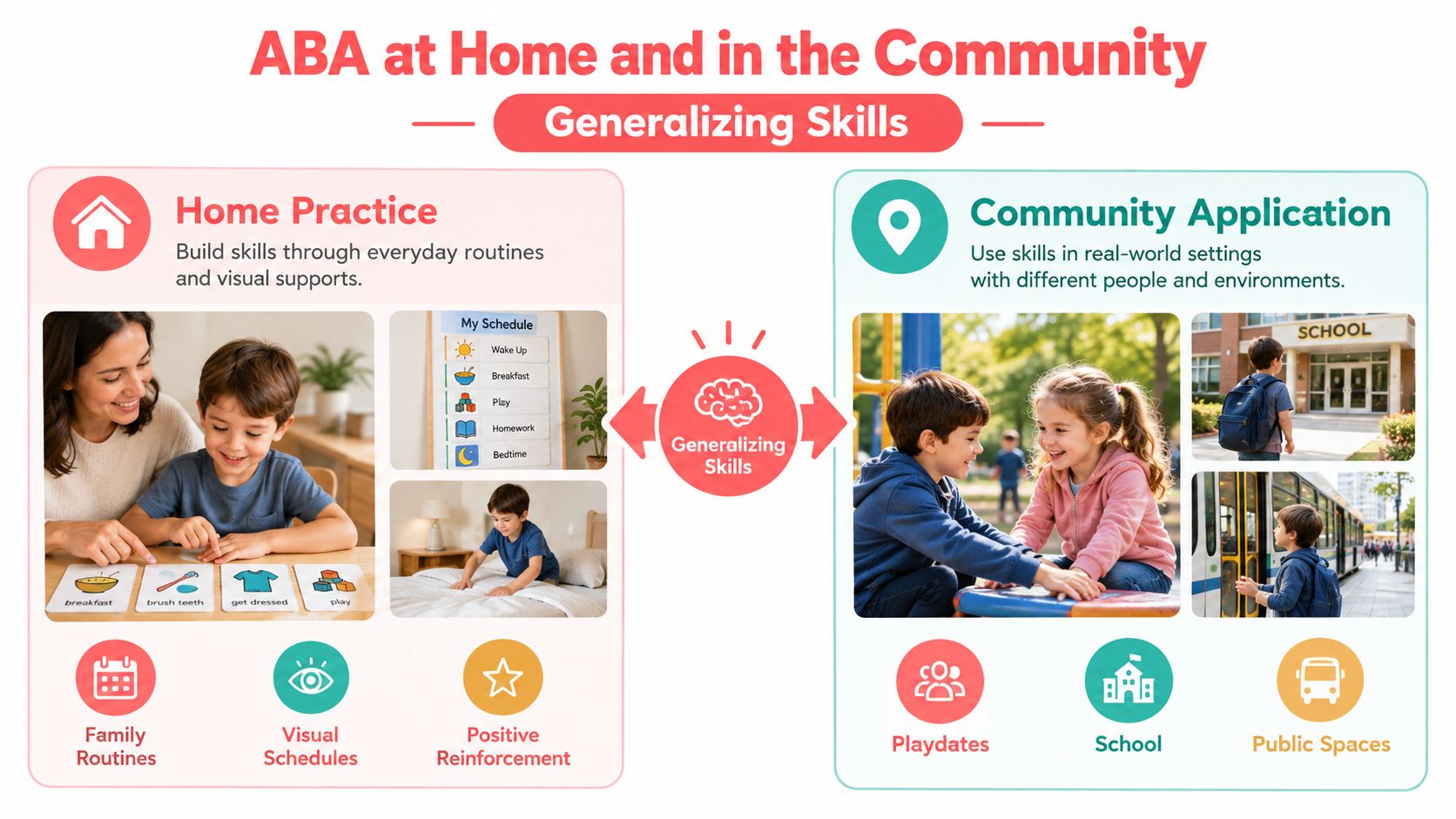
Your child may greet a therapist in a quiet room, then hesitate when a cousin approaches at a noisy family gathering. That difference is common. Generalization means using a learned skill with different people, materials, settings, or times, and it usually needs deliberate practice.
A review of ABA-focused research reported that, across 32 completed studies, generalization was trained in 23 and tested in 27. Generalization was observed for 87 of 103 participants, while maintenance was documented in only 19 studies. The ABAI review summary supports a practical lesson for families: learning a skill and using it in daily life are connected, but they are separate goals.
How the BCBA plans for transfer
The BCBA may check the skill with:
- People: A familiar therapist, another staff member, a sibling, teacher, or peer.
- Places: The therapy room, home, school, playground, or another community setting.
- Materials: Different games, toys, conversation topics, and visual supports.
- Time: During teaching and again after the skill seems established.
The team may teach several examples rather than repeat one script. “Can I play?” might be practiced during building, pretend play, and a playground routine. Your child learns the purpose of joining, not only one memorized exchange. In practice, the therapist might change the game, invite a new person, or pause long enough for your child to try without immediate help.
Parents provide the bridge
Caregiver coaching turns a treatment target into an ordinary family routine. At snack, you might model asking a question and waiting for the answer. In the car, you might rehearse a phrase your child wants to try at a family gathering. During a playdate, watch for a natural opening instead of prompting every part of the interaction. Our guide to helping children handle social situations with confidence offers ideas for setting up these moments.
Your role is less like running another therapy session and more like carrying a familiar tool into a new room. Notice an opportunity, offer only the support needed, and let your child take the next turn. Teachers can use the same approach during recess, group work, arrival, and transitions, with shared visual supports and consistent language.
The need for this planning appears in recent reviews. One review reported that only 5 of 24 primary-school studies assessed follow-up, with mixed maintenance findings. A 2025 review found strong baseline-to-generalization comparisons but much smaller differences when intervention was compared with true generalization phases. The 2025 review on ABA and social-communicative abilities points families toward a useful question: how will the team check that skills travel, not only teach them?
Who Benefits, When, and What to Keep in Mind
Parents often ask, “Will this help my child?” A responsible answer starts with assessment, not a promise. Social skills training may be considered for children with autism, and families may also ask about it when a child has ADHD, social anxiety, or pragmatic language differences. Those labels alone don't determine fit.
The useful questions are more personal. What does your child already communicate? Which situations are enjoyable, confusing, or exhausting? Does anxiety make peer interaction harder? Does your child want to join other children, or are adults assuming that they should? A strong plan considers age, communication skills, co-occurring needs, culture, interests, and the child's own perspective.
Meaning matters
Teaching eye contact or small talk as an automatic checklist can miss the reason social connection matters. A child who loves trains may be more willing to practice conversation when the first exchange involves a shared train set. Another child may prefer parallel play, written communication, movement, or a quieter interaction.
The goal should support participation and self-advocacy. That may mean learning to say “not now,” request a break, explain a preference, ask for clarification, or find a peer who shares an interest. Social competence isn't the same as performing every expected social behavior on demand.
Listen for the child's answer in behavior. Increased withdrawal, distress, or refusal may signal that the target, pace, prompt, or setting needs adjustment.
Evidence also points to the importance of individual differences. A 2025 review recommends choosing goals and strategies according to age, sex, comorbidities, strengths, weaknesses, culture, the child's perspective, and self-advocacy. A pilot trial of an adapted school-based autism social skills program reported meaningful anxiety effects in adolescents and recommended age-appropriate tailoring and mental health monitoring. The 2025 record for this intervention research is a reminder that emotional well-being belongs in progress conversations.
Progress rarely follows a straight line. A child may greet a peer during a structured game but not at a noisy birthday party. They may learn to ask for a turn, then need support when someone says no. The BCBA should review the data, talk with you, and adjust goals instead of treating a fixed checklist as the final definition of success.
One small video-group study described in a broader review involved four adolescents ages 13 to 16, with two sessions per week for three months, and reported major increases in target social behaviors across social domains. The review of ABA research on social communication and theory of mind is one example of structured teaching, not a guarantee that every child will respond in the same way.
Questions, New Home, and Next Steps for Your Family
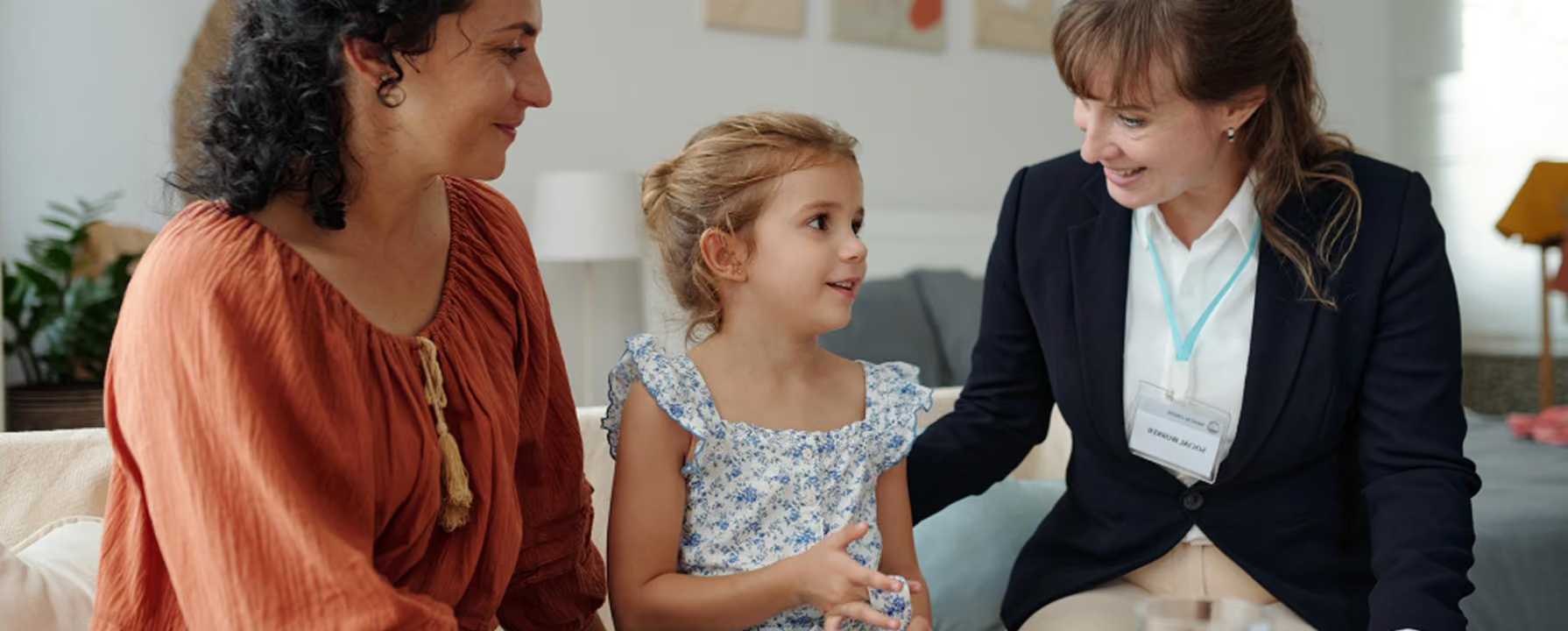
A consultation should feel like a conversation about fit, not a sales presentation. Bring examples from ordinary life, including moments that went well, moments that ended in frustration, and situations your child avoids or seeks out.
Questions to bring to a consultation
Ask the BCBA:
- How will you assess my child's current social strengths? Look for direct observation, caregiver input, and attention to the settings where concerns occur.
- How will goals be written and reviewed? A useful goal should describe a meaningful, observable action rather than a broad label.
- How will therapy connect with home and school? Ask what the session-to-home handoff includes and whether teachers or other caregivers can use shared supports.
- How will you measure progress? Data can include independence, prompting, participation, caregiver observations, and performance across settings, not only a checklist.
- How will you decide between group and individual sessions? The answer should reflect your child's communication, comfort, strengths, interests, and current opportunities.
- How will my child's preferences shape the plan? Your child's interests and feedback should influence targets, materials, reinforcement, and pacing.
- How will you monitor stress? Ask how the team will notice anxiety, fatigue, avoidance, or distress and what adjustments are available.
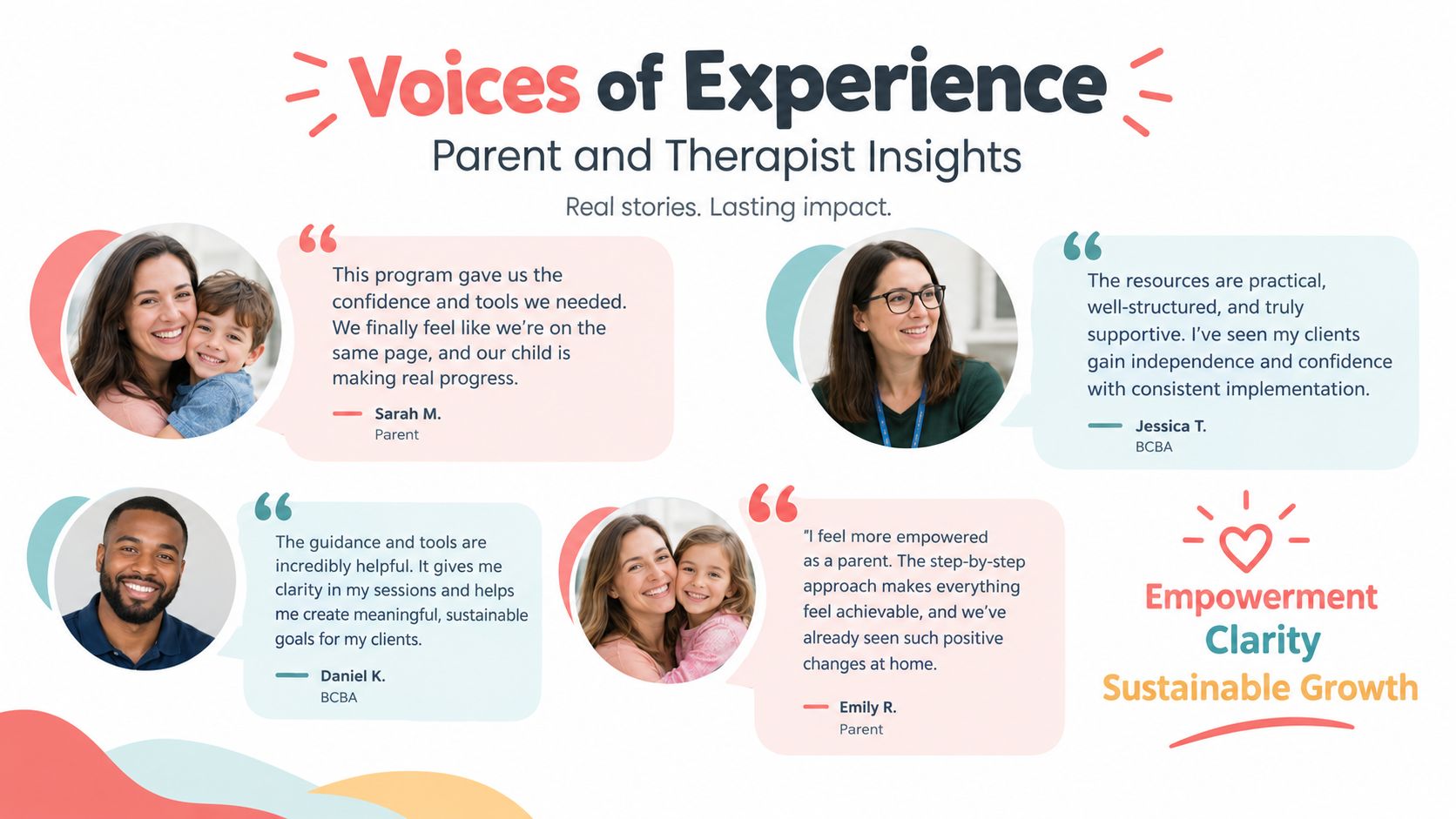
Parent-mediated ABA programs commonly include education about autism, ABA principles, behavior management, communication, and teaching new skills through natural environment training. A systematic review identified six parent-training studies, and one included program found that therapist-assisted parent support could improve parent-reported social skills. The review of parent-mediated ABA interventions supports asking for coaching that is practical and connected to your family's routines.
Small practice at home
Choose one target, not every skill at once. Narrate your own social moves during a routine: “I'm waiting until Grandma finishes talking, then I'll ask my question.” Before a family gathering, script two or three phrases your child may want to try, such as “Can I sit with you?” or “What are you playing?”
Keep practice brief and natural. Notice attempts, offer help when needed, and share both successes and stumbles with the clinical team. Your observations can help the BCBA adjust the prompt, setting, materials, or target before frustration builds.
Starting a conversation with FriendlyABA doesn't commit your family to a particular schedule or service. You can ask about assessment, individualized social skills development, home and school coordination, caregiver coaching, fit, timeline, and funding, then take the time you need to decide.
FriendlyABA offers individualized ABA support through BCBAs and trained therapists, including social skills development, caregiver coaching, and practice across home, school, and community routines. Visit FriendlyABA to start a no-pressure conversation about how social skills training could fit your child and your family.
Our Latest Insights








You don't have to figure it out alone
Whether you're exploring ABA therapy for the first time or searching for a provider who truly feels like the right fit, we're here to help.