


What Is Generalization in ABA? a Parent’s Guide
What Is Generalization. Learn what generalization in ABA means for your child. Discover types, why it matters, and practical strategies

Your child says “water” at therapy, and you feel that little rush of relief. Then you get home, ask for the same word at dinner, and nothing comes out. Or maybe your child uses a picture card beautifully with one therapist, but freezes when Grandma offers the snack.
That gap is exactly where generalization matters. In ABA, it means a learned skill shows up outside the exact teaching moment, with new people, in new places, or with new materials. It's the difference between a child repeating a skill during practice and using it in daily life, which is what families usually care about most. ABA terminology defines generalization as behavior learned in one context appearing in a different, untrained context, and that idea sits at the center of meaningful progress.
Table of Contents
Understanding Generalization in ABA Therapy
A child can look like they've “got it” in therapy and still not use the skill anywhere else. That's the part that can feel confusing for parents, because mastery in one room doesn't always mean the skill is functional at home, school, or in the community. Generalization is the bridge between practice and real life.
What changes when generalization happens
In ABA, a child might learn a request with one therapist, one table, one set of toys, and one routine. Generalization means that same child can use the skill with a parent, a teacher, or a peer, and can do it across different settings and materials. A child who asks for a snack during therapy may later ask for help in the kitchen, at recess, or during homework time.
That transfer doesn't happen by accident as often as people hope. Older ABA practice sometimes leaned on a “train and hope” approach, but research-oriented practice moved away from assuming skills would automatically travel. Families usually need a plan for where the skill should show up, who should be part of practice, and what everyday cue will remind the child to use it.
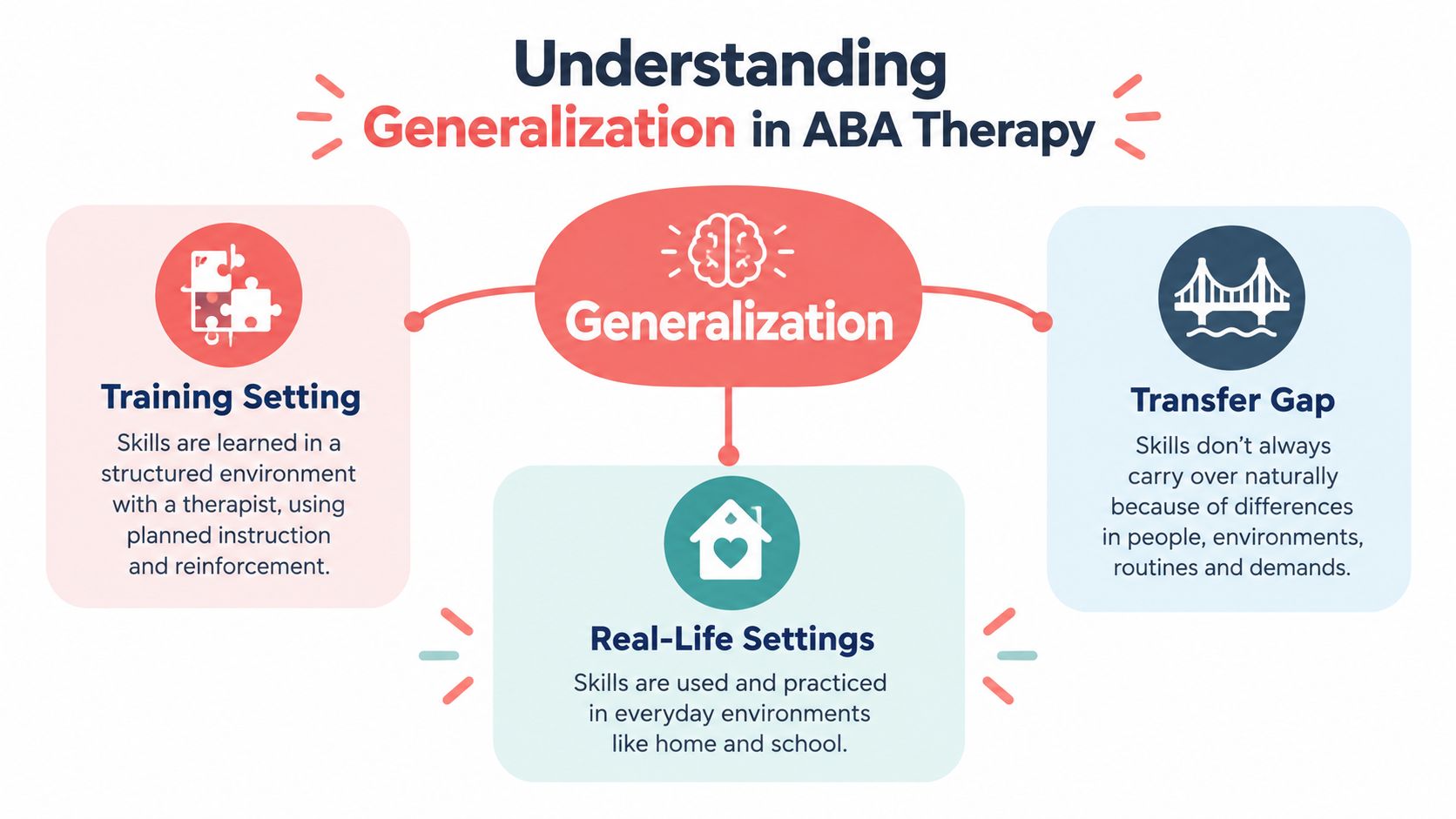
Practical rule: if a child can do the skill only when the therapist is standing right there, it's not fully generalized yet.
Why parents often misread early success
Parents understandably celebrate the first correct response. That matters, but it's only the starting point. The key question is whether the child can use the skill when the teaching setup changes, because that is what makes the skill useful outside therapy. A BCBA, which is a behavior analyst who designs and oversees the plan, should help define those real-world checks clearly.
Three Types of Generalization Explained
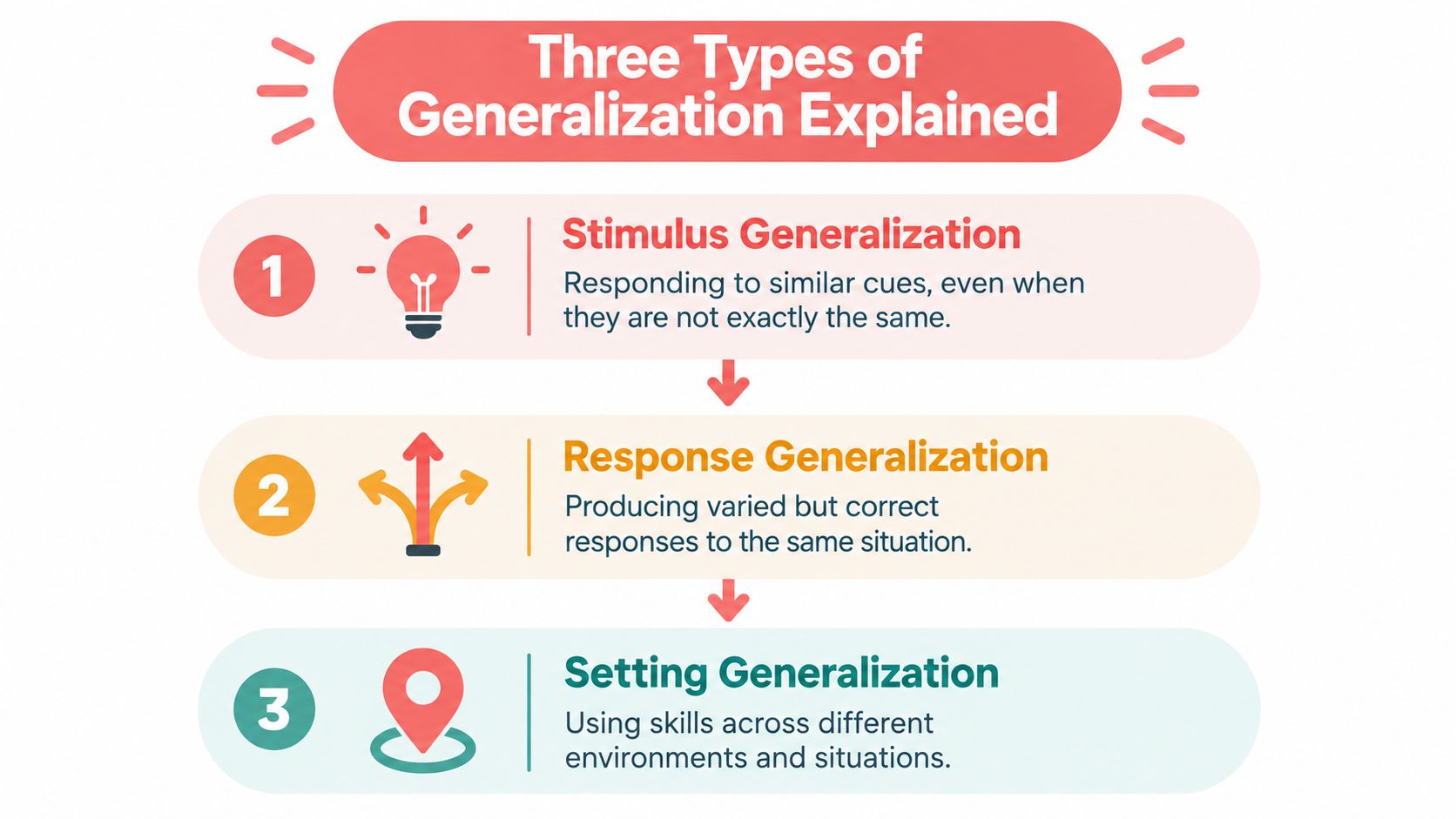
Generalization isn't one single thing. It shows up in different ways depending on what changes between practice and real life, and that's why a child may generalize one skill quickly but need more help with another. Thinking in categories helps parents stop guessing and start observing.
Stimulus generalization
This happens when a child responds to something similar, not identical. A child who learns to identify a dog from one photo may later recognize dogs in a book, in a cartoon, or in the neighborhood. The cue changed a little, but the meaning stayed close enough for the skill to carry over.
Response generalization
This means the child uses a different but still useful behavior. If a child learns to request water, that request might come out as speech, a sign, a picture card, or an AAC device. The form changes, but the purpose stays the same.
Setting generalization
This is the everyday meaning most parents mean when they ask about generalization. The child uses the skill across places, people, and routines, such as at home, school, or in the community. A request that works with one therapist but not with a parent or teacher still needs support in setting generalization.
A good question to ask is not “Did my child learn it?” but “What changed when we tested it?”
Why Generalization Matters for Your Child
A child may answer correctly in therapy and still miss the same skill at home, at school, or in the community. That gap matters because daily life does not happen in one calm room with one person and one set of materials. Generalization is what makes a learned skill useful where your child actually needs it.
Research reviews show that generalization is often measured less often than the skill itself. A critical review of 491 single-case studies in the Journal of Applied Behavior Analysis from 2003 to 2012 found that 85 studies reported generalization probes, about 17% of the studies reviewed, according to a critical review summarized in a graduate thesis (source). A broader evidence synthesis of 770 autism-intervention study records found that only 31% included any generalization measure, with rates varying by outcome area from 39% for language and 46% for social and communication outcomes, down to 24% to 29% for problem behavior, adaptive behavior, and cognition. If no one checks transfer, it is easy to mistake practice performance for real-world use.
What that means in plain language
A child can answer a question during a session and still not use the same skill with a sibling later. A child can practice a self-help step at the table and still need help in the bathroom. Families feel that difference right away, because useful behavior has to show up in the places where life happens.
ABA teams should plan for this from the start by teaching across people, places, materials, and routines, then checking whether the skill still works when those pieces change. Parents can test it in clear ways: does the child use the skill with a parent as well as a therapist, in the kitchen as well as the clinic, and with new materials as well as the practice set? Generalization is a measurable skill, not a vague hope. The goal is reliable use of the skill across daily life, and sameness of performance is secondary.
Strategies to Promote Generalization
The good news is that generalization can be planned. Families don't have to wait and hope, they can build it into the way a skill is taught and practiced. A BCBA can help shape this, and the home plan can make the difference between one-room learning and everyday use.
Five practical moves that help
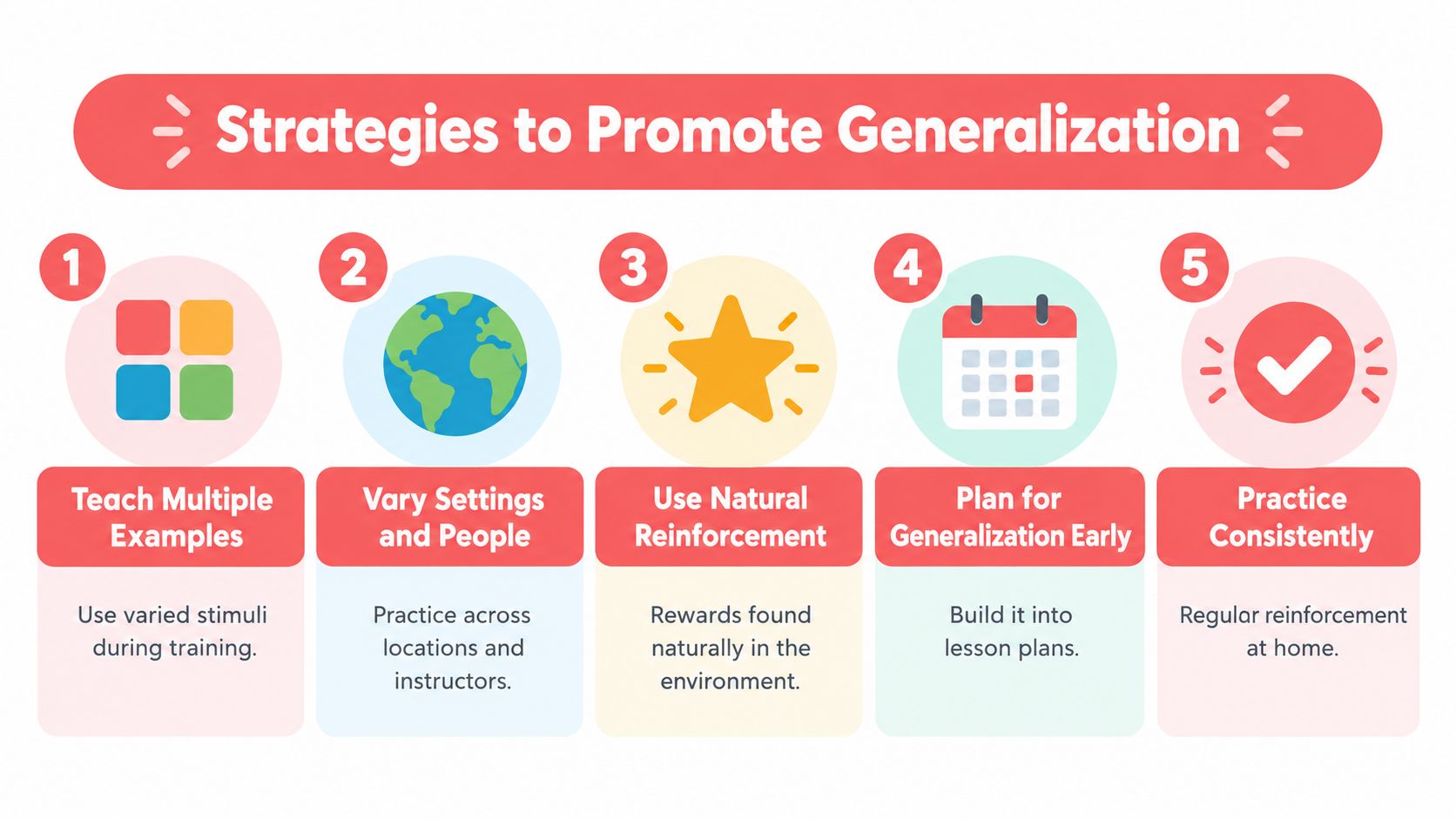
- Teach Multiple Examples. Use several versions of the same skill, not one frozen script. If your child is learning animals, practice with photos, toys, books, and real-life examples.
- Vary Settings and People. Try the skill with a therapist, then a parent, then another familiar adult, and do it in more than one room or setting.
- Use Natural Reinforcement. Let the reward fit the moment, like getting the snack, help, break, or toy the child asked for.
- Plan for Generalization Early. Don't leave transfer as an afterthought. Put it into the goal from the beginning.
- Practice Consistently. Short, regular practice in daily routines usually works better than waiting for a big test.
How this looks in a real family routine
A child learning to ask for help can practice during play, at snack time, and during cleanup. The same basic request can be used with different adults so the child learns the skill is useful, not just tied to one person. If the child is learning a communication goal, the teaching plan should also match the family's daily life, which is why functional communication training often pairs well with generalization work.
Generalization Across People, Places, and Materials
A strong generalization plan changes more than one thing on purpose. If the person stays the same, the room changes. If the room stays the same, the materials change. The point is to see which part helps the skill hold up, and which part still needs practice.
| Dimension | Example | How to Support It |
|---|---|---|
| People | A child requests help from a parent after learning it with a therapist. | Practice with different caregivers, teachers, and familiar adults. |
| Places | The same self-help skill works at home, at school, and in the community. | Rehearse in more than one setting, not only in the therapy room. |
| Materials | A child identifies a dog in a photo, a book, and a real-life setting. | Rotate toys, pictures, objects, and everyday items. |
| Routines | The child greets someone during arrival, mealtime, or transition. | Build the skill into daily moments instead of isolated drills. |
That table sounds simple, but it helps families ask better questions. If a child can request juice with one adult but not another, the team knows exactly where the next teaching step belongs. If the skill works with one set of materials but not another, the materials need to vary more during practice.
For families thinking about peer interaction, this logic matters in social skills training too, because a child who chats during therapy still has to manage real back-and-forth with different kids in different places. The more clearly you define who, where, and with what, the easier it is to see progress truthfully.
Common Misconceptions About Generalization
One of the biggest myths is that learning automatically carries over once a child masters a skill. In reality, transfer often needs to be taught and checked. If no one programs for it, the child may keep the skill tied to the original therapist, room, or cue.
Another myth is that a child with autism either generalizes or doesn't. The evidence points to something more practical, which is that generalization is skill-specific and depends on how it's taught and measured. Some skills transfer more easily than others, and some need more structured practice across different conditions.
What to watch for instead of assumptions
A single successful probe doesn't prove independence everywhere. It only shows that the child used the skill in that one test condition. Parents get a more accurate picture when the team checks more than one person, more than one setting, and, when possible, more than one routine.
Don't let one good day become the whole story.
That mindset protects families from false confidence and from unnecessary disappointment. It also pushes the therapy team to build plans that are more realistic and more useful.
How to Support Generalization at Home
You don't need to be a therapist to help your child carry skills into daily life. Small, steady practice in ordinary moments can do a lot. The key is to make the practice look like real life, not like another drill session.
Start by asking your child to use a skill with a different family member. Then try it in a different room, and later during a different routine, like meals, getting dressed, or play. If the skill only works in one place, the home plan still needs variety.
A simple way to understand it:
- Change the person: let a sibling, grandparent, or other caregiver prompt the skill.
- Change the place: practice in the kitchen, bedroom, yard, or car.
- Change the moment: use the skill during snacks, transitions, or cleanup.
- Use a real payoff: give the child what naturally fits the request, such as help, attention, or the item they asked for.
If your child is already getting parent coaching, FriendlyABA's parent training support fits neatly into this kind of home practice because it focuses on everyday use rather than isolated repetition. Ask your team which routines are best for practice and how you'll know the skill is showing up outside sessions.
Working With Your ABA Team on Generalization
Generalization works best when the team treats it as part of the goal, not a bonus. During assessment and treatment planning, ask which people, places, and materials will be part of practice. Ask how the team will measure the skill in settings that differ from therapy.
A strong ABA program should also include caregiver coaching and natural-setting work, because skills are more likely to stick when they're practiced where they're needed. FriendlyABA uses home-, school-, and community-based service options, so the same goal can be practiced in the places where your child lives their day. That kind of structure supports transfer without turning every moment into formal therapy.
Questions worth asking your BCBA
- Where will this skill be checked besides therapy?
- Who else will practice it with my child?
- How will we know if the skill works with new materials or routines?
- What happens if the child can do it here but not there?
Those questions keep the plan honest. They also help you spot whether the team is measuring real-life use or only session performance.
FriendlyABA is one option for families who want ABA therapy built around home, school, and community routines, with BCBAs and therapists who can plan for transfer from the start. If you want help turning generalization into something you can see and track, visit FriendlyABA to book a consultation and talk through your child's goals.
Our Latest Insights


You don't have to figure it out alone
Whether you're exploring ABA therapy for the first time or searching for a provider who truly feels like the right fit, we're here to help.