


A Total Approach to ABA Therapy: A Whole-Child Guide
Discover what a total approach to ABA therapy means for your child. Learn how whole-child, family-centered ABA builds real-world skills.

Some mornings tell you more about a child's support needs than any worksheet ever could. A parent is packing lunch with one hand, holding a shoe with the other, and trying to keep the day from sliding off the rails before 8 a.m. Their child is upset because the cereal looks different, a sibling is too close, and turning off a favorite video feels impossible. Nothing about that moment is “just behavior.”
It's communication. It's flexibility. It's coping. It's daily living. It's family stress, all happening at once.
That's why a total approach matters in ABA. When support only focuses on one behavior in one room, families often end up asking the same painful question later: “Why can my child do it in therapy, but not here?” The work is helping skills hold up in kitchens, car rides, classrooms, and grandparents' homes, with real people and real noise and real life.
Table of Contents
- The Old Model Versus the Real-Life Model
- Caregiver Coaching Isn't Extra
- Family Priorities Belong at the Center
- Five Domains in a Total Approach
- What These Domains Look Like in Real Life
- The Overlap Is the Whole Point
The Morning That Made Me Rethink Therapy
I still think about the breakfast rush that so many parents describe almost word for word.
A child is watching a preferred show while a parent tries to move the morning along. The lunchbox isn't zipped. One sock is missing. A younger sibling is tugging at a sleeve. Then the cereal brand is different, or the spoon isn't the usual one, or someone says, “Time to put on shoes,” and suddenly the whole morning blows open.

It's Not Five Separate Problems
Parents often get handed these moments as separate items.
One concern is transition difficulty. Another is food rigidity. Another is sibling conflict. Another is trouble following directions. Another is emotional regulation.
But at the kitchen-table level, those aren't separate. They're one connected picture of a child who may need help with several skills at the same time.
- Transitioning off something preferred asks for flexibility and trust.
- Trying a different breakfast may involve sensory tolerance, communication, and coping.
- Managing a sibling nearby touches social awareness and emotional regulation.
- Getting dressed and out the door depends on routines, attention, and daily living skills.
When I started looking at mornings this way, it changed how I thought about therapy. If we teach “sit nicely at a table” but the family still can't get through breakfast, then we haven't helped enough.
The hard part of daily life usually isn't one isolated skill. It's several small skills colliding in one ordinary moment.
A Wider Lens Helps More
The idea of a whole-child model didn't appear overnight. A major early milestone was Leo Kanner's 1943 paper describing 11 children with what became the first widely recognized clinical description of autism as a distinct childhood disorder. Over time, autism care moved away from parent-blame models and toward coordinated support, and by the 2000s integrated programs were intentionally combining speech-language therapy, occupational therapy, educational support, and family support, with intervention started as early as possible. That broader view also shows up in current ABA guidance, where ABA is described as addressing multiple developmental domains, including cognitive, communicative, social, emotional, and adaptive functioning, as summarized in this overview of autism care and comprehensive ABA.
That's the heart of a total approach. We don't just ask, “What happened during the session?” We ask, “What would make this whole morning easier for this child and family?”
What a Total Approach Really Means
A total approach means we look at the whole child, not just the loudest challenge.
That includes communication, social connection, emotional regulation, self-care, attention, flexibility, and the practical routines that make daily life work. In plain language, we're not trying to win one therapy moment. We're building skills that fit into the child's actual life.
The Old Model Versus the Real-Life Model
Older therapy thinking often leaned too hard on isolated performance. A child could answer correctly at a table, with the same therapist, the same materials, and the same instructions every time. Then the family would go to the grocery store or a birthday party, and the skill would seem to disappear.
That's one reason single-skill, drill-only work has fallen out of favor. A child doesn't live at a therapy table. Your child lives at home, in school, in the car, in waiting rooms, and around people who don't all sound or respond the same way.
A total approach asks better questions:
- Where does this skill break down most often
- Who is usually there when it happens
- What support would help the child use the skill outside therapy
- Which goals matter most to the family right now
Caregiver Coaching Isn't Extra
Parents sometimes think coaching is an optional add-on. It isn't. It's part of the plan.
If your child spends far more time with family than with a therapist, then family routines are where learning has to stick. Research on caregiver-implemented ABA has helped make that clear. In a randomized clinical trial of a virtual parent training program, the treatment group showed large, statistically significant improvements across all dependent measures while the waitlist group did not. A separate 12-week ABA parent-training program also reported that parents felt more positive about their experiences and competencies over the course of training, as discussed in this review of caregiver training in ABA and school-linked supports.
Practical rule: If a plan only works when the therapist is in the room, the plan is too small.
Family Priorities Belong at the Center
The tone of therapy matters. A strong BCBA, which means Board Certified Behavior Analyst, doesn't walk in with a generic program and start checking boxes. They learn what matters to your child and what's wearing your family out.
For one family, that's mealtime. For another, it's getting through the school drop-off. For another, it's helping a child tell a sibling, “I need space,” instead of hitting. The goals may look different, but the philosophy stays the same. The plan should match the child's profile and the family's real day.
The Five Domains a Whole-Child Plan Touches
When people hear “ABA,” they sometimes picture a huge, intimidating plan. It helps to shrink that idea into five familiar areas of life. These domains overlap, and that's exactly the point.
Five Domains in a Total Approach
| Domain | Sample Goal | Routine Where It Shows Up |
|---|---|---|
| Communication and language | Ask for a snack or a break with words, gestures, or a device | Breakfast, homework, car rides |
| Social and play skills | Join a sibling game for a short turn | After school, playground, family game night |
| Daily living and self-care | Complete part of the toothbrushing routine with less help | Morning routine, bedtime |
| Emotional and behavioral regulation | Use a calming strategy after disappointment | Losing a game, hearing “not now,” leaving a preferred activity |
| Cognitive or learning-to-learn skills | Follow a short routine and shift between tasks | Getting dressed, cleaning up toys, school transitions |
What These Domains Look Like in Real Life
Communication and language is more than talking. It includes requesting help, refusing safely, asking for a break, or telling you what hurts. A child who can communicate clearly often has fewer moments of confusion and less need to rely on distress to get a message across.
Social and play skills are the little building blocks of being with other people. That might mean waiting for a turn, noticing what another child is doing, or staying in a shared activity long enough for play to become enjoyable instead of overwhelming.
Daily living and self-care covers the routines families feel every single day. Shoes, brushing teeth, washing hands, sitting for a meal, getting into the car. These goals may not sound glamorous, but they often change household stress the fastest.
The Overlap Is the Whole Point
Emotional and behavioral regulation is the ability to recover, not the expectation that a child should never get upset. We look for ways to teach what the child can do when things go wrong, such as asking for space, waiting with support, or using a calming routine.
Cognitive or learning-to-learn skills include attention, flexibility, following routines, and responding to changes. These are often the hidden supports under many other goals. A child can't use communication well in daily life if they can't shift attention, tolerate small changes, or stay with a routine long enough to practice.
A thoughtful BCBA coordinates these domains so they reinforce each other. A child who learns to request “help” during toothbrushing is working on communication, regulation, and self-care all at once.
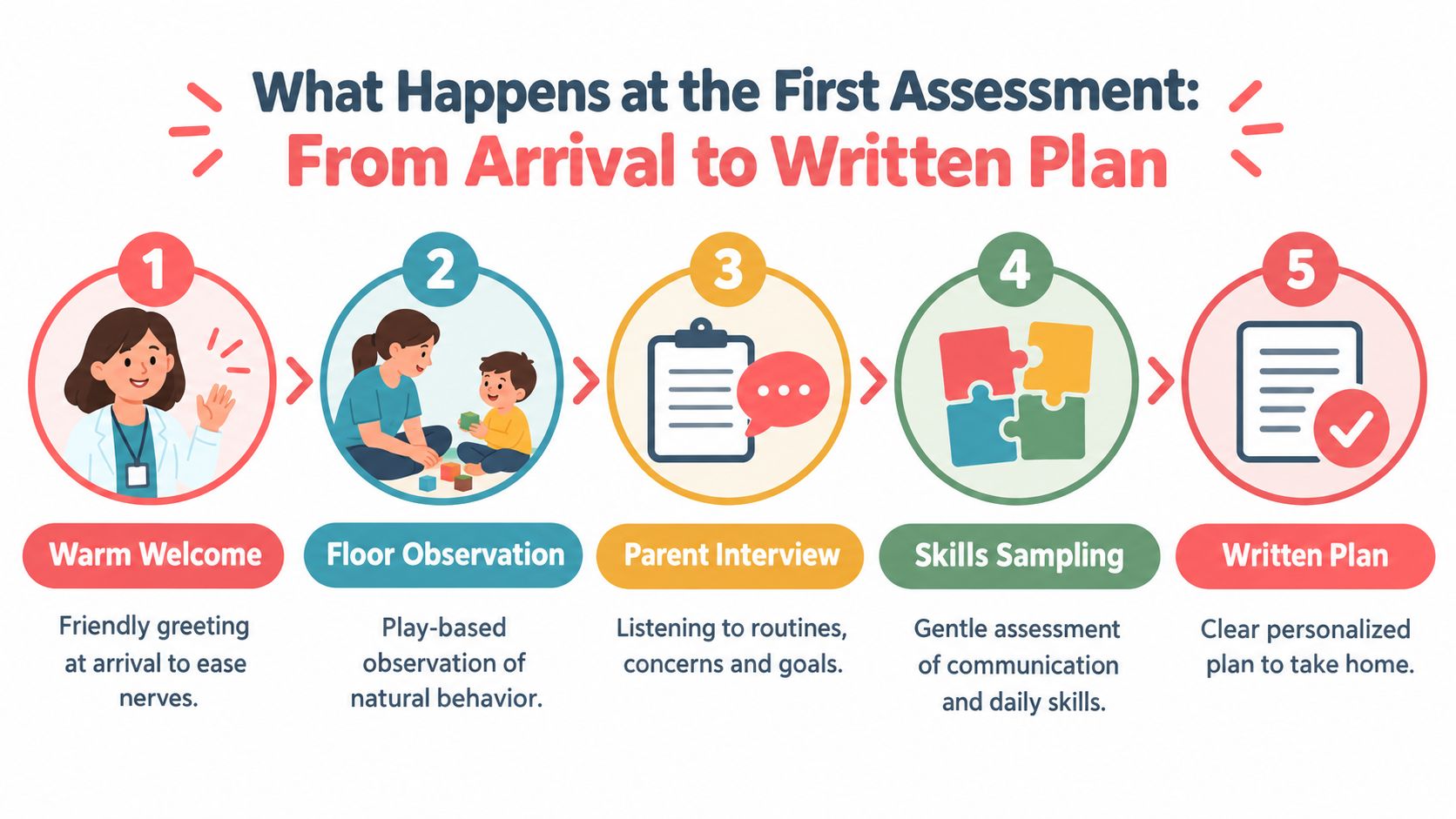
What Happens at the First Assessment
The first assessment feels big when you've never done one before. Most families walk in worried that their child will be judged, pushed too hard, or expected to perform on command. A good assessment shouldn't feel like that.
At the start, the clinician usually works to lower pressure. That often means getting on the floor, following the child's lead in play, and observing how they move through the room, respond to new people, and show interest in toys or activities.
What the Team Is Watching For
During the visit, the clinician is learning from two sources at once. One is your child's behavior in the moment. The other is your description of daily life.
Parents are often asked about:
- Sleep and routines such as bedtime, mornings, and transitions
- Communication patterns like how your child asks for things or shows distress
- Sensory or environmental triggers including noise, clothing, foods, or crowded spaces
- Strengths and interests from favorite toys to topics that light them up
- Recent changes such as regression, school stress, or new behaviors
Many providers also use structured tools such as the VB-MAPP, ABLLS-R, or Vineland-3 alongside open-ended observation. Those tools can be helpful, but scores alone don't tell you how a child solves problems in a kitchen, handles waiting at the front door, or responds when a sibling changes the game.
For a closer look at this process, parents can read what to expect during your first ABA assessment.
Later in the process, it can help to see the flow in motion.
What You Take Home
By the end, the goal isn't a pile of notes. It's a written roadmap with goals your family cares about.
That may include tolerating haircuts, asking for breaks, joining a sibling board game, improving transitions, or building morning routine independence. The final plan should feel recognizable. You should be able to say, “Yes, that's our child. Yes, those are our hard moments.”
At FriendlyABA, a provider's style becomes clear. Some teams stay broad and vague. Others build treatment plans around real routines across home, school, and community, with BCBA oversight and caregiver input from the start.
How Skills Travel From Session to Real Life
Maya is eight. In therapy, she learns to say, “I need a break,” during a task that feels frustrating. In the session, it looks great. She says it with the therapist, earns a short pause, and comes back ready to try again.
Then school starts on Monday. Her worksheet is hard, the classroom is louder than the therapy room, and she doesn't ask for a break at all. At Thanksgiving, grandma hugs too long, cousins are everywhere, and the same phrase never appears.
Doing It Once Isn't the Goal
That isn't failure. It's a reminder that generalization is the test.
A peer-reviewed discussion of natural environment teaching explains that this approach directly programs for generalization by using a variety of stimulus formats, settings, and people, as described in this paper on natural environment teaching and generalization. In everyday terms, a skill has to be practiced in more than one place, with more than one person, and under more than one kind of stress.
That's why a total approach doesn't stop when a child can do something in session.
What Cross-Setting Teaching Looks Like
A BCBA may teach the same core skill across small variations:
- Different people such as therapist, parent, teacher, grandparent
- Different places like clinic room, kitchen table, classroom, playground
- Different materials including worksheets, puzzles, games, chores
- Different reasons to use the skill such as noise, waiting, frustration, or needing help
One classic caregiver-training study makes an important point here. When parents were only shown how to carry out one target behavior, that learning didn't generalize well to new targets. A broader training package that taught the underlying behavior procedures did generalize, and the study concluded that both adult learning and child generalization need to be measured to judge real-world effectiveness, as shown in this foundational study on parent training and generalization.
A therapy-room win matters. A school, home, and family-table win matters more.
This is also why many families do best with practical communication support woven into daily routines. If that's an area you're working on, building communication skills in everyday moments gives a parent-friendly example of how small practice opportunities add up.
When progress is working, it often looks less dramatic than parents expect. It shows up as a child using a skill in a grocery aisle, at the park, or with a relative who wasn't in the original teaching moment.
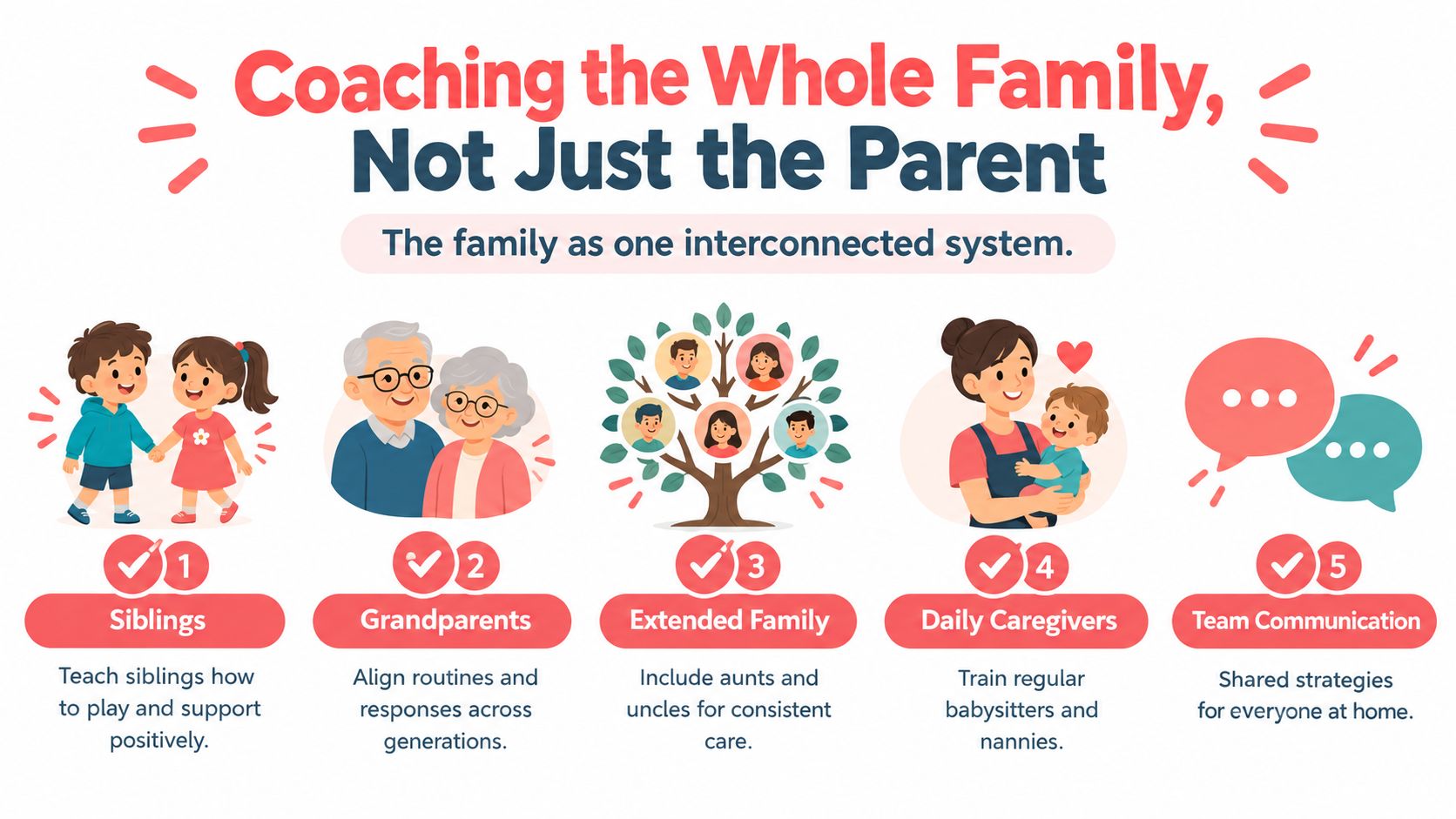
Coaching the Whole Family, Not Just the Parent
Many articles talk about parent involvement as if one adult carries the whole week. Most families know that isn't how life works.
A child may eat breakfast with one parent, get picked up by a grandparent, play with a sibling after school, and spend Saturday with an aunt or a babysitter. If only one adult knows the plan, the plan gets thinner every time the child moves into a new routine.
The Family System Matters
Current autism research priorities are pushing this question further. Community-engaged work is asking how siblings and grandparents can be involved, how to individualize support for families who can't or don't want the same kind of coaching, and how to respect different caregiving styles and decision-making structures, as outlined in this discussion of caregiver-focused autism research priorities.
That matters because the “best” family-centered plan isn't always the one with the most training. It's the one with the right fit.
Some adults want live coaching. Others do better with a short written plan and one practice routine. Some families want everyone in the room. Others need a quieter, one-person-at-a-time approach.
A Simple Adaptation Checklist
Try walking through these questions at home:
- Map the week: List the routines your child moves through regularly, from breakfast to bedtime to errands and visits.
- Name the adults: Include parents, siblings, grandparents, babysitters, and anyone else who shows up often.
- Match the moment: Pick one small teaching role for each person. A sibling may practice turn-taking. A grandparent may support snack requests. A babysitter may use the same transition phrase before cleanup.
- Keep coaching brief: Short huddles often work better than formal “training.” A five-minute practice before dinner can go further than a long lecture.
- Respect family style: Some households are very verbal. Others are quieter or more routine-based. Strategies should fit the family, not fight it.
If you'd like examples of home goals that connect to caregiver support, goals for parents can help spark ideas.
When Family Members Feel Unsure
Older siblings may feel burdened if adults expect too much. Keep their role light and relational. Think play partner, not junior therapist.
Grandparents may be skeptical if the language feels too clinical. Skip jargon. Show them one response that helps, such as pausing before repeating a demand or honoring a clear break request.
Rotating caregivers need simplicity. Give them one or two strategies that are easy to use consistently, not a long packet they'll never open.
How to Know You're Getting Quality ABA
Parents deserve clear answers before signing up for services. You don't need to become an expert overnight, but a few concrete questions can tell you a lot.
What to Look For
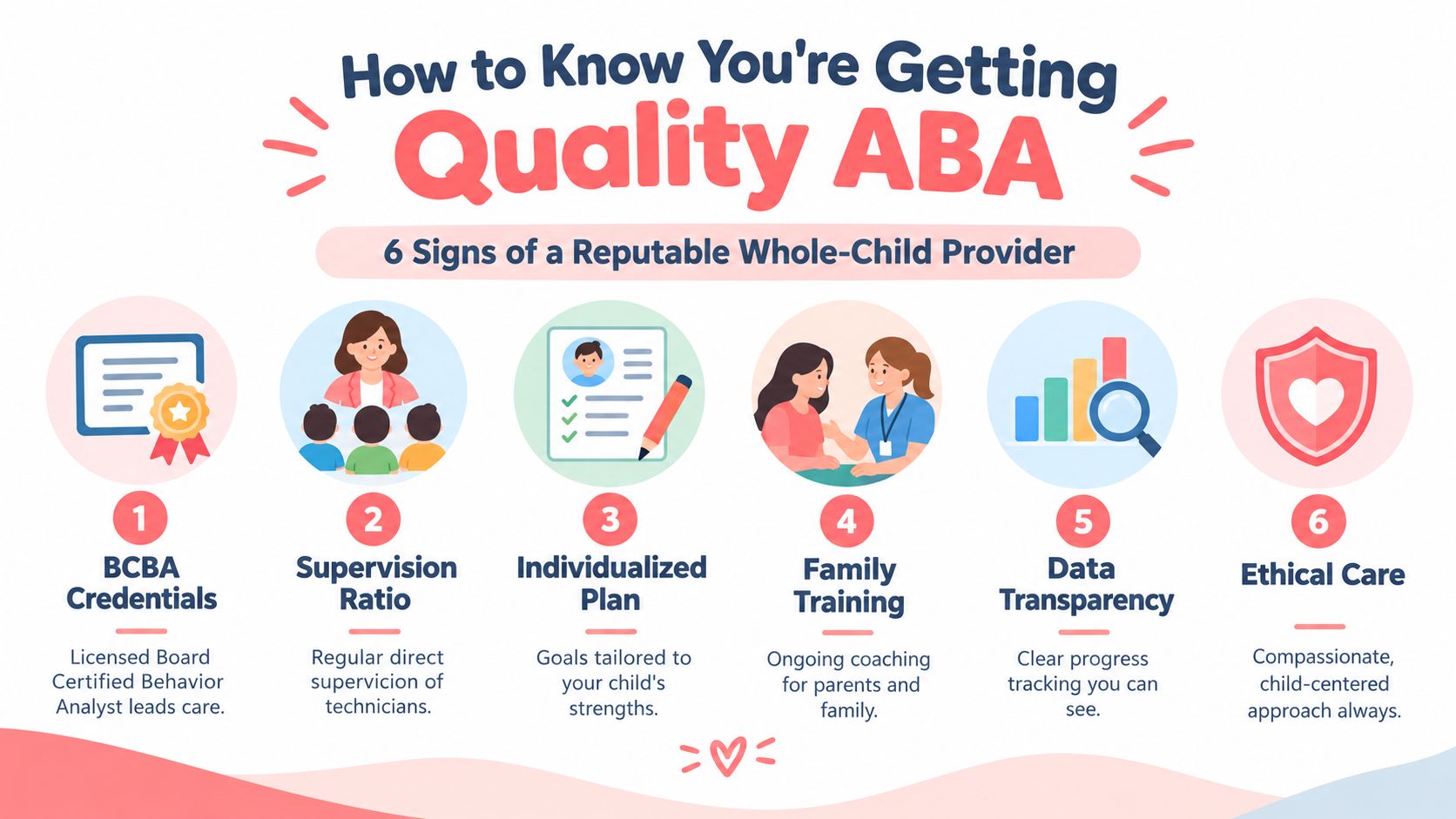
Start with credentials and supervision.
The Behavior Analyst Certification Board says supervisors who oversee BCBA or BCaBA fieldwork, or ongoing supervision for BCaBA and RBT certificants, must complete 8-hour supervision training based on the Supervisor Training Curriculum Outline before supervising others, according to the BACB supervision and training requirements. That tells you quality ABA is supposed to be guided by clinicians with formal supervision preparation.
For trainees pursuing BCBA certification, published supervision standards specify 2,000 hours of supervised fieldwork with 5% supervision in each supervisory period, or 1,500 hours of concentrated supervised fieldwork with 10% supervision, and the supervisory period is one calendar month, as summarized in this guide to BCBA supervision requirements.
The BACB also states that trainees must have at least 60% of fieldwork hours in unrestricted activities and no more than 40% in restricted activities, and supervisors must observe the trainee working directly with a client at least once per supervisory period, based on BACB supervision guidance for fieldwork and observation.
Questions Worth Asking
Use these as your short list:
- Who writes the plan: A BCBA should design and sign the treatment plan.
- How often does supervision happen: Ask how direct oversight works in day-to-day practice.
- What tools are used: Validated assessments such as the VB-MAPP or ABLLS-R are common pieces of a fuller evaluation.
- How is progress shared: You should see data, plain-language updates, and room for questions.
- Do goals reach beyond sessions: Strong plans include home, school, and community routines, not only table work.
- Is family coaching built in: It shouldn't be treated like an afterthought.
Two red flags show up often. One is a cookie-cutter program that sounds the same for every child. The other is very limited BCBA involvement with too much left to chance.
Small Moments, Big Milestones, and Your Next Step
Go back to that kitchen morning.
The cereal changed. Shoes were still missing. A sibling was too close. The parent was trying not to cry before school even started. That kind of morning doesn't usually transform because of one dramatic breakthrough. It changes through quieter wins that start linking together.
The Milestones Families Often Notice First
One child starts asking for a break instead of dropping to the floor.
Another starts accepting that a sibling can sit at the same table without everything unraveling.
A teacher mentions that transitions are smoother, or that the child needed less prompting to move from one activity to the next.
These are not tiny things. They're daily-life milestones.
Progress Usually Looks Ordinary at First
A total approach helps families notice the right kind of progress. Not only “Did my child do the target in session?” but “Is home a little calmer?” “Did that skill show up somewhere new?” “Did one hard part of the day get lighter?”
A recent meta-analysis supports the value of coached caregiver involvement here. It found a significant large effect of caregiver coaching on caregiver outcomes compared with other instructional approaches, with g = 0.745, SE = 0.125, p = 0.0013, 95% CI [0.43–1.06], in this meta-analysis on caregiver coaching approaches. For parents, the takeaway is simple. Coached practice tends to prepare adults better than instruction alone.
Another current priority in autism services is figuring out how to support real families across settings, including telehealth versus in-person coaching, access barriers, and the practical work of measuring generalization and caregiver follow-through in daily routines, as described in this report on caregiver coaching, access, and cross-setting implementation.
Choosing a total approach means choosing a steadier road. It means caring about the kitchen, the classroom, the car, the playground, and the family table equally. And for many families, the next step isn't a commitment to everything. It's just a first conversation where someone listens carefully and helps you sort out what matters most.
FriendlyABA provides ABA services in home, school, and community settings, with BCBAs and therapists who build individualized plans around the routines families are living every day. If this whole-child, family-centered model feels like the right fit for your child, you can learn more or schedule a conversation through FriendlyABA.
Our Latest Insights





You don't have to figure it out alone
Whether you're exploring ABA therapy for the first time or searching for a provider who truly feels like the right fit, we're here to help.