


Parent Coaching Services: A Practical Guide for Families
Discover what parent coaching services involve, how they support families of children with autism, and how to choose the right fit for your routines and goals.

You've made it through dinner, but your child still hasn't eaten. The request for a snack became crying, the transition to the bathroom took twenty minutes, and bedtime is stretching later by the minute. You know your child is capable of more, yet knowing what to try in the moment can feel impossible.
That's where parent coaching services can help. Instead of leaving caregivers with a handout and hoping the strategy works at home, coaching creates a shared process of choosing a meaningful goal, practicing it during real routines, observing what happens, and adjusting the plan together. The approach is practical, individualized, and built around the small moments that make up family life.
Table of Contents
- Start with one meaningful routine
- Watch, practice, and receive feedback
- Try the plan and record what happened
- Communication at meals
- Independence in a routine
- Shared attention during play
- A predictable transition cue
Why the Hours Between Sessions Matter Most
A therapy session may give your child focused support, but most communication, learning, and daily living happen elsewhere. They happen while you're preparing breakfast, helping with shoes, turning off a favorite show, or trying to leave the house on time.
Suppose your child reaches for a preferred snack but doesn't yet request it clearly. During a therapy visit, a clinician may practice a communication strategy in a calm setting. At home, the same opportunity appears when everyone is hungry and the next activity is waiting. You might need help knowing when to pause, what prompt to give, and how to respond if your child becomes upset.
The practical question: What should you do during the next thirty seconds, in the routine your family is already living?
Parent coaching services are designed for that question. A caregiver learns a strategy, tries it with support, notices the child's response, and receives guidance about what to change. The purpose isn't to make you perform therapy perfectly. It's to help you feel more prepared and consistent when ordinary situations become difficult.
The shift can be meaningful. A bedtime routine may become a place to practice following a simple sequence. Mealtime may become an opportunity to request, wait, or make a choice. Play may create space for shared attention instead of two people playing beside each other.
Good coaching also respects the emotional reality of parenting a child with autism. You may be tired, balancing siblings, managing work, or unsure whether a strategy will make a difficult moment worse. A useful provider starts there, then builds a plan that fits your child, your priorities, and your household.
What Parent Coaching Services Actually Are
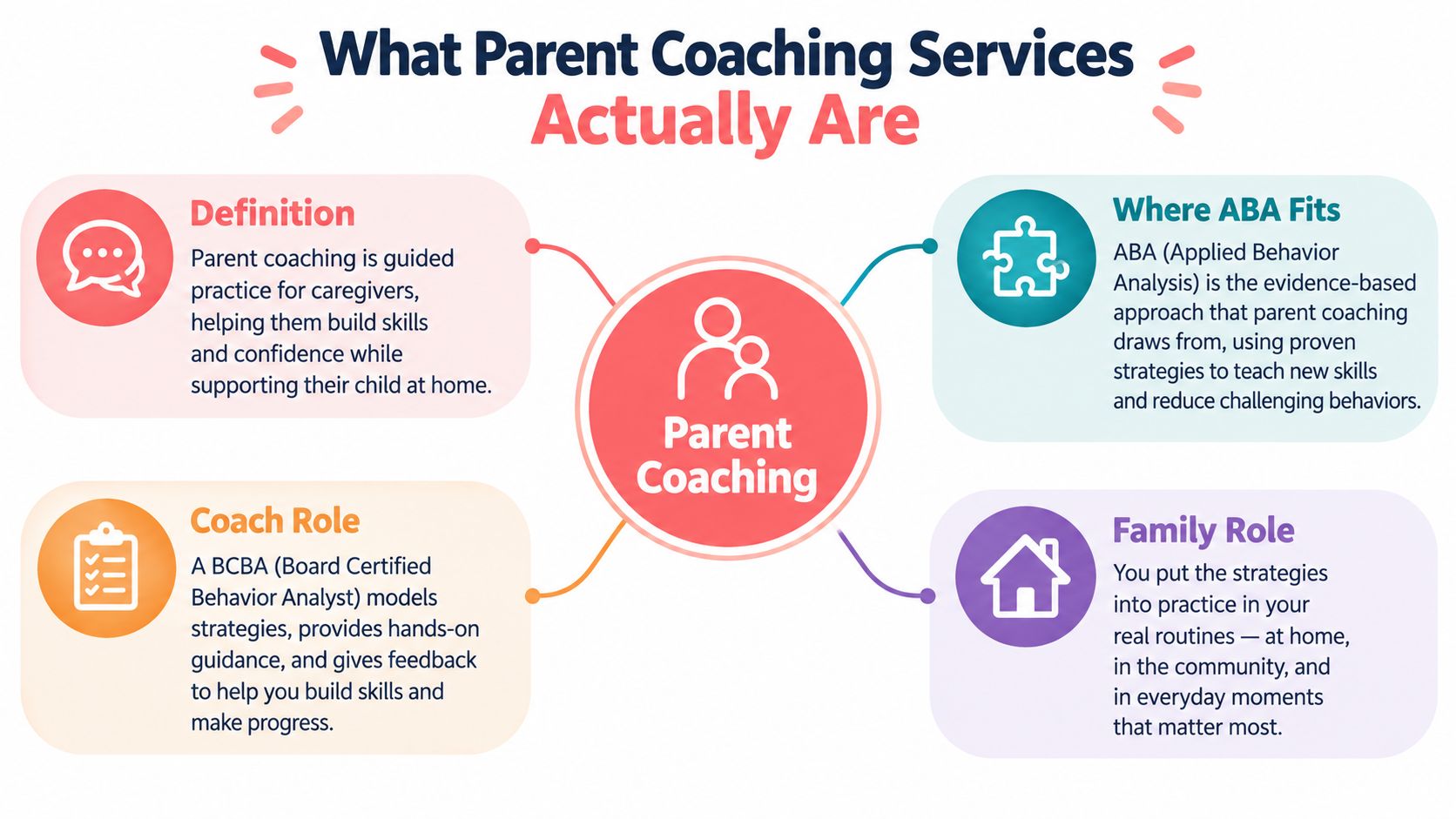
Parent coaching is guided caregiver practice. A qualified clinician teaches you an individualized strategy, demonstrates how it works, watches you try it, and offers feedback. You then use the strategy during routines at home or in another setting where the skill matters.
The approach commonly draws from Applied Behavior Analysis, or ABA, an evidence-based approach that examines how skills develop and how changes in the environment can support useful behavior. In family services, ABA may address functional communication, independence, play, safety, social connection, and daily routines. The focus should be meaningful skills, observable progress, and respectful collaboration.
A BCBA, or Board Certified Behavior Analyst, designs and supervises behavior-support programs. The BCBA may work with registered behavior technicians, often called RBTs, and caregivers to select goals, teach procedures, review data, and make changes when a plan isn't working as intended.
Coaching is different from information
A brochure can explain why a child may have a challenging behavior. A parenting class can offer broad suggestions. Talk therapy can support a parent's emotional health. Those services may be valuable, but coaching is active and specific.
You might work on requesting help during meals. The clinician could:
- Explain the target: Define what a successful request looks like for your child.
- Model the strategy: Show how to arrange the opportunity and use a prompt.
- Watch your practice: Observe your timing, wording, and response.
- Give feedback: Help you make the next attempt easier or more effective.
- Track the result: Record what your child did and what support was needed.
Parent coaching isn't therapy for the parent, and it isn't a judgment about your parenting. It's a short-term, goal-focused partnership that helps caregivers use individualized strategies accurately in real situations. Families exploring the difference between information and active training can also review FriendlyABA's explanation of parent training for autism.
FriendlyABA treats caregiver collaboration as part of care rather than an optional extra. The family brings knowledge of the child's preferences, history, strengths, and routines. The clinical team brings assessment, ABA expertise, measurement, and structured problem-solving. Both perspectives shape the plan.
What the Research Says Parents Gain
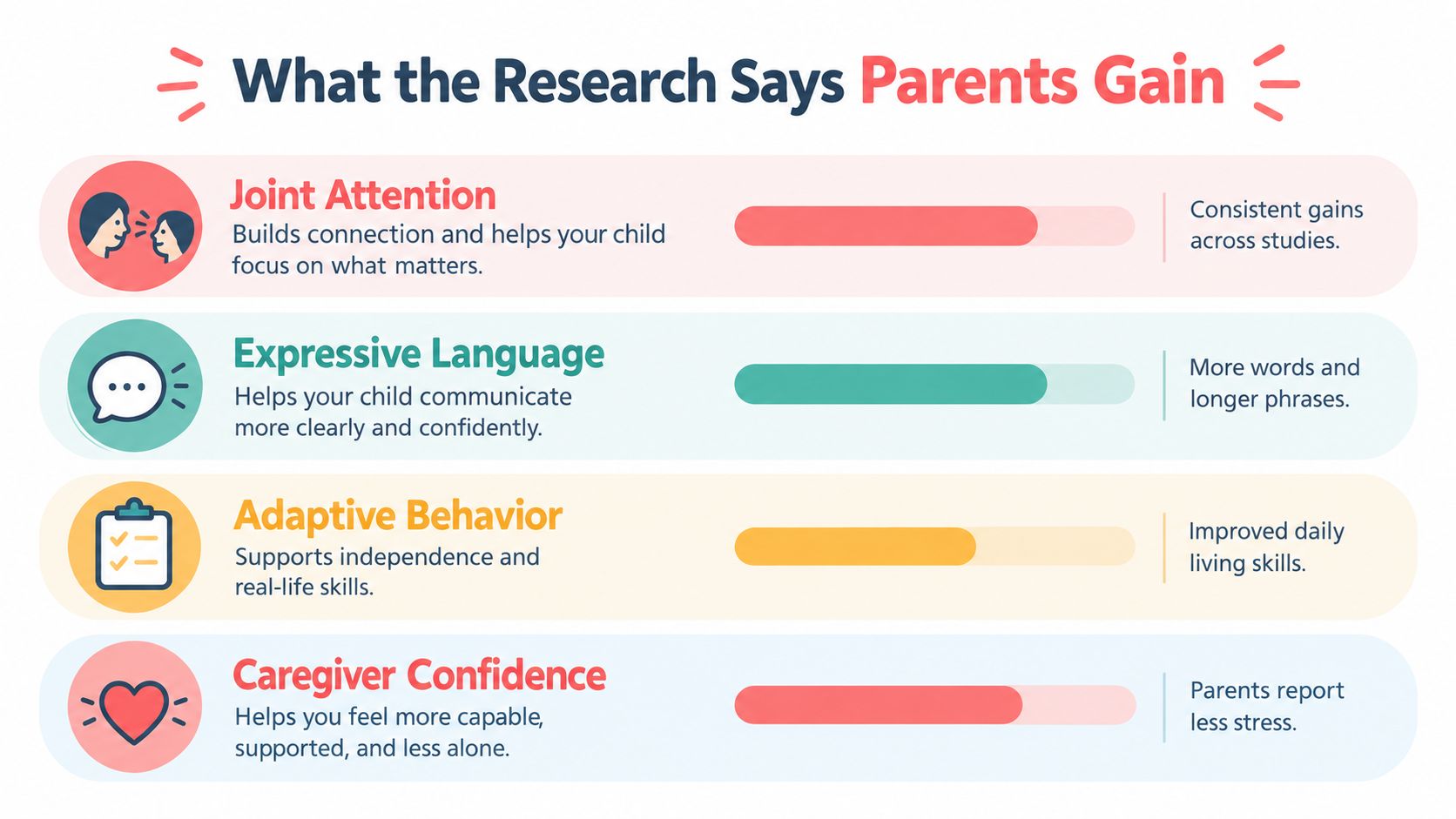
Research on parent-mediated intervention gives a useful big-picture answer, even if no study can predict one child's exact path. In a systematic review of parent-mediated interventions, researchers searched 582 academic articles, assessed 109 in full text, and included 13 studies in the final analysis. They found strong evidence for gains in joint attention, with moderate evidence across language, nonverbal communication, interaction, play, adaptive functioning, behavior, autism-related symptoms, and broader social communication.
Joint attention can sound technical at first. In everyday life, it means your child and another person are focused on the same thing together. That might be your child following your point to a dog outside, looking from a toy back to you, or showing you something interesting just to share it. Those small exchanges matter because they build the back-and-forth foundation that later communication depends on.
For many families, the research terms matter less than the ripple effect at home. When a child can communicate a need more clearly, frustration may ease. When a dressing step becomes more familiar, independence can grow. When transitions improve, routines like getting out the door in the morning may feel less like a tug-of-war and more like something your family can repeat with less strain.
What caregivers gain from structured practice
Parents often gain more than a strategy. They gain a way to read the situation, try a response, and see whether it helped. That measurement-based loop is one reason coaching tends to feel different from just receiving information.
- More confidence: You have a starting point before a routine gets hard.
- Better consistency: Caregivers can respond in similar ways across the same routine.
- Useful information: Simple tracking can show whether your child needs a different prompt, more wait time, or more practice.
- A stronger partnership: Your observations help shape the next goal and the next adjustment.
A clinical trial comparing parent training and parent education followed 180 children with autism and moderate or greater disruptive behavior. After 24 weeks, the parent training group showed a 47.7% reduction in irritability scores, compared with 31.8% in the parent education group. A blinded clinician rated 68.5% of children in the training group as much improved or very much improved, compared with 39.6% in the education group.
Those results do not guarantee the same outcome for every family. They do show why repeated practice, feedback, and adjustment matter. Parent coaching works as an ongoing partnership where a clinician helps you test strategies inside real routines, measure what happens, and refine the next step. That support reaches the places where your child communicates, plays, eats, learns, and rests, without asking you to become a therapist.
How a Coaching Cycle Actually Unfolds
A coaching visit should feel concrete. You shouldn't leave wondering what the strategy was or how to use it before the next appointment.
Start with one meaningful routine
The first step is choosing a goal that matters to your family. “Improve communication” is too broad for a first practice target. “Request a snack at the table” gives everyone something observable to work on.
Other useful goals might include putting one item into a backpack, transitioning from bath to pajamas, asking for a break, or taking a turn during play. The goal should reflect your child's priorities and your family's daily life.
Watch, practice, and receive feedback
The BCBA may model the strategy first. For a snack request, the clinician could arrange a clear opportunity, pause, and provide the level of prompt your child needs. You then practice while the clinician observes.
Feedback might focus on waiting a little longer, offering a visual choice, changing the prompt, or responding quickly when your child communicates. This isn't a test. It's rehearsal with someone available to help before you're facing the same moment alone.
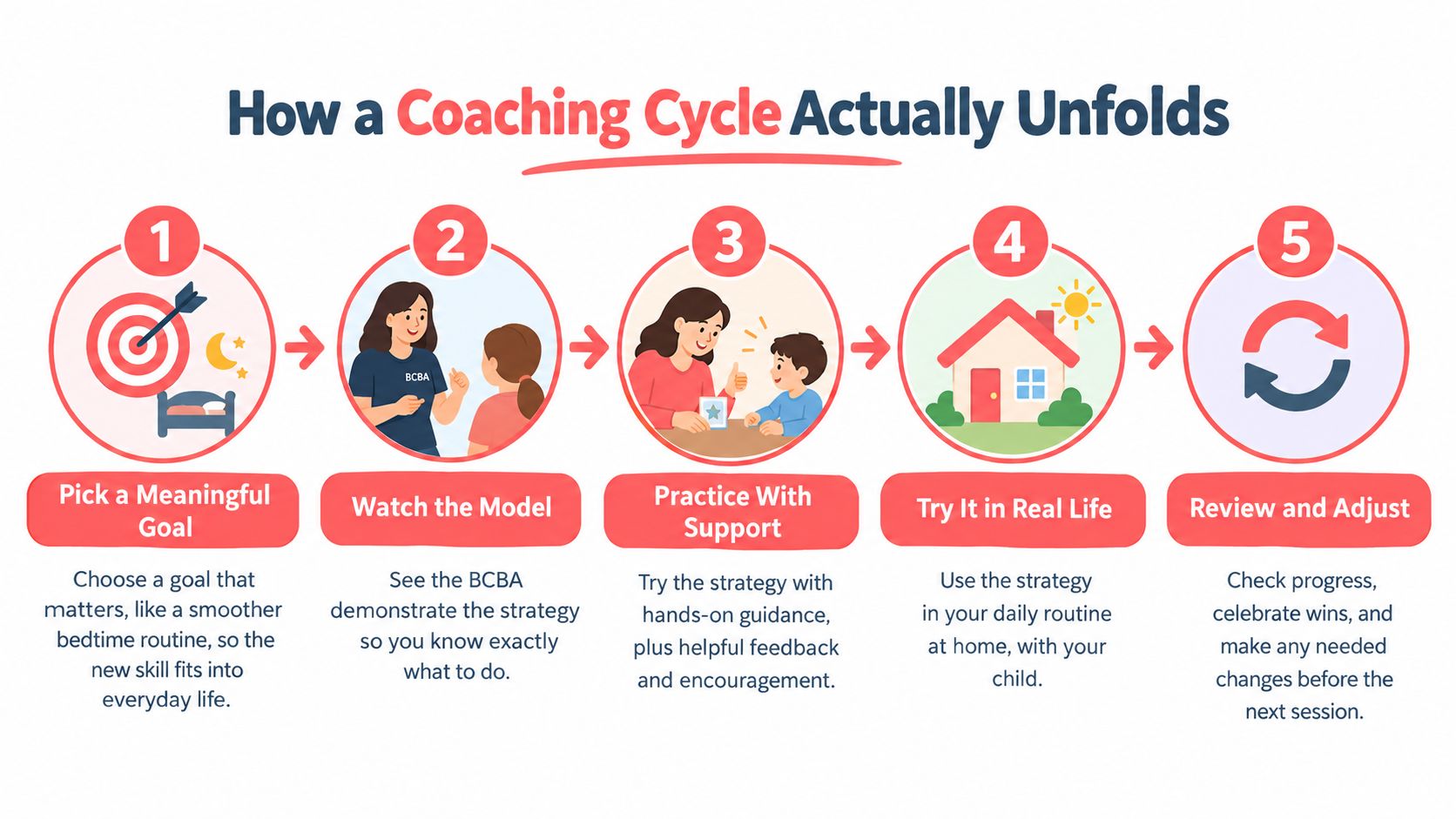
Try the plan and record what happened
Between visits, you'll use the strategy during the selected routine. Tracking can stay simple. You might note whether your child responded, what prompt was needed, and what made the routine easier or harder.
At the next session, you and the clinician review the information. If the request is becoming easier, the team may reduce prompts or expand practice to another setting. If the routine is breaking down, the plan may need a different communication response, a smaller step, or a change in timing.
FriendlyABA's structured workflow can include consultation, assessment, plan development, implementation, milestone review, and documented updates. That framework keeps coaching connected to a larger individualized program rather than treating each visit as an isolated lesson.
The cycle matters because families rarely need more advice in the abstract. They need a strategy that can survive a rushed morning, a noisy kitchen, a tired caregiver, or a child who responds differently from one day to the next.
In-Home, Telehealth, or a Hybrid Approach
The best format depends on the routine you want to change, the support you need, and what your household can realistically manage. There isn't one correct delivery method for every family.
In-home coaching allows the clinician to observe the environment directly. A BCBA may see how your child moves through the kitchen, where transitions become difficult, how siblings affect the routine, or which materials are present. The caregiver can practice at the table, during bath time, or while preparing to leave.
Telehealth coaching happens through live video. You may demonstrate a routine, position the camera so the clinician can observe, or record an interaction for review when live participation isn't practical. It can reduce travel and make regular check-ins easier, but it can also place more responsibility on the caregiver to manage the device, room setup, and demonstration.
| Format | Best for | Watch for |
|---|---|---|
| In-home | Routines such as mealtimes, transitions, safety, toileting, dressing, and generalization across the household | Caregiver availability, privacy, scheduling, and whether the home visit feels comfortable |
| Telehealth | Families who can reliably connect by video and demonstrate communication, play, or structured routines from home | Internet problems, digital-literacy needs, camera placement, sibling interruptions, and caregiver workload |
| Hybrid | Families who want convenient video check-ins plus periodic direct observation of the environment | Coordinating schedules, deciding which visits need to be in person, and keeping expectations clear |
Technology access and caregiver stress deserve an honest discussion. Telehealth may expand access to specialty clinicians, but convenience doesn't remove the need for modeling, practice, feedback, and technical support. A caregiver who is already managing several children may need help setting up the camera or may prefer an in-person visit for a difficult transition.
A hybrid plan can work well when parents travel, both caregivers work, or the family lives far from a clinic. Regular video sessions can support follow-through, while periodic in-person observation can help the clinician check fidelity and understand environmental barriers.
Research on caregiver coaching has identified technology, digital literacy, caregiver burden, and home-setting demands as recurring barriers. A comparison of telehealth and in-person parent coaching also reflects why families need individualized decisions rather than a blanket preference for one format. FriendlyABA provides additional context about telehealth ABA therapy.
Small Moments You Can Start Practicing Today
You don't need to redesign the whole day. Choose one routine, make one small adjustment, and notice what your child does next. These ideas are starting points, not replacements for an individualized plan from your BCBA.
Communication at meals
Put a preferred item where your child can see it, then pause before handing it over. If your child reaches, model a simple request your child already understands, such as a word, sign, picture, or gesture. Give enough support for a successful attempt, then respond promptly.
The aim isn't to withhold food or create frustration. It's to create a calm opportunity for communication and learn which level of prompting helps your child participate.
Independence in a routine
Pick one small step your child can attempt, such as placing a spoon on the table or putting pajamas in a basket. Wait briefly before helping. If needed, use a gesture or short verbal cue, then provide assistance while keeping the step manageable.
Success may mean completing part of the routine, not finishing everything alone. Your coach can help decide which prompt to use and when to reduce it.
Shared attention during play
Follow what interests your child. If your child is rolling a car, sit nearby and comment on the movement. Pause occasionally, imitate an action, or offer a related turn without taking control of the play.
A shared smile, glance, sound, or brief exchange can become the beginning of a longer interaction. Notice what your child chooses and build from there.
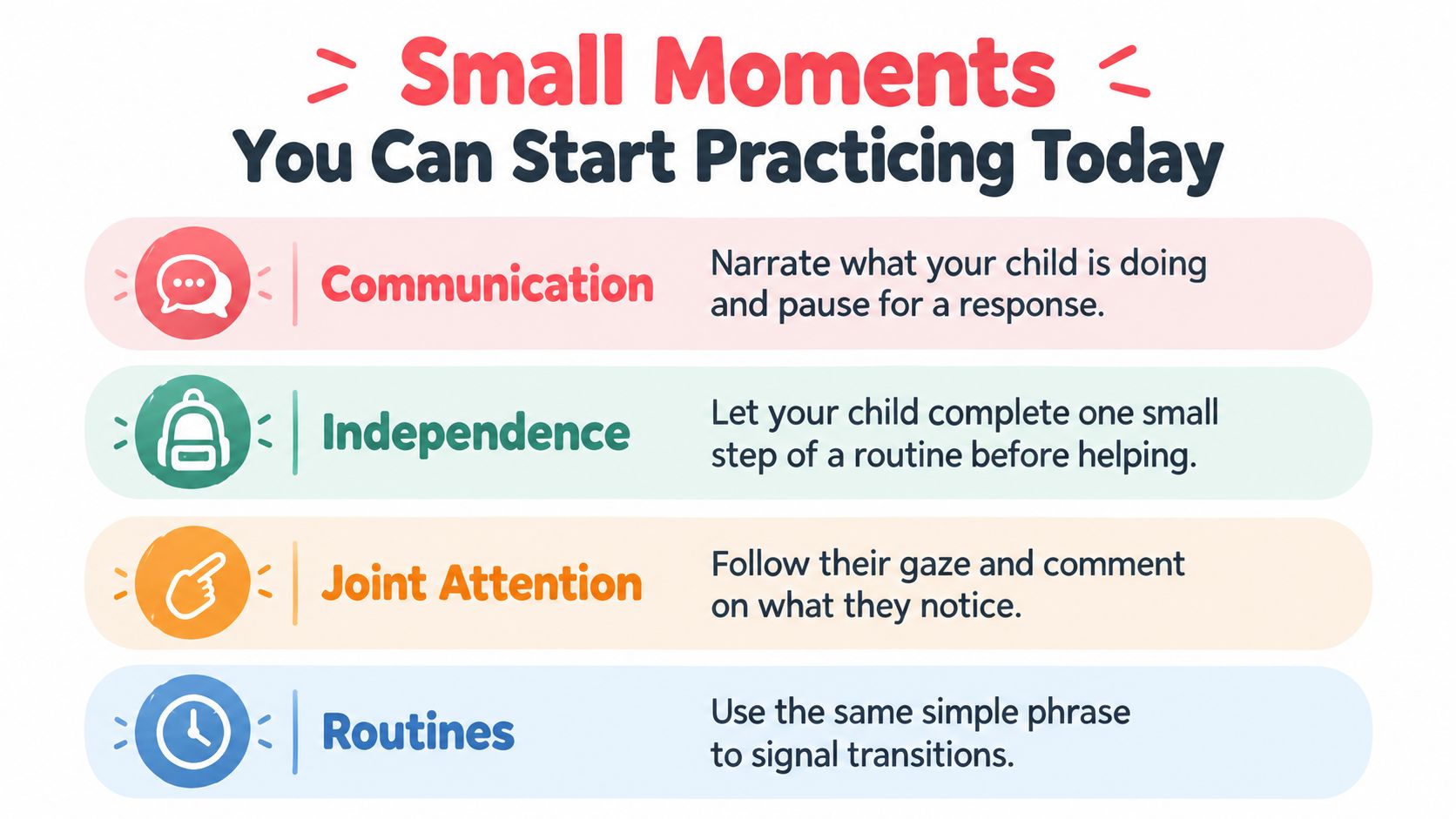
A predictable transition cue
Use the same short phrase before a familiar change, such as “two more turns, then bath.” Pair it with a visual, gesture, or timer if those supports help your child. Keep your voice calm and follow through consistently.
Write down what happened so you can discuss it with your coach. Families looking for more ideas about organizing caregiver priorities can explore FriendlyABA's resource on goals for parents. Small moments between visits are where big milestones grow, especially when the plan is adjusted to fit your child rather than forced onto the routine.
Misconceptions Worth Putting Aside
“Coaching means someone thinks I'm doing something wrong.”
Many parents worry about this at first. Good coaching starts from a different assumption. You already know the patterns in your home, what sets mornings off track, what helps your child settle, and which goals matter to your family. The clinician adds observation, teaching, and feedback so you can test small changes together and keep the ones that actually help.
“Telehealth can't support meaningful behavioral goals.”
Telehealth can be a good fit for routines where coaching the caregiver is the main task, such as meals, play, homework, or bedtime. In-home support may fit better when the room setup, safety concerns, or physical prompts need close attention. Many families do best with a mix. The useful question is not which format is better in general. It is which format matches the routine you are trying to improve.
“Progress only happens during formal therapy.”
Progress usually grows in the hours between visits. A session is more like a practice lab than the whole game. What matters is whether the strategy works in the everyday places your child lives, eats, plays, and transitions.
“Parent education and parent training are basically the same.”
They lead to different results. As noted earlier, the randomized trial discussed in the research section showed structured parent training outperforming parent education on irritability and clinician-rated improvement. That is why coaching includes guided practice, feedback, and adjustment over time, not just information.
“The coach replaces my knowledge of my child.”
A respectful BCBA should treat your input as part of the measurement process, not as background noise. Good coaching is a partnership. Your experience shapes the goal, the plan, and the decision about what to keep, change, or stop.
How to Choose a Provider and Get Started
A strong parent coaching program should make the process understandable before you commit. Look for a BCBA-led design, clear goals, observable measures, and a willingness to explain not only what to do but why the strategy fits your child.
Use this checklist during an initial conversation:
- Family priorities: Ask how your concerns and routines shape the goals.
- Practical teaching: Ask whether the clinician will model, observe your practice, and provide feedback.
- Progress monitoring: Ask what information will be tracked and how often the plan will be reviewed.
- Flexible delivery: Ask whether in-home, telehealth, or hybrid sessions are available when appropriate.
- Respectful care: Ask how the team incorporates your child's communication style, preferences, strengths, and consent signals.
- Coordination: Ask how the program communicates with other caregivers, school staff, or providers when collaboration is useful.
You might bring these questions to a consultation:
- What goal would you start with based on our current routines?
- How will you know whether the strategy is helping?
- What happens if we can't use the plan consistently at home?
- Which coaching format would fit the routine we're struggling with?
- How will we decide when to change or expand the goal?
FriendlyABA provides individualized ABA services with BCBAs and trained therapists across home, school, and community settings. Its parent coaching approach focuses on practical caregiver training, everyday routines, ongoing support, and documented progress rather than a one-time lesson.
A consultation doesn't have to be a commitment. It can give you a chance to describe what's happening, ask questions, and decide whether the approach feels appropriate for your family.
FriendlyABA offers parent coaching that helps caregivers practice individualized ABA strategies for communication, daily routines, independence, emotional regulation, and positive behavior. Visit FriendlyABA to book a consultation and talk through whether in-home, telehealth, or hybrid support fits your family's needs.
Our Latest Insights
















You don't have to figure it out alone
Whether you're exploring ABA therapy for the first time or searching for a provider who truly feels like the right fit, we're here to help.