


BCBA Supervision Requirements: A Parent's Complete Guide
Understand BCBA supervision requirements for your child's ABA therapy. Learn about hours, documentation, and what FriendlyABA does to ensure quality care.

To become a BCBA, a candidate completes either 2,000 hours of standard supervised fieldwork or 1,500 hours of concentrated supervised fieldwork, with at least 5% or 10% of monthly fieldwork hours supervised, respectively. Those requirements describe the trainee's path to certification, while your child's care should also include qualified oversight, direct observation, thoughtful communication, and treatment decisions connected to your child's everyday life.
You may be looking at an ABA provider's website, preparing for an assessment, or sitting in a first meeting and wondering, "Who is overseeing my child's therapy?" It's a sensible question. ABA can involve several people, including a Board Certified Behavior Analyst (BCBA), who designs and evaluates behavior-analytic programs, and a Registered Behavior Technician (RBT) or therapist, who carries out many teaching activities under supervision.
The numbers behind BCBA supervision requirements can feel distant from family life. In practice, they help answer a more useful question: does the therapy team have a reliable system for training, observing, reviewing, and improving care?
Table of Contents
Why Supervision Matters for Your Child's Therapy
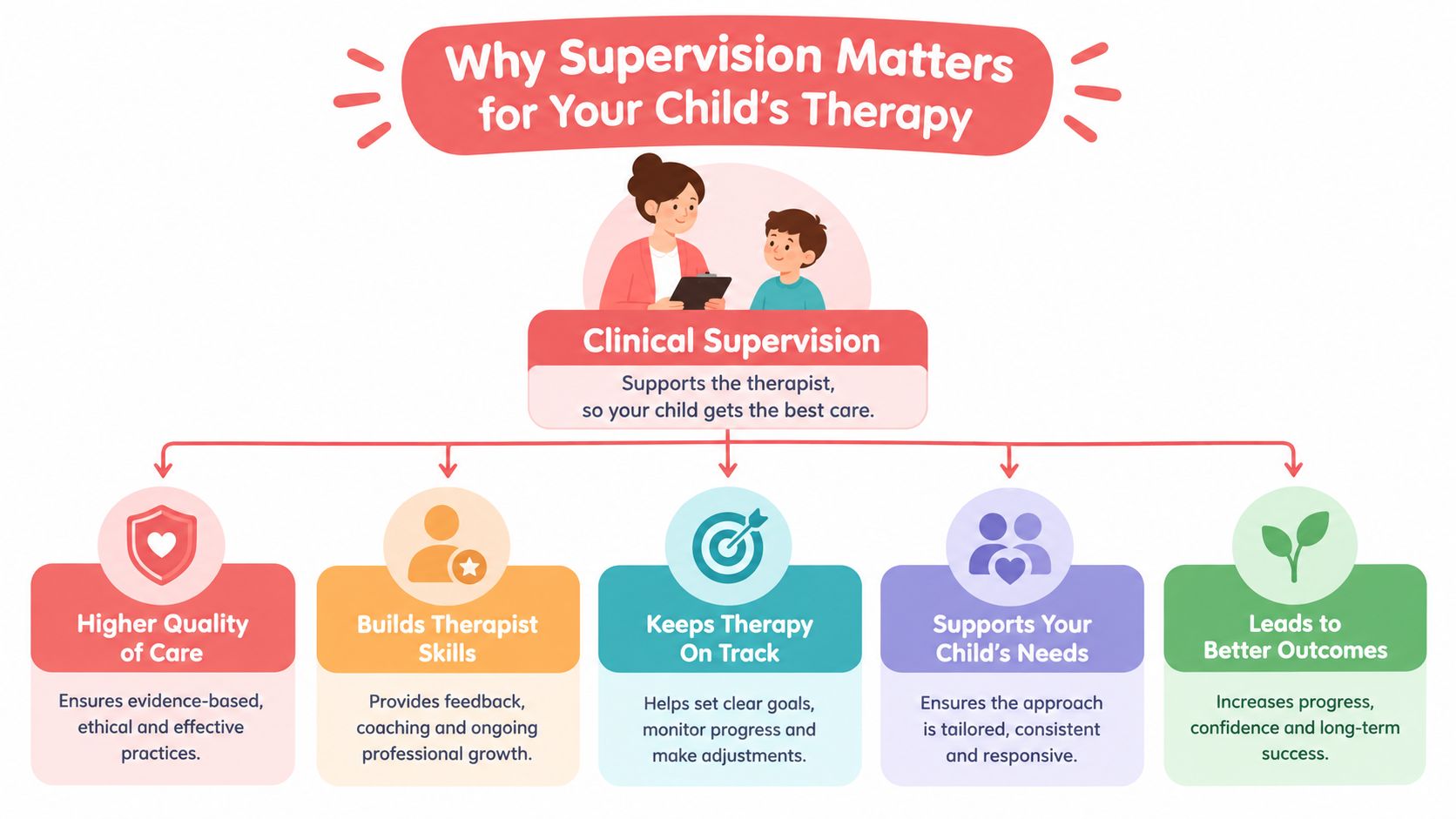
A parent may meet a warm, capable therapist and still wonder: who checks the plan, and how does anyone know it is helping? That question can arise after a treatment proposal, an assessment, or an introduction to several staff members. Asking for a clear answer is part of being an informed partner in your child's care.
BCBA supervision requirements provide a professional safety net around supervised experience. The Behavior Analyst Certification Board's BCBA Handbook describes a fieldwork framework allowing candidates to accrue 20 to 130 fieldwork hours per calendar month. Each month includes a minimum supervision ratio. Standard supervised fieldwork requires at least 5% of accrued hours under supervision, while concentrated supervised fieldwork requires at least 10%. For a candidate accruing 100 hours, that means at least 5 hours of supervision on the standard pathway or 10 hours on the concentrated pathway.
These rules do not require a BCBA to conduct every minute of your child's therapy. They connect supervised work with qualified oversight, documented experience, and regular feedback. During each supervisory period, the supervisor must observe the trainee working with a client. At least 50% of supervised time must be individual rather than group supervision, according to the same BACB fieldwork requirements.
For families: A good supervision cycle is visible: the supervisor observes, the team discusses, the plan is adjusted, and the change is followed up in the next session.
At FriendlyABA, this approach aligns with small moments, big milestones. A child's communication attempt, transition, play interaction, or daily routine can reveal useful information. The clinical team can review those details with the family, connect them to treatment goals, and adjust teaching so new skills remain meaningful beyond the therapy room.
Understanding the Two Certification Pathways
The BACB recognizes two supervised-fieldwork pathways for people working toward BCBA certification. Both involve real supervised experience, but they use different total-hour and monthly-supervision structures.
| Pathway | Total Hours | Monthly Range | Min Supervision |
|---|---|---|---|
| Standard Supervised Fieldwork | 2,000 hours | 20 to 130 hours | At least 5% |
| Concentrated Supervised Fieldwork | 1,500 hours | 20 to 130 hours | At least 10% |
The BACB BCBA Handbook identifies the standard route as 2,000 hours of supervised fieldwork and the concentrated route as 1,500 hours of concentrated supervised fieldwork. Concentrated supervision is the more intensive option because the monthly oversight requirement is higher.
What the pathway means
Standard supervised fieldwork gives a trainee a longer experience pathway with ongoing supervision. Concentrated supervised fieldwork uses fewer total hours but expects more supervision each month. In both cases, the work takes place under a qualified supervisor, typically a BCBA connected with the trainee's employer, university, or practice setting.
These are not just numbers on a spreadsheet. Fieldwork gives a future BCBA opportunities to apply coursework with real clients, analyze information, participate in treatment planning, and learn how to make professional decisions. The supervisor's role is to guide that development rather than merely approve attendance.
A therapist's title alone doesn't tell you how much oversight they receive. A trainee may be working toward certification, while a certified BCBA may be responsible for clinical direction. Parents can ask:
- Who is a trainee? Ask which team members are still completing supervised fieldwork.
- Who supervises them? Request the supervisor's name and BCBA credentials.
- How does supervision affect my child's program? Ask how observations, data review, and feedback connect to your child's goals.
If terms such as RBT, BCBA, or ABA therapist are new to you, FriendlyABA's explanation of what an ABA therapist does can help separate job roles from certification responsibilities.
What Good Supervision Looks Like for Your Child

A supervision plan can meet the required ratio and still leave important questions unanswered. Parents can ask whether the trainee is learning to assess, plan, communicate, and respond responsibly, because those skills shape the quality and safety of a child's care.
The BACB requires at least 60% of a BCBA candidate's fieldwork to involve unrestricted activities, while no more than 40% may involve restricted activities, according to BACB supervision and training guidance. Restricted activities generally involve direct implementation. Unrestricted activities give a trainee practice with broader professional work, including assessment, program design, data analysis, caregiver training, and behavior-analytic decision-making. The difference is similar to learning both how to follow a recipe and how to choose, adjust, and explain the recipe for a particular family.
The parts parents can look for
A strong supervision relationship includes more than watching a therapist deliver a program. It may help the trainee learn to:
- Review data: Identify patterns, check recording consistency, and notice when a teaching plan needs closer examination.
- Support assessment: Consider a child's strengths, preferences, communication, routines, and barriers to participation.
- Develop programs: Select meaningful goals and plan teaching steps that fit the child and daily environment.
- Coach caregivers: Explain strategies clearly and respectfully so families can use them during ordinary routines.
- Evaluate implementation: Observe whether a plan is followed as designed and give specific feedback when changes are needed.
Parents do not need to judge every technical detail. They can look for evidence that supervision connects the team's learning with decisions about their child.
Group learning can support development, but it cannot replace individual guidance. Group supervision may account for no more than 50% of total supervision time. During each supervisory period, the supervisor must also directly observe the trainee working with a client, as described in the BACB supervision standards.
The supervisor's preparation matters as well. A supervisor overseeing BCBA fieldwork must complete an 8-hour supervision training based on the current supervisor-training curriculum before providing supervision.
A useful parent question: “When you observe the team, what specific skill are you evaluating, and how will your feedback change the way my child is supported?”
This question moves the conversation beyond attendance. It asks what the team learned and how that learning will improve the child's support.
From Paperwork to Practical Care
Compliance paperwork has a purpose, but a completed form doesn't tell you whether supervision is clinically meaningful. A trainee could receive the required oversight while repeatedly practicing the same narrow task, seeing only one setting, or receiving little feedback about caregiver collaboration and generalization.
This is why the quality and distribution of supervision matter. The BACB discussion of fieldwork and supervision highlights the difference between satisfying a technical requirement and preparing a trainee to make independent, ethical decisions across real cases. The central family question isn't only, “Was the percentage met?” It's also, “Is the team learning how to support my child in the places and routines that matter?”
Skills that travel with the child
A child may communicate successfully in a therapy room but need support using that skill at the breakfast table, in a classroom, or at a playground. Clinically meaningful supervision helps the team consider how skills will generalize across people, materials, instructions, and environments.
For a home, school, and community provider, that can include:
- Caregiver coaching: A parent practices a strategy during a routine, receives feedback, and helps decide whether it feels practical.
- Generalization planning: The team identifies how a skill can be practiced with different people and in natural settings.
- Assent-based practice: Staff pay attention to the child's communication, comfort, and participation instead of treating compliance as the only measure of success.
- Culturally responsive treatment: The team respects family values, language, routines, and priorities when selecting goals and teaching approaches.
- Fidelity checks: A BCBA observes implementation and helps staff use the plan consistently while still responding to the child as an individual.
FriendlyABA's applied behavior analysis assessment approach reflects why assessment and supervision should connect to the child's strengths, developmental history, preferences, and family-identified priorities. More supervision hours don't automatically mean better supervision. The better measure is whether supervision helps the team make careful decisions and use strategies that remain useful beyond the session.
A parent might see this in a small but important moment. Instead of merely recording that a child didn't complete a task, the team asks whether the instruction was clear, whether the child had a way to request help, whether the activity matched the child's current skills, and whether the goal belongs in that routine. That is supervision translated into care.
Remote and In-Person Supervision Options
Remote supervision can expand access to qualified oversight, especially for families and providers in rural areas or across multiple states. It can also create blind spots if a video meeting becomes a substitute for meaningful observation.
The BACB fieldwork guidance on remote supervision indicates that remote supervision is permitted only when the supervisor already knows and oversees the clients. Clients must know about and agree to remote observation or other virtual treatment activity. Consent, secure technology, and clear communication therefore belong at the center of the arrangement.
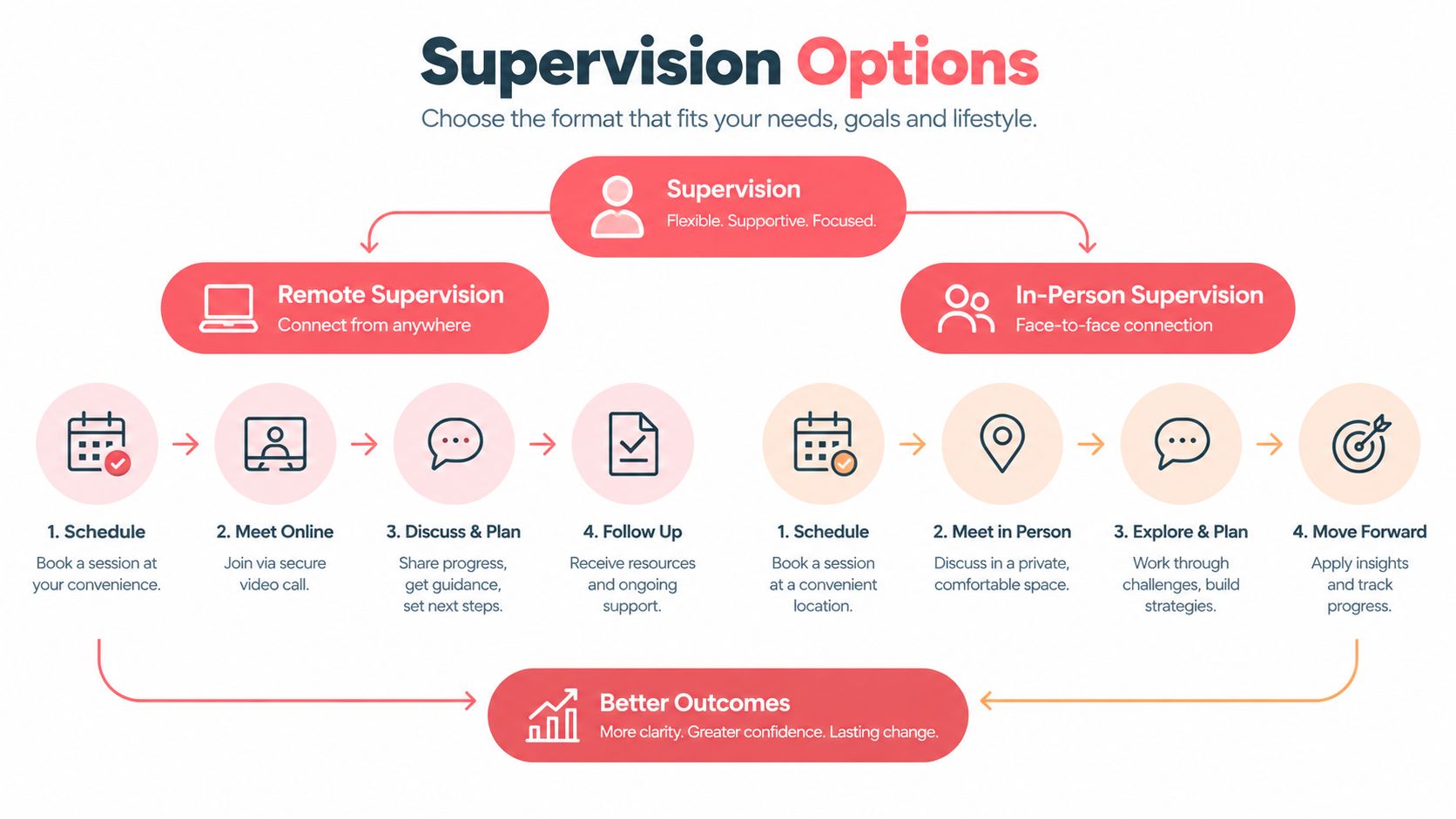
Remote supervision
Remote observation may allow a BCBA to watch a session without requiring a long drive. It can support live discussion, data review, and coaching when the technology works well and the supervisor has an established relationship with the client.
Parents should still ask how the team will handle:
- Connectivity: What happens if the video freezes or the audio drops?
- Camera position: Can the supervisor see the child, therapist, materials, and relevant interaction?
- Privacy: How will health information be protected in the home or school?
- Recording: Will anyone record the session, and has the family agreed to that practice?
- Clinical limits: When will the provider decide that an in-person observation is preferable?
Remote access can become “paper compliance” when a video call is detached from direct clinical observation. It works best when it supports an ongoing relationship, not when it replaces knowledge of the child and the setting.
Here's a related explanation of telehealth ABA therapy for families comparing virtual and in-person services.
In-person supervision
In-person observation can make it easier to notice subtle interactions, caregiver responses, environmental barriers, and changes in the child's engagement. It may be especially useful when the team is introducing a new plan, supporting a challenging routine, collaborating with school staff, or troubleshooting a problem that isn't clear on video.
Neither format is automatically superior for every situation. The right choice depends on the child, setting, consent, privacy protections, supervisor's knowledge of the case, and the quality of the observation.
Questions to Ask About Your Child's Supervision
You don't need to memorize BACB language to have a productive conversation with an ABA provider. A few direct, warm questions can show you how supervision connects to your child's treatment.
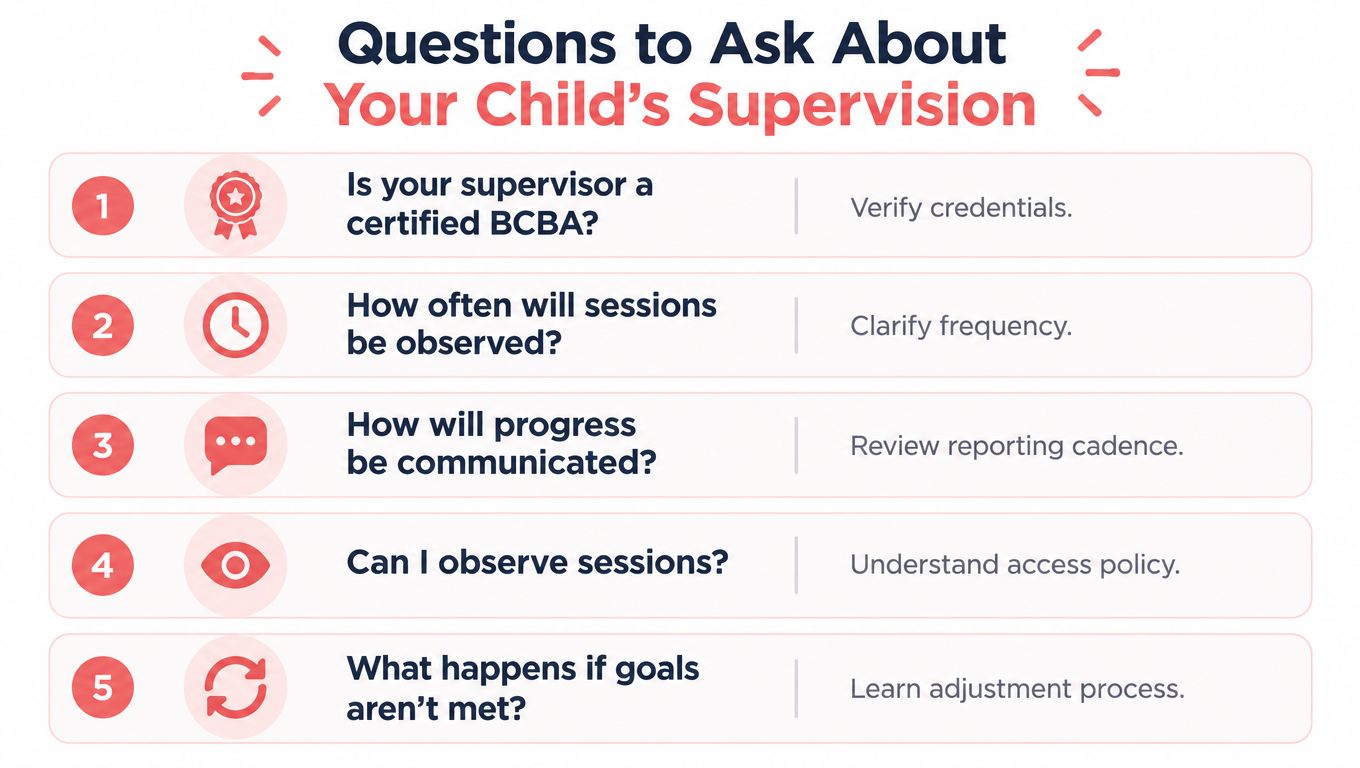
Try asking:
- Who is the BCBA responsible for my child's program? Ask for the supervisor's name, role, and how they participate in assessment, planning, observation, and review.
- Which team members are trainees or supervised staff? This helps you understand who is developing professional skills and who provides clinical direction.
- How often will the supervisor observe sessions? Ask whether observations happen at home, school, in the community, remotely, or through a combination of settings.
- How will you communicate treatment changes? Find out how data, observations, caregiver feedback, and new recommendations will be shared with you.
- Can I share concerns or request a review? A good partnership gives you a clear way to report changes in routines, new priorities, discomfort, or questions about a goal.
- How do you decide whether a goal needs adjustment? The answer should involve observable information, clinical judgment, and your family's priorities, not just whether a task was completed.
- How do you support generalization? Ask how the team will help a skill move from therapy into home, school, and community life.
You can introduce these questions by saying, “I'm learning how supervision works, and I'd like to understand how it supports my child.” That framing invites collaboration rather than putting the team on the defensive.
How FriendlyABA Applies These Standards
FriendlyABA provides ABA services through BCBAs and trained therapists, with programs designed for children and families in home, school, and community contexts. Its model connects clinical oversight to the places where communication, independence, play, transitions, and safety skills matter.
That multi-setting approach gives supervision a practical focus. A BCBA may need to review session data, observe implementation, discuss caregiver feedback, and update treatment planning when a strategy works in one environment but not another. School coordination may involve classroom participation, transitions, routine adherence, or positive peer interaction. Home-based care may focus on functional communication, daily living, play, or safety during familiar routines.
A family partnership, not a handoff
Parents aren't expected to watch from the sidelines. Caregiver coaching helps families practice strategies between sessions, ask questions, and explain what is or isn't working in daily life. The team can then use that information alongside direct observation and data review.
FriendlyABA's clinical workflow includes consultation, thorough assessment, individualized planning, therapy implementation, milestone review, and documented updates. The focus stays on observable skills and meaningful participation, while recognizing that each child's strengths, preferences, communication style, and family routines shape the right plan.
Supervision protects quality best when it reaches the child's real life, not only the clinic schedule or the paperwork system.
For parents, this means asking how the BCBA's oversight appears in ordinary moments. Who reviews the plan? Who observes the therapist? Who listens when a caregiver says a strategy is difficult to use? Who helps the team adapt while keeping goals meaningful? Clear answers can make a complicated service structure easier to understand.
Your Quick Reference Guide to Supervision
A useful parent conversation might begin with a simple question: “Who checks that my child's therapy is safe, appropriate, and useful outside the session?” This checklist helps you review the answer with an ABA provider or compare it with your child's care plan.
- Certification pathways: A BCBA candidate completes either 2,000 hours of standard supervised fieldwork or 1,500 hours of concentrated supervised fieldwork, according to the BACB's current BCBA Handbook.
- Monthly fieldwork range: Candidates may accrue 20 to 130 fieldwork hours per calendar month under the current framework.
- Monthly supervision: Standard supervised fieldwork requires at least 5% of accrued monthly hours supervised. Concentrated fieldwork requires at least 10%.
- Supervision format: At least 50% of supervised time must be individual rather than group supervision.
- Direct observation: The supervisor must observe the trainee working with a client at least once during each supervisory period.
- Fieldwork composition: At least 60% of a BCBA candidate's fieldwork must involve unrestricted activities, while no more than 40% may involve restricted activities, as described in the BACB's supervision and training guidance.
- Supervisor preparation: Supervisors overseeing BCBA fieldwork must complete an 8-hour supervision training based on the current supervisor-training curriculum.
- Remote supervision: Remote observation requires an established supervisor-client relationship, client knowledge, agreement to remote observation or virtual treatment activity, and attention to privacy and observation quality.
- Clinical meaning: Ask whether supervision includes data review, direct observation, caregiver collaboration, treatment updates, generalization planning, and feedback connected to your child's everyday settings.
The checklist gives families a starting point, not a complete evaluation of an individual program. Ask how oversight helps your child learn, communicate, participate, and feel supported. Those answers connect certification rules to daily care, much like a map shows whether a route actually reaches the destination.
FriendlyABA offers BCBA-led ABA programs with individualized planning, therapist oversight, caregiver collaboration, and support across home, school, and community settings. Visit FriendlyABA to learn more or book a consultation about how supervised care could fit your child's needs.
Our Latest Insights








You don't have to figure it out alone
Whether you're exploring ABA therapy for the first time or searching for a provider who truly feels like the right fit, we're here to help.