


Descriptive Assessment Aba
Descriptive assessment aba. Learn what descriptive assessment in ABA means, how ABC data works, and what comes next for your child. A warm, practical guide

A child knocks over a block tower, drops to the floor when shoes need to come off, or cries as soon as an activity ends. You may understand what happened, but you may not know why it happened. Was the task too difficult, was your child trying to communicate, or did something in the environment make the moment harder?
That uncertainty can leave parents feeling stuck between guessing and waiting. A descriptive assessment in ABA offers a calmer starting point. Instead of judging the behavior or rushing to a conclusion, a trained clinician observes what happens before, during, and after it, then uses those observations to build a careful hypothesis.
Table of Contents
What a Descriptive Assessment Actually Feels Like
You're sitting at the kitchen table, watching your child build a tower with colorful blocks. The tower falls, and your child knocks over the remaining blocks. You help rebuild it. A few minutes later, the same thing happens again, and then once more.
By the third time, you may be wondering whether your child is frustrated, asking for help, trying to end the activity, or enjoying the sound of the blocks falling. You may also feel worried that someone will see only the behavior and miss the child behind it.
A descriptive assessment starts with curiosity rather than blame. A BCBA, or Board Certified Behavior Analyst, watches the situation as it naturally unfolds and records important details. The clinician may note what activity was happening, who was nearby, what your child was asked to do, what the behavior looked like, and what happened immediately afterward.

Your child isn't being tested
A descriptive assessment isn't a test that your child can pass or fail. It also isn't a judgment of your parenting. The clinician is trying to understand the entire moment, including demands, communication opportunities, sensory experiences, attention, transitions, and access to preferred activities.
For example, the block tower may fall because the structure is difficult to build. Your child may then knock over the pieces because an adult immediately rebuilds the tower and provides close attention. Or the behavior may happen when a preferred activity is about to end, making the blocks only one part of a larger transition pattern.
The observation doesn't decide the answer by itself. It gives the team a more reliable way to ask the right question.
A helpful starting point: The clinician isn't asking, “How do we stop this behavior?” The first question is, “What is happening around this behavior that may be important?”
Turning worry into a question
The practical value of descriptive assessment is that it turns a confusing incident into information that can be compared over time. A single event may be hard to interpret. Repeated observations can show whether the behavior is more likely during transitions, difficult tasks, limited attention, crowded spaces, or changes in routine.
This approach is especially useful when parents and clinicians want skills to carry across home, school, and community life. The SAGE Encyclopedia overview of applied behavior analysis describes descriptive assessment as a direct-observation approach connected to observable behavior and environmental relations. In everyday language, that means the team watches what people can see and records the surrounding conditions carefully.
The process is compassionate because it makes room for your child's experience while also giving the adults a practical way to respond. Once the observations are organized, the team can examine the basic ABC pattern.
The Basics of Descriptive Assessment in ABA
A descriptive assessment is a structured way to observe and record behavior in the setting where it naturally occurs. The clinician doesn't deliberately arrange a situation to produce the behavior. Instead, the BCBA watches home routines, classroom activities, community outings, or another setting and records what happens.
Descriptive assessment sits within the broader process of functional behavior assessment, often called an FBA. An FBA may include conversations with caregivers, reviews of records, direct observation, and other forms of information gathering. Direct observation is valuable because it lets the team compare what people report with what actually happens during daily routines.
The two parts parents usually see
Naturalistic observation means watching your child in a familiar environment. A BCBA might observe breakfast, getting ready for school, homework, play, a classroom transition, or a visit to the park. The clinician aims to see ordinary routines rather than create an artificial performance.
ABC recording organizes the observation into three parts:
- Antecedent: What happened immediately before the behavior?
- Behavior: What did your child do, described in clear and observable terms?
- Consequence: What happened immediately after the behavior?
Consider a child who drops to the floor at the front door when asked to take off their shoes. An ABC note might look like this:
| ABC part | Example observation |
|---|---|
| Antecedent | An adult says, “Shoes off,” after the child enters the house. |
| Behavior | The child lies on the floor, cries, and keeps both feet inside the shoes. |
| Consequence | The adult pauses the request, talks with the child, and helps remove the shoes. |
This note doesn't prove that the child is trying to escape the shoe-removal routine. It does show a repeated sequence the team can examine. The BCBA may also record the time, location, people present, activity, and any other event that could affect the pattern.
The method has deep roots in applied behavior analysis. A key historical milestone was the 1968 publication of “Some Current Dimensions of Applied Behavior Analysis” by Donald M. Baer, Montrose M. Wolf, and Todd R. Risley. Later ABA practice continued to use direct observation and ABC recording as ways to study behavior in relation to the environment. Training materials also identify conducting a descriptive assessment of problem behavior as a professional competency.
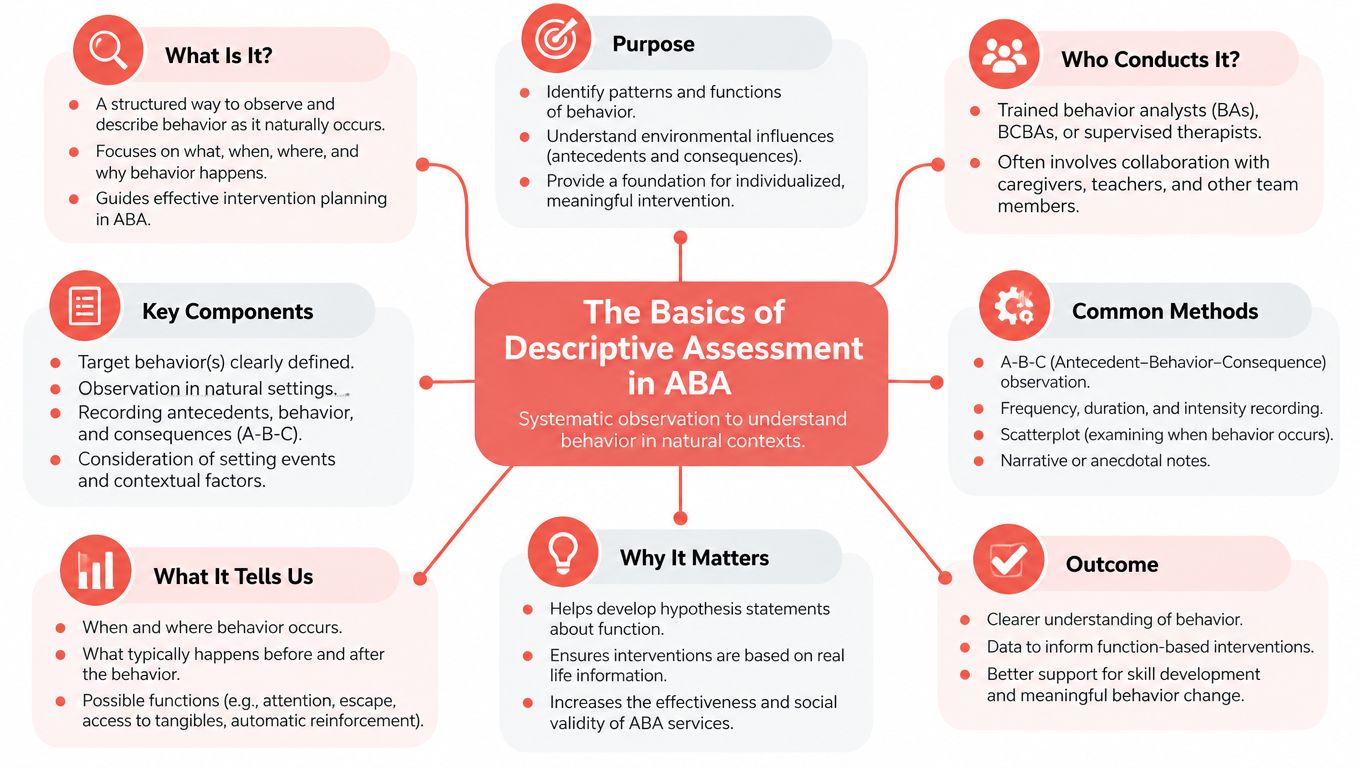
A BCBA may pair ABC notes with other measurements, such as how often a behavior occurs, how long it lasts, or how quickly it begins after an instruction. These measurements help the team track change without relying only on memory or impressions.
The video below offers another visual introduction to the process.
The next step is learning how clinicians read these records as a pattern rather than treating every incident as an isolated problem.
How ABC Data Tells a Story
An ABC data sheet is more than a list of difficult moments. A BCBA reviews several entries together and looks for repeated relationships. The goal isn't to label your child. It's to identify conditions that may make a behavior more likely and consequences that may be maintaining it.
Reading the three columns
The antecedent is the event immediately before the behavior. It might be a request to clean up, a transition from a preferred activity, a change in the schedule, or a period when an adult is helping someone else.
The behavior should be described so another trained observer would recognize it. “Had a bad attitude” is too vague. “Pushed the worksheet away, shouted, and left the chair” gives the team something observable to measure.
The consequence is what happened right afterward. Did the task stop? Did an adult provide attention? Did the child get access to a toy, snack, break, or help? The consequence doesn't mean punishment. It describes what followed.
Suppose a child has difficulty moving from play to table work. Across several observations, the behavior happens shortly after a transition instruction, and the worksheet is paused when the child protests. That pattern may suggest an escape function, meaning the behavior could help delay or avoid a difficult or non-preferred task. If an adult consistently talks at length with the child after the behavior, attention may also be relevant.
| Day | Antecedent | Behavior | Consequence |
|---|---|---|---|
| Monday | Tablet time ends and a table activity is presented | Child cries and pushes materials away | Activity is delayed while an adult talks with the child |
| Tuesday | Teacher signals a move from play to group work | Child drops beside the play area | Teacher helps the child leave the area and group work is postponed |
| Wednesday | Parent presents a writing task after free play | Child tears the paper and says, “No” | Parent removes the paper and offers reassurance |
| Thursday | A preferred game ends before a learning activity | Child runs toward the hallway | Adult follows and the planned activity pauses |
| Friday | A transition warning is followed by a table demand | Child protests and does not sit | Adult reduces the task and provides one-to-one support |
The table doesn't establish a cause. It shows a possible pattern across transition times, task presentation, and delayed demands. A BCBA may compare that pattern with other explanations, including communication difficulty, fatigue, sensory discomfort, or a need for clearer predictability.
Parents can learn more about possible behavior functions in this guide to the functions of behavior, but a general explanation can't replace an individualized assessment.
Looking beyond the incident
The clinician also checks when, where, and with whom behavior occurs. A child may protest during homework with one caregiver but not during play-based learning with another adult. A child may seek attention during a busy family dinner but leave tasks alone in a quiet room.
Repeated ABC entries help the team develop a working hypothesis. They don't create a verdict. That distinction matters because descriptive data can produce a plausible pattern even when the observed consequence isn't the true cause. Research has warned that descriptive assessment can suggest attention as a maintaining variable even when attention isn't causal, as discussed in this Journal of Applied Behavior Analysis research article.
The team must therefore decide whether the picture is clear and safe enough to guide an initial plan, or whether stronger testing is needed.
When Observation Is Enough and When More Is Needed
The choice between using descriptive data and moving to a functional analysis isn't a contest between a “simple” method and a “better” method. It's a clinical decision based on clarity, safety, consistency, and the consequences of getting the hypothesis wrong.
A functional analysis differs from descriptive assessment because the clinician deliberately changes environmental conditions to test what affects the behavior. Descriptive assessment observes naturally occurring events. Functional analysis tests a relationship under planned conditions.
A practical decision rule
Use this simple guide with your BCBA:
- Clear pattern plus low risk: The team may begin an intervention based on the descriptive hypothesis, while continuing to collect data.
- Unclear pattern: The team may need more observation, additional caregiver interviews, or a functional analysis.
- Dangerous behavior: Safety planning and stronger assessment methods may be necessary, but the team should carefully consider whether deliberately evoking behavior is appropriate.
- Different patterns across settings: The BCBA may gather more setting-specific information before deciding how to proceed.
- No meaningful change after an initial plan: The original hypothesis may need testing or revision.
A child who gently pushes materials away during a predictable transition may have a clear pattern that supports teaching a break request and improving transition signals. A child who engages in dangerous behavior for different reasons at home and school presents a more complex question. Observation alone may not show which variable is most important.
Clarity plus low stakes can support action. Ambiguity, risk, or an unsuccessful first plan calls for a deeper review.
A functional analysis can provide stronger experimental evidence, but it requires careful planning, consent, trained staff, and safety procedures. The purpose isn't to put a child through unnecessary distress. It's to answer a question that remains unresolved after less intrusive information gathering.
The Association for Science in Autism Treatment explanation of functional behavior assessment explains that descriptive assessment and functional analysis serve different roles. Descriptive assessment can help a BCBA narrow the possibilities, while functional analysis may be used to test and confirm a hypothesis when needed.
The most important question for parents is not, “Did the clinician do the most advanced assessment?” It's, “Does the assessment give us enough trustworthy information to choose a safe, individualized next step?”
Watching Behavior Across Home, School, and Community
A child can look like a different child in different settings. One child may cry and leave the group during circle time, become unusually quiet at the dinner table, and run toward the parking area during a visit to the park. These behaviors may share a function, or they may reflect different needs in different environments.
At school, the child may struggle when the teacher moves from a preferred activity to group instruction. At home, silence during dinner may happen when several people ask questions at once. At the park, leaving the play area may occur when an adult announces that it's time to go. Each setting changes the demands, available attention, distractions, and opportunities to escape.
A coordinated view
A BCBA can compare observations across environments instead of assuming that one setting explains everything. The team may ask:
- What instructions or transitions occur before the behavior?
- Who is nearby, and what do they do afterward?
- Can the child request help, a break, more time, or a preferred activity?
- Does the behavior happen during noisy, crowded, or unpredictable routines?
- What changes when the child has a visual schedule or advance warning?
Caregivers and teachers are essential partners because a clinician can't observe every important moment. A teacher may notice that the child participates when directions are paired with pictures. A parent may know that poor sleep or a change in routine made the morning unusually difficult. A caregiver's structured note can reveal context that a brief observation misses.
If home and school records both show behavior after difficult transitions and both show improvement when the child receives a clear warning, the hypothesis becomes more convincing. If school behavior follows academic demands while home behavior follows loss of attention, the differences matter. Diverging patterns may signal multiple functions, setting-specific needs, or the need for a fuller analysis.
The guidance on descriptive assessments from Autism Speaks describes the value of observing behavior in naturalistic settings, where time, place, and context can become visible. That information can guide support for generalization, which means helping a child use a skill with different people and in different places.
Coordinating multiple reporters can feel like another task on an already full schedule. Your BCBA should make the process manageable by explaining exactly what to record, choosing useful observation windows, and helping the adults compare information without turning every moment into paperwork.
What Parents Can Do to Support the Process
Your observations are not background information. They're some of the most valuable data the team can receive because you see routines, changes, preferences, and small signals that may not appear during a scheduled session.
Before observation begins
Keep a simple behavior log for one to two weeks if your BCBA recommends it. You don't need to write a long narrative. A few clear details are more useful than a page of guesses.
Record:
- Time and place: Note whether the event happened before school, during dinner, in a classroom, or at the store.
- Activity: Describe what your child was doing or expected to do.
- What happened first: Write the instruction, transition, noise, denied request, or other immediate event.
- What the behavior looked like: Use observable words such as cried, pushed, hit, ran, covered ears, or left the chair.
- What happened afterward: Record what adults and other children did, including whether the task stopped or attention increased.
Don't try to prevent every incident so the clinician sees only “good” behavior. Ordinary routines give the BCBA information about what your child encounters every day.
During the observation
Welcome the clinician into a normal routine when possible. You can answer questions, but try not to create a special performance or change every response. Tell the BCBA about context that may seem unrelated, including sleep changes, illness, new medications, schedule changes, appetite, or a difficult event at school.
Keep a shared note on your phone or in a notebook so caregivers can record similar information. Consistent notes help everyone notice whether the same pattern appears with parents, grandparents, teachers, or therapists.
The parent training resource from FriendlyABA can help families think about how caregiver coaching fits into daily routines and skill practice.
After the observation
Ask your BCBA three direct questions:
- What patterns emerged from the observations?
- What is the current working hypothesis, and what evidence supports it?
- What will we try first, and how will we know whether it is helping?
You can also ask what the team will measure, when the data will be reviewed, and what would lead to a change in the plan. A thoughtful clinician should be comfortable explaining uncertainty. “We have a strong hypothesis, but we'll keep checking it” is often more responsible than pretending the first observation answered everything.
Your job isn't to diagnose the behavior. Your job is to describe the moment honestly so the clinical team can make sense of it with you.
From Observations to a Plan That Works
Descriptive assessment becomes useful when the information leads to practical support. The BCBA combines ABC patterns, observations from different settings, caregiver priorities, and the child's strengths to write a working hypothesis. That hypothesis can then guide teaching, environmental changes, and progress monitoring.
A written hypothesis might describe a child who has difficulty leaving a preferred activity, communicates by dropping to the floor, and usually receives extra time with the activity afterward. The team may decide to teach a functional communication response for “more time” or “break,” add a visual transition cue, and make the end of the activity more predictable.
The plan should identify:
- What adults will do before the behavior: provide a clear warning, show a visual schedule, shorten the first demand, or offer a choice.
- What skill the child will learn: request help, ask for a break, indicate “finished,” wait, transition, or tolerate a small change.
- How adults will respond: reinforce the new communication and follow the agreed safety and support steps.
- What data will be collected: frequency, duration, independence, prompt level, or successful transitions.
- When the team will review the plan: use planned checkpoints such as 30, 60, and 90 days to examine progress and decide whether adjustments are needed.
Those checkpoints aren't promises about how quickly a child will change. They're opportunities to review whether the teaching strategy is clear, whether adults are using it consistently, and whether the goals remain meaningful.
For example, if observations show that a child struggles most when routines change without warning, the team might create a predictable visual sequence for getting ready. The child could practice checking the schedule, selecting between two options, and requesting help. The BCBA would review whether the child uses those skills with different caregivers and in different settings, rather than looking only at what happens during therapy.
Descriptive assessment is therefore the start of a feedback loop. Data may show that prompts need to be faded, reinforcement needs to be adjusted, or the environment needs additional support. If the pattern doesn't improve, the team should revisit the hypothesis instead of assuming the child is refusing to learn.
Families exploring the broader process can review this overview of applied behavior analysis assessment to understand how assessment information can contribute to individualized treatment planning. A respectful plan should make room for caregiver priorities, the child's communication style, safety needs, preferences, and participation in ordinary life.
FriendlyABA offers individualized ABA assessment, home, school, and community support, along with caregiver coaching from BCBAs and trained therapists. If you want help understanding your child's behavior and choosing a thoughtful next step, visit FriendlyABA to book a consultation or appointment.
Our Latest Insights











You don't have to figure it out alone
Whether you're exploring ABA therapy for the first time or searching for a provider who truly feels like the right fit, we're here to help.