


Parent Training for Autism a Warm Guide for Families
Learn how parent training for autism works, what you will practice, and how to choose a supportive program that fits your family routines.


Your child is halfway into a morning routine, the cereal is getting cold, and you're trying to remember the exact way the therapist showed you to prompt a request for juice without turning breakfast into a battle. That's the moment many parents realize parent training for autism is not about adding one more task to an already full day, it's about getting support for the moments that already matter.
At FriendlyABA, that kind of support is part of the work, not an extra. Parent coaching is meant to help families use small, practical strategies in real routines, so home feels less like a place where therapy happens and more like the place where skills start to stick. If you're new to ABA, or still trying to sort out what caregiver training really looks like, this guide will walk you through the basics, the day-to-day skills, the ways services are delivered, and the honest picture of what progress can look like.
If you're wondering whether your child might benefit from ABA therapy at all, this related guide can help you notice some early signs: 7 signs your child may benefit from ABA therapy.
Table of Contents
- A Gentle Start to Parent Training for Autism
- Coaching, not doing it for you
- What the coaching relationship looks like
- Communication and social connection
- Daily living and independence
- Behavioral support in plain language
A Gentle Start to Parent Training for Autism
A lot of parents arrive at ABA feeling like they've been handed a new language and a full-time job at the same time. One parent may be trying to get shoes on before school, another is figuring out how to handle a meltdown over a red cup, and someone else is hearing terms like “prompting” and “generalization” before they've even had a chance to breathe.
Parent training for autism starts with those real moments. It is coaching for the parts of the day that already happen, breakfast, transitions, requests, bedtime, and the small breakdowns in between. The goal is to help you support communication, behavior, and independence in ways that fit your family, not add another layer of homework to an already full day.
At FriendlyABA, parent coaching is meant to feel practical, not heavy. The work usually starts with your child's strengths, your concerns, and the routines where things get stuck, then builds from there with a BCBA, which stands for Board Certified Behavior Analyst, a clinician trained to design and oversee ABA plans. If you want a simple picture of what an ABA therapist does, that role helps explain the support behind the scenes.
Practical rule: if a strategy only makes sense in the therapy room, it probably is not ready for parent coaching yet.
What families usually gain most is clarity, consistency, and a few tools they can use right away. What may stay less certain is exactly how fast progress will show up, or which skills will generalize on their own without practice in daily life. That is why the next sections focus on the basics, the skills families practice, how sessions can fit into busy schedules, what progress can realistically look like, and how to choose a program that feels supportive instead of overwhelming.
If you are still wondering whether your child might benefit from ABA therapy at all, this guide to early signs your child may benefit from ABA therapy can help you spot a few common clues.
What Parent Training for Autism Really Means
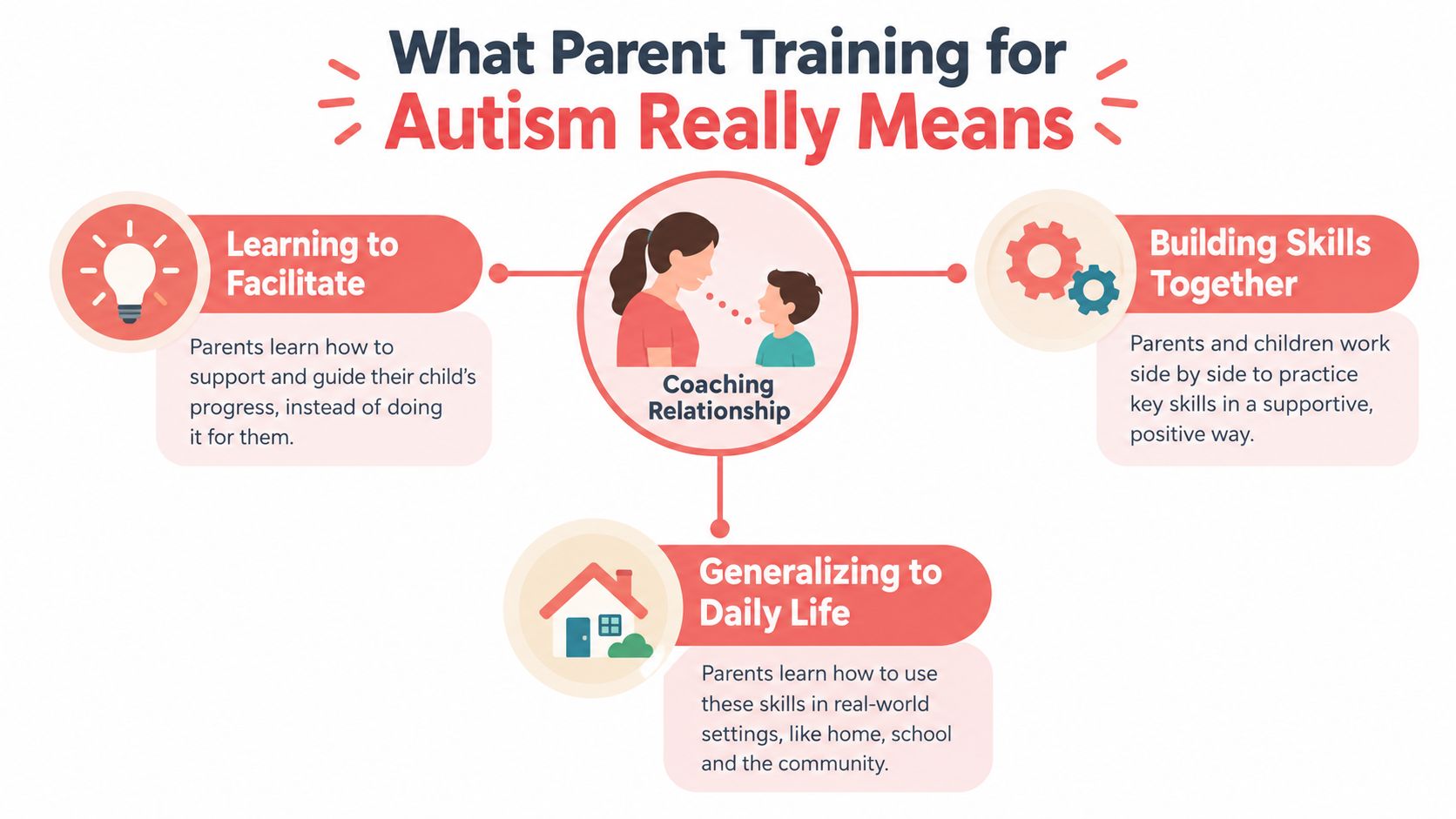
Think of parent training like learning to coach your child during the game, not learning to replace the coach. A therapist may show a strategy, model it, and help you practice it, but you are the person who uses it in the messy, ordinary moments of daily life, like getting out the door, asking for help, or calming down after disappointment.
Coaching, not doing it for you
ABA stands for Applied Behavior Analysis, a structured way of teaching skills and reducing barriers to learning. In parent training, the focus is usually on teaching caregivers how to use evidence-based strategies between sessions so skills don't stay trapped in one room or with one person. That might mean learning how to prompt a request, how to reinforce a useful behavior, or how to make a routine easier to follow.
The key boundary matters. Caregivers are not being turned into their child's therapist. Guidance from California autism practice guidelines says a parent or caregiver should not serve as the official behavior technician or behavior analyst for their own child, and caregiver training is typically built around individualized assessment, modeled practice, in-vivo coaching, and support for generalizing skills into new settings (California autism practice guidelines).
That boundary is reassuring. It means the work is designed around what parents can realistically do at home, not around turning dinner into a clinic session.
What the coaching relationship looks like
A BCBA may watch a routine, point out what's working, and help you adjust one small piece at a time. You might practice waiting for a response, using a visual cue, or giving a choice in a way that lowers stress and increases follow-through. The point is not perfection, it's repetition with feedback.
Parents usually do best when the strategy fits a real routine they already live with, not a script they have to memorize.
The best parent training usually feels like a partnership. You bring the knowledge of your child and your home, and the clinician brings the structure, the data, and the behavior plan. Together, you make the skill easier to use on an ordinary Tuesday, not just during a calm, ideal session.
Core Skills You Will Practice at Home and Beyond
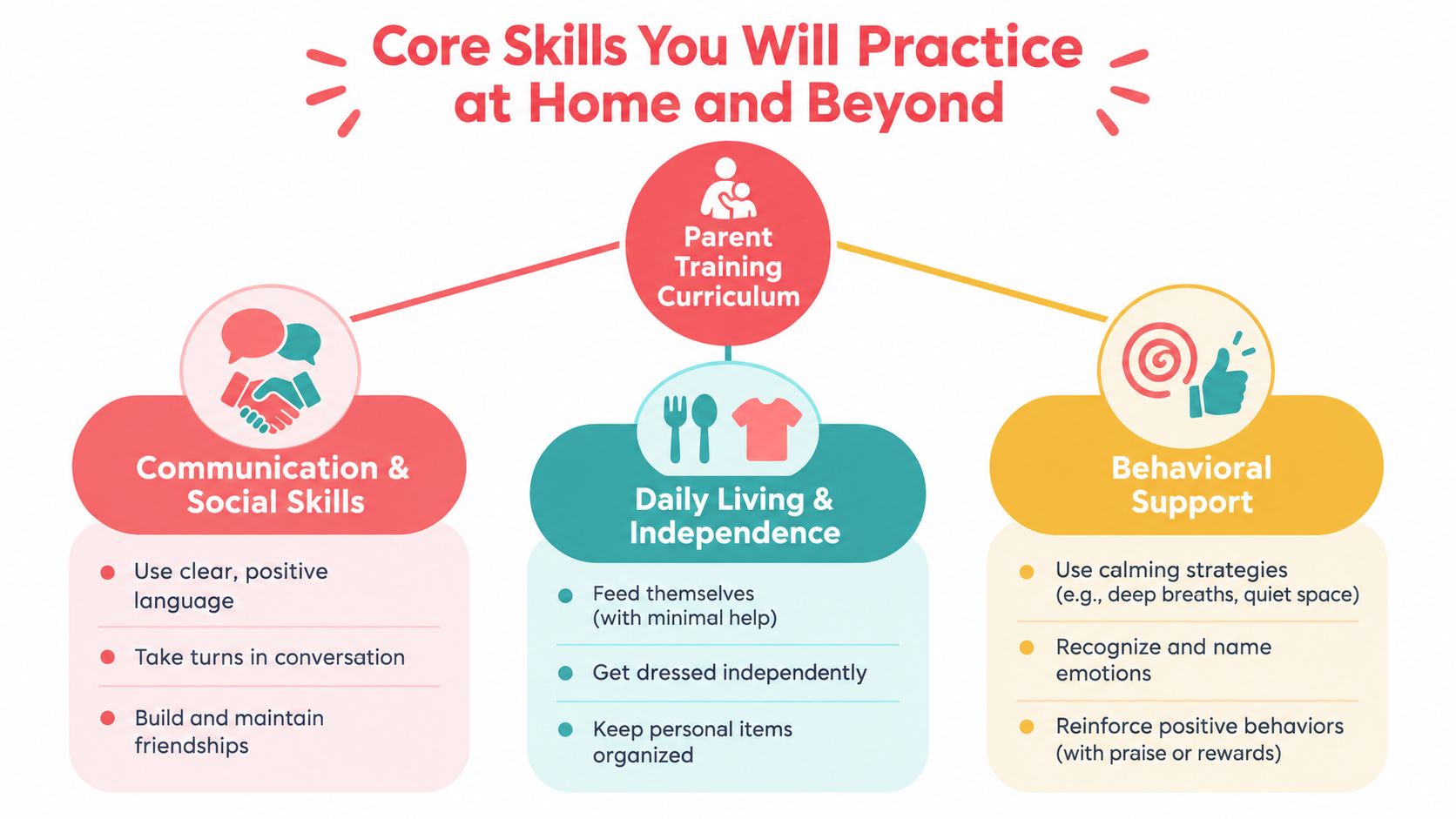
The skills families practice are usually simpler than they first sound. They're the kinds of things that make daily life smoother, like helping a child ask for a snack instead of grabbing, or getting through a bedtime routine without a long negotiation.
Communication and social connection
A lot of parent coaching starts with communication, because it affects nearly everything else. Families may practice giving a child a chance to request help, modeling short phrases, or creating a reason to communicate during play. Even something as simple as pausing before handing over a favorite toy can open the door for a request.
Social moments matter too. Turn-taking with a ball, waiting for a response during a game, or helping a child greet a sibling can all be part of the plan. These are small moments, but they build the habits that support connection.
Daily living and independence
Daily routines are a natural place to practice. Brushing teeth, putting on socks, washing hands, and cleaning up toys all give parents repeatable opportunities to teach one step at a time. A BCBA may break the routine into smaller parts so it feels less like a struggle and more like a sequence your child can learn.
Behavioral support in plain language
Behavior support is often where parents feel the most relief, because it turns a confusing pattern into something observable and workable. Instead of trying to “fix” a child, the caregiver learns how to prevent some problems, respond more consistently, and teach a replacement behavior that works better for the child.
- Use clear cues: short directions are easier to follow than long explanations.
- Reinforce the right moment: notice when your child uses the skill, even briefly.
- Practice in ordinary routines: breakfast, bath time, and getting dressed are all learning opportunities.
Useful lens: if a skill only works during a special activity, it hasn't fully transferred yet.
FriendlyABA's home-based ABA service is one option for practicing these skills in natural routines, because the setting itself becomes part of the lesson. That can make it easier to see where a child is succeeding, where the routine is getting stuck, and what needs to change next.
How Parent Training Is Delivered to Fit Real Family Life
Families don't all need the same format. Some need in-home support because that's where the hardest moments happen, while others need telehealth because work, siblings, transportation, or distance make frequent visits hard.
| Choosing a Delivery Mode That Fits Your Family | What Sessions Feel Like | Best Fit For |
|---|---|---|
| In-home coaching | The clinician watches real routines, offers feedback in the moment, and helps you practice where daily life actually happens | Families who want support in morning, meal, or bedtime routines |
| Clinic or community sessions | You practice strategies in a structured setting, then carry them into home and community life | Children who need practice in more than one setting |
| School-coordinated support | Caregivers and school staff work toward shared routines and consistent responses | Families who want alignment between home and school |
| Telehealth or hybrid support | Coaching happens by video, often with planning, demonstration, and follow-up between visits | Working families, multilingual households, and caregivers with limited availability |
Home-based support can feel especially practical when the same routines cause stress every day. If that's the kind of fit you're looking for, FriendlyABA describes its home-based ABA services as individualized sessions in the child's natural environment, which can make the coaching feel more grounded and less abstract.
Telehealth has its own strengths. Recent studies show online coaching can improve parent use of evidence-based strategies and child communication behaviors, and a 2025 review on fathers in parent-coaching interventions found the evidence base is still only moderate, which means many programs still need to do a better job understanding caregiver roles and access barriers (telehealth and fathers review).
What a good fit often looks like
The right format usually depends less on what sounds polished and more on what your family can keep doing. A strong plan is one you can attend, understand, and use again next week.
If the schedule is impossible, the plan is too big for the family, no matter how strong it looks on paper.
One more thing matters here. The more a program helps you practice in the settings where life really happens, the easier it is for skills to transfer beyond the session. That's often where the value of parent coaching shows up.
What Progress Can Look Like and What Remains Uncertain
Families often ask the hardest question first, and they should. They want to know what tends to improve, what might improve a little, and what may stay uneven even with good support.
Some of the strongest evidence points to behavior change. A 2023 systematic review and meta-analysis of parent training for children with autism spectrum disorder included 8 randomized controlled trials with 653 total participants and found a significant reduction in disruptive behavior, with a standardized mean difference of -0.59 (PubMed review). A separate Cochrane review on early intervention delivered by parents found that parent-delivered interventions reliably changed parent-child interaction patterns and showed some improvement in child language comprehension and autism severity (Cochrane review).
Where gains are usually more modest
Not every outcome moves the same way. A meta-analysis of 19 randomized clinical trials in young children with autism found small but measurable benefits across domains, with weighted Hedges' g averaging 0.23 and ranging from 0.18 for communication-language to 0.27 for socialization (meta-analysis). That's a helpful reminder that progress can be real even when it's gradual and specific rather than dramatic.
The same analysis reported that outcomes were not significantly different by treatment dose, which suggests that quality, implementation, and the target behavior may matter more than just adding more sessions. In plain language, the right skill practiced well can matter more than a bigger calendar.
What families often want to know most
A newer meta-analysis of parent-mediated interventions found no clear benefit for broad autism characteristics, adaptive functioning, language, or parental stress, while still finding improvements in child behavior problems and parent sensitivity/synchronicity (2026 meta-analysis). That nuance matters. Families often care about communication, daily functioning, and smoother routines, but they should know that broad diagnostic change may be limited or uncertain.
Realistic goal-setting helps here. A strong parent plan usually names a behavior you can see, hear, or count in daily life.
A practical way to frame progress is to ask, “What will be different in our home routine?” That might mean less resistance at bedtime, more willingness to ask for help, or a smoother handoff from screen time to dinner. Those are meaningful changes, even when they don't look dramatic from the outside.
How to Choose a Program and Provider With Confidence
A good parent training program feels like practical coaching, not a pile of homework. It should make room for your real routines, your real questions, and the moments that happen at the kitchen table, in the car, or at bedtime.
What to look for
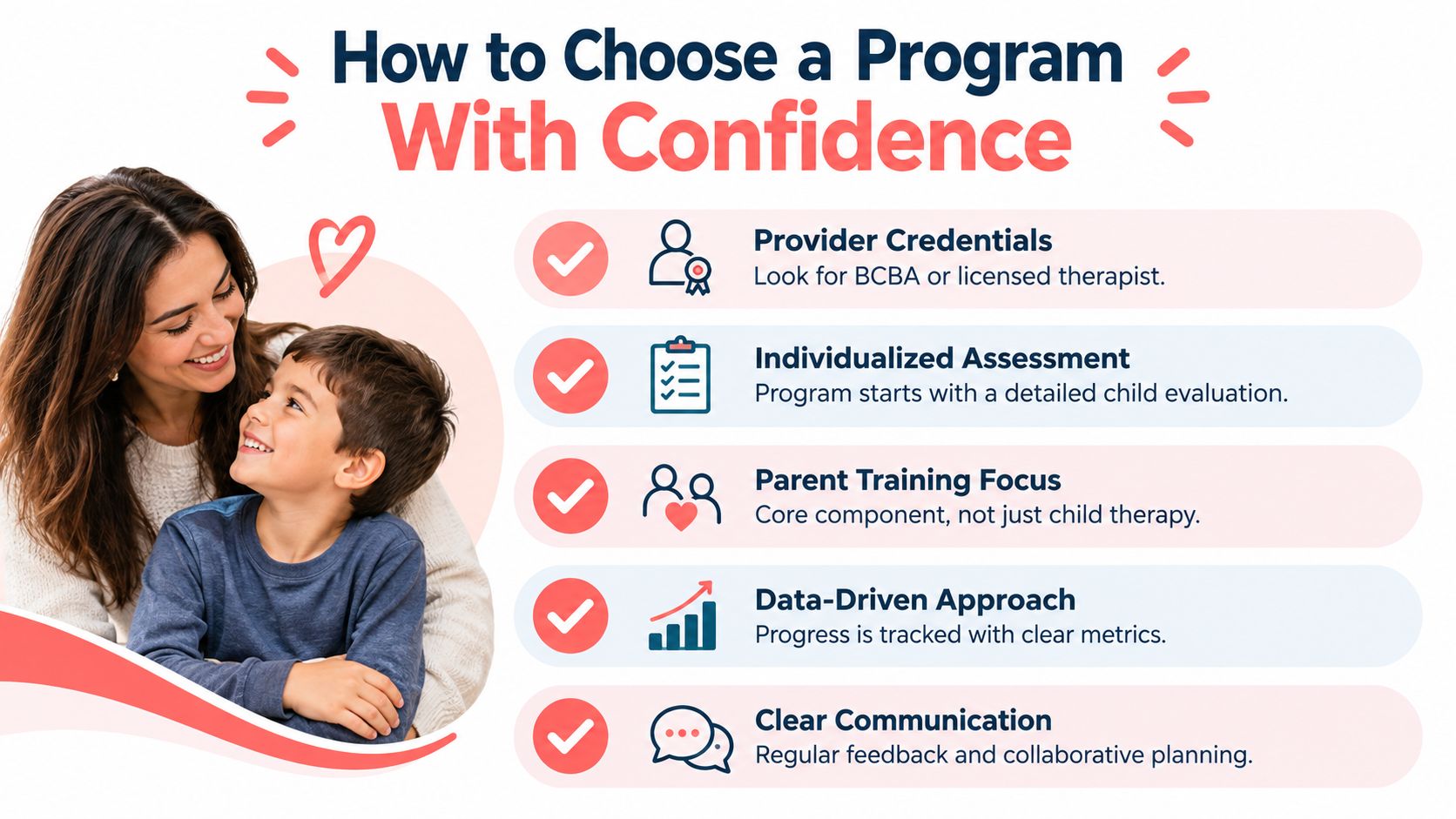
Start with an assessment that reflects your child, not a template. A strong program includes BCBA supervision, clear progress tracking, and practice in daily settings so skills can carry over. Parents should also hear plain-language explanations, because strategies only help when you can understand and use them.
Here's a simple checklist:
- Individualized assessment: the plan starts with your child's strengths, challenges, and routine.
- Caregiver collaboration: your goals and concerns shape the work.
- Data-based decisions: the team checks whether a strategy is helping.
- Practice in real life: home, school, or community settings matter.
- Clear feedback: you should know what's working and what needs revision.
If you are comparing providers, ask how parent coaching is structured, how often a BCBA reviews the plan, and how the team supports carryover across settings. Those questions tell you far more than a polished brochure ever will.
A careful overview of ABA therapy basics for parents can also make those consultation conversations easier to follow. It gives you a clearer starting point when the terms start to blur together.
Red flags worth noticing
Watch for programs that treat parent training like an afterthought. Watch for plans with no clear way to track progress, or for approaches that look the same for every child. A family should never be handed a set of instructions without support or follow-up.
FriendlyABA's process includes consultation, assessment, plan development, therapy implementation, and milestone reviews with ongoing updates. That kind of structure helps parents know where they are in the process and what comes next, without leaving them to guess.
Moving Forward Together With Small Moments and Big Milestones
Parent training for autism works best when it feels like support for real life, not a stack of clinical chores. The strongest gains often show up in communication, behavior, and parent-child interaction, while broader developmental changes may be smaller or less predictable. That's not a failure, it's a reason to set thoughtful goals and stay focused on what you can see at home.
If you want to start small today, pick one routine that keeps getting stuck, notice the exact moment it breaks down, and write down what your child does right before the problem starts. Then try one simple change, like shortening your instruction, offering a choice, or pausing long enough for a response. Small adjustments like that can give your BCBA something concrete to build on.
You don't need to solve every challenge this week. You do need a plan that respects your child, your energy, and your family life, and that's where good coaching makes a difference.
FriendlyABA offers ABA services with parent coaching built into the process, so families can practice strategies in the routines that matter most at home, in school, and in the community. If you're ready to talk about individualized support for your child with autism, visit FriendlyABA to book a consultation and see what a practical, family-centered plan could look like.
Our Latest Insights




You don't have to figure it out alone
Whether you're exploring ABA therapy for the first time or searching for a provider who truly feels like the right fit, we're here to help.