


Telehealth ABA Therapy: What Parents Should Know
Telehealth ABA therapy explained for parents: how it works, what research says, when it fits, and how to set up sessions your child will engage with.


You may be reading about telehealth ABA therapy after another long day, with a child who needs support, a work schedule that won't bend, and a therapy waitlist that seems to get longer each time you check it. The practical question isn't whether video appointments sound convenient. It's whether a clinician can understand your child, coach you effectively, and help with meaningful skills when everyone is at home.
Feeling hopeful and skeptical at the same time is reasonable. ABA, or Applied Behavior Analysis, is a therapy that builds practical skills through positive, structured learning, and telehealth changes where that learning happens. The right choice depends on your child's goals, your family's capacity, and the kind of support a clinician can safely provide through a screen.
Table of Contents
Why Families Are Exploring Telehealth ABA Therapy
It's late, and you're searching while your child sleeps. Earlier, getting dressed turned into a struggle, communication broke down during dinner, and a transition that looks simple on paper took most of the evening. You've already considered in-home services, school support, and traditional clinic visits, but travel, availability, or scheduling has made each option difficult.
Then you see telehealth ABA therapy. A part of you wonders whether a video call can make a real difference. Another part wonders whether your child will leave the room, ignore the screen, or become frustrated before the session even begins. Those questions don't mean you're resistant to therapy. They mean you're trying to make a careful decision for your family.
Telehealth can be particularly useful when the important moment happens in the home. A caregiver may need help supporting communication during breakfast, teaching a child to follow a bedtime routine, or responding consistently when a preferred activity ends. In those situations, the clinician can observe the setting where the skill is needed and coach the adult who will keep practicing after the appointment.
A useful starting point: Ask which goals can be taught effectively through coaching and observation, rather than asking whether telehealth is universally good or bad.
Families also explore in-home ABA therapy because home-based support can fit naturally around play, meals, self-care, and family routines. Telehealth isn't automatically easier, though. It may reduce travel while increasing the caregiver's active role, and it still requires privacy, workable technology, and a plan for measuring progress.
This guide focuses on the decision behind the service. You'll learn what a virtual session involves, what research supports, which goals often fit telehealth, when a hybrid or in-person arrangement may be safer, and how to prepare your home. You'll have questions to bring to a BCBA, or Board Certified Behavior Analyst, so you can discuss what your child needs right now.
What Telehealth ABA Therapy Actually Looks Like
Think of telehealth ABA as a video appointment with your pediatrician, but with more active coaching and practice. Instead of only discussing what happened during the week, the clinician may watch a routine, demonstrate a strategy, ask you to try it, and offer feedback while the situation is still happening.
A BCBA, or Board Certified Behavior Analyst, is a master's-level clinician who designs and supervises behavior plans. A BCBA may work with trained therapists, often called registered behavior technicians or RBTs, depending on the service model. The team should define who observes, who coaches, who collects information, and who changes the plan.
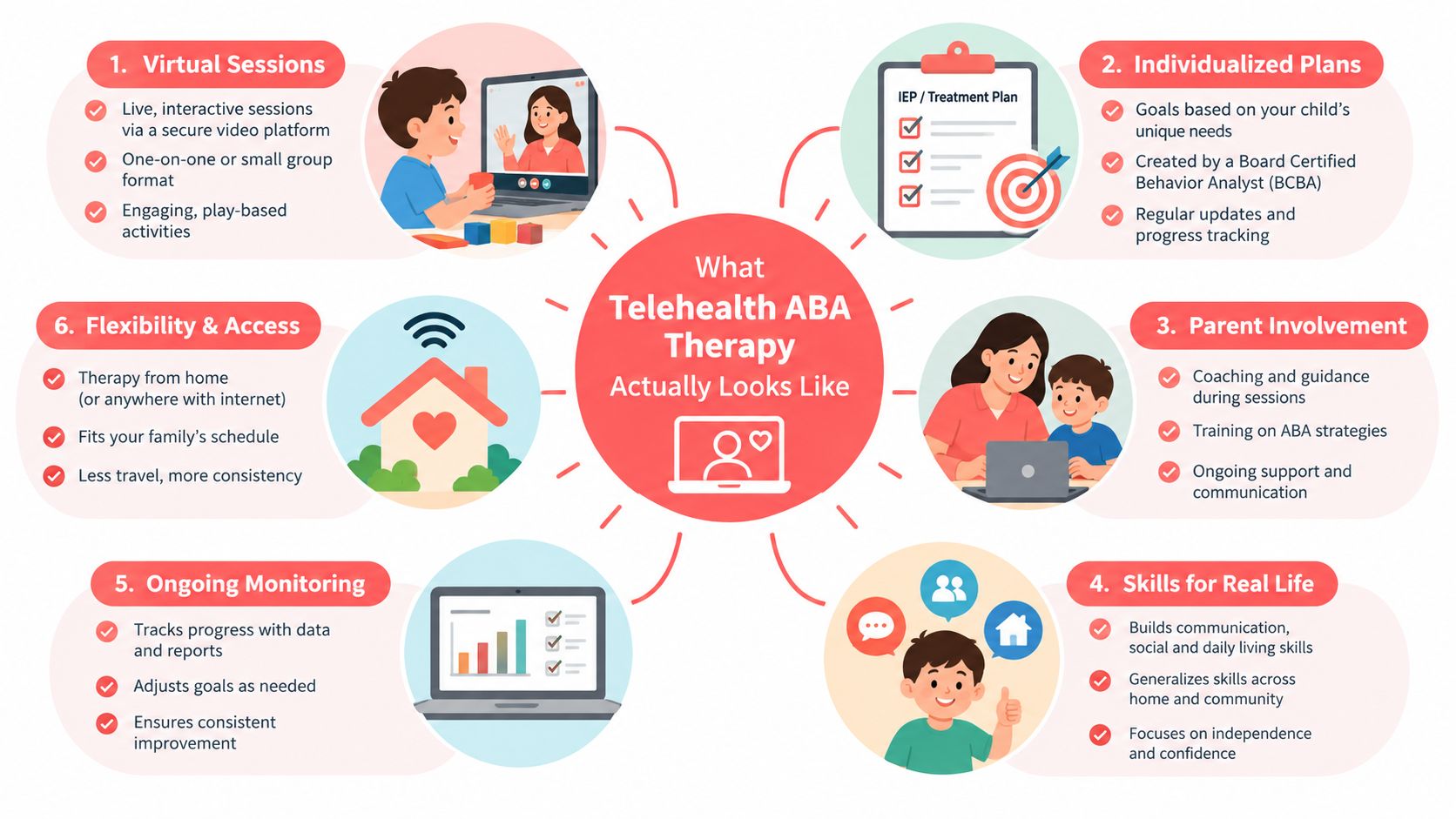
The main ways sessions are delivered
Live caregiver coaching is often the clearest use of telehealth. The BCBA watches you support your child during play, snack, toothbrushing, or a transition. The clinician might model how to offer choices, wait for communication, reinforce an attempt, or respond to a behavior safely.
Direct child sessions place the clinician more directly in the interaction. The child may practice identifying items, responding to instructions, communicating choices, playing, or participating in short social activities through video. This model works best when the child can engage with the format and the goals don't depend on physical guidance.
Remote observation allows the BCBA to see behavior in a natural setting. With appropriate consent and privacy protections, the clinician may observe a home routine or coordinate with a school team. Observation helps the provider notice what happens before and after a behavior, not just hear a summary later.
Hybrid care combines virtual and in-person visits. A therapist may work directly with the child while the BCBA supervises remotely, or the family may alternate between home visits and video coaching. This arrangement can offer hands-on support for some goals while preserving telehealth's flexibility for caregiver consultation.
The pandemic made remote care a much more common operational option. During the first three months of the COVID-19 pandemic, monthly therapy use among the diverse autistic children examined in one review fell by 10.65 hours, with p < 0.001. During the following nine months, use rose by 2.39 hours per month, also with p < 0.001, but that recovery didn't replace the initial loss. Across the studies summarized, 36.8% to 77% of parents reported disruptions to ABA services, while the number of autistic children receiving teletherapy across disciplines had increased tenfold by the end of June 2020 (review of therapy utilization during the pandemic).
That history explains why telehealth matters, but it doesn't answer whether it fits your child. A thoughtful provider should assess the child, caregiver, goals, environment, and safety needs before recommending a format. Families considering caregiver coaching can also review what active participation involves in parent training for autism.
What the Research Says About Telehealth ABA
The research supports a careful middle position. Telehealth ABA appears feasible and can be effective for selected goals, but it shouldn't be described as an automatic replacement for in-person treatment.
A 2018 systematic review evaluated 28 studies involving telehealth delivery of behavior-analytic interventions for children and adolescents with autism spectrum disorder. The applications included videoconferencing, remote caregiver coaching, and training for interventionists who implemented ABA procedures. Every study reported improvement in at least one measured outcome, which supports the possibility of delivering ABA-related training and intervention remotely (the systematic review in the Journal of Autism and Developmental Disorders).
The same review also showed why parents should look beyond encouraging headlines. Twenty-seven of the 28 studies, or 96%, were rated as weak in research quality. The reviewers concluded that telehealth ABA appeared feasible and potentially effective, but couldn't yet be classified as an established evidence-based practice under their criteria.
That doesn't make the approach useless. It means the quality of the service matters greatly. A casual video conversation and a structured telehealth program aren't the same thing.
What a responsible program measures
A clinician should begin with an individualized assessment. That means identifying the skill or behavior that matters, understanding what happens around it, and agreeing with the family on an observable way to track change.
Families should expect a plan that includes:
- Direct progress measurement: The team records meaningful information about communication, routines, participation, or behavior rather than relying only on impressions.
- Treatment-fidelity checks: Fidelity means checking whether the caregiver or therapist is using the plan as designed. The provider should observe implementation and offer corrections.
- Regular review: The BCBA should adjust teaching steps when progress stalls, a routine changes, or the plan is too difficult to use.
- Generalization checks: Generalization means seeing whether a skill works with different people, materials, rooms, routines, or communication partners.
- Safety planning: The team identifies which situations require in-person support or a different response before remote services begin.
Structured parent coaching can produce strong implementation when the teaching process is active. In one telehealth behavioral parent-training study, mean parent fidelity was 96.8%, while clinician fidelity averaged 98.6%. In a separate application involving functional assessment and functional communication training, mean parent fidelity was 96.2% during functional analysis and 97.6% during functional communication training (telehealth behavioral parent-training study). These averages came with wide ranges, so they shouldn't be treated as guarantees for every family or session.
The practical question is therefore not just, “Does telehealth work?” It is, “Can this clinician deliver this goal safely and accurately through this format, with the support our family can provide?”
When Telehealth Fits Your Child's Goals
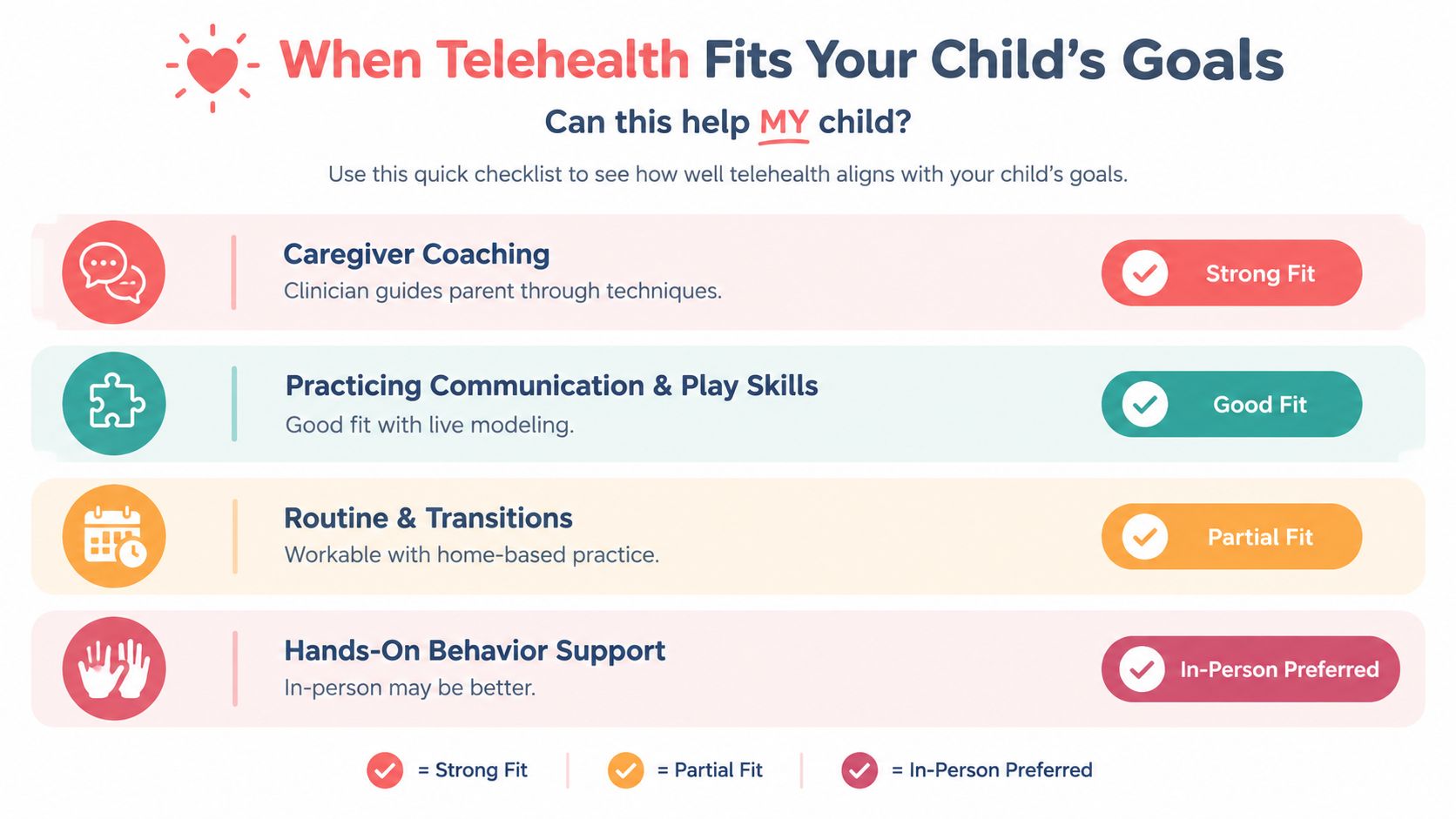
A parent might ask, “Can telehealth help my child specifically?” The answer begins with the goal, not the technology.
Telehealth tends to be strongest when the intervention happens in a natural routine and a caregiver can participate. For example, a BCBA may coach you to offer two choices during breakfast, pause to give your child time to request, and reinforce an understandable attempt. The provider can then help you use the same approach during play or getting ready to leave.
Caregiver coaching, home observation, troubleshooting, and routine-based practice are often practical remote targets. Telehealth may also support consistency between in-person visits, especially when a family needs help applying a strategy across several parts of the day.
A goal-by-goal view
| Therapy Goal | Telehealth Strength | When In-Person or Hybrid May Be Better |
|---|---|---|
| Communication | Strong fit for caregiver coaching, choice-making, functional requests, and live modeling during routines | In-person support may help when the child needs direct prompting, specialized materials, or intensive communication assessment |
| Daily routines | Good fit for practicing dressing, meals, hygiene, transitions, and task steps in the home | Hybrid care may help when the routine involves significant safety concerns or physical assistance |
| Social skills | Can support caregiver-led play, turn-taking, conversation practice, and observation of sibling interaction | In-person sessions may provide richer practice with peers, groups, or community activities |
| Behavior support | Useful for observing patterns, coaching prevention strategies, and reviewing what happens before and after behavior | In-person care may be preferred for severe safety behaviors, crisis situations, or behavior requiring hands-on support |
| Parent training | Strong fit for demonstration, rehearsal, feedback, and problem-solving across daily routines | A hybrid plan may be useful when the caregiver needs live modeling in the home before practicing independently |
A systematic review of telehealth interventions for autism found outcomes were generally comparable with face-to-face services in studies that directly compared the formats. Reviewed outcomes included communication, social communication, adaptive skills, play, challenging behavior, and progress toward individualized education program goals. The review also found no generally significant group differences for outcomes such as implementer fidelity and children's social-communication progress (systematic review of telehealth interventions for autism).
An IEP, or Individualized Education Program, is a formal school plan for a student's special education services and goals. Progress toward an IEP goal may be relevant to telehealth planning, but school-based needs still require coordination with educators and attention to the setting where the skill must be used.
The review's findings are encouraging, not universal. Telehealth may be less suitable for a child who can't yet tolerate brief virtual interaction, a caregiver who can't participate reliably, or a goal that requires physical prompting. Severe safety concerns also deserve careful in-person assessment.
A good BCBA should be willing to recommend hybrid or in-person care when the goal requires it. The format can also change over time as your child's skills, preferences, routines, or safety needs change.
Setting Up Your Home for Successful Virtual Sessions
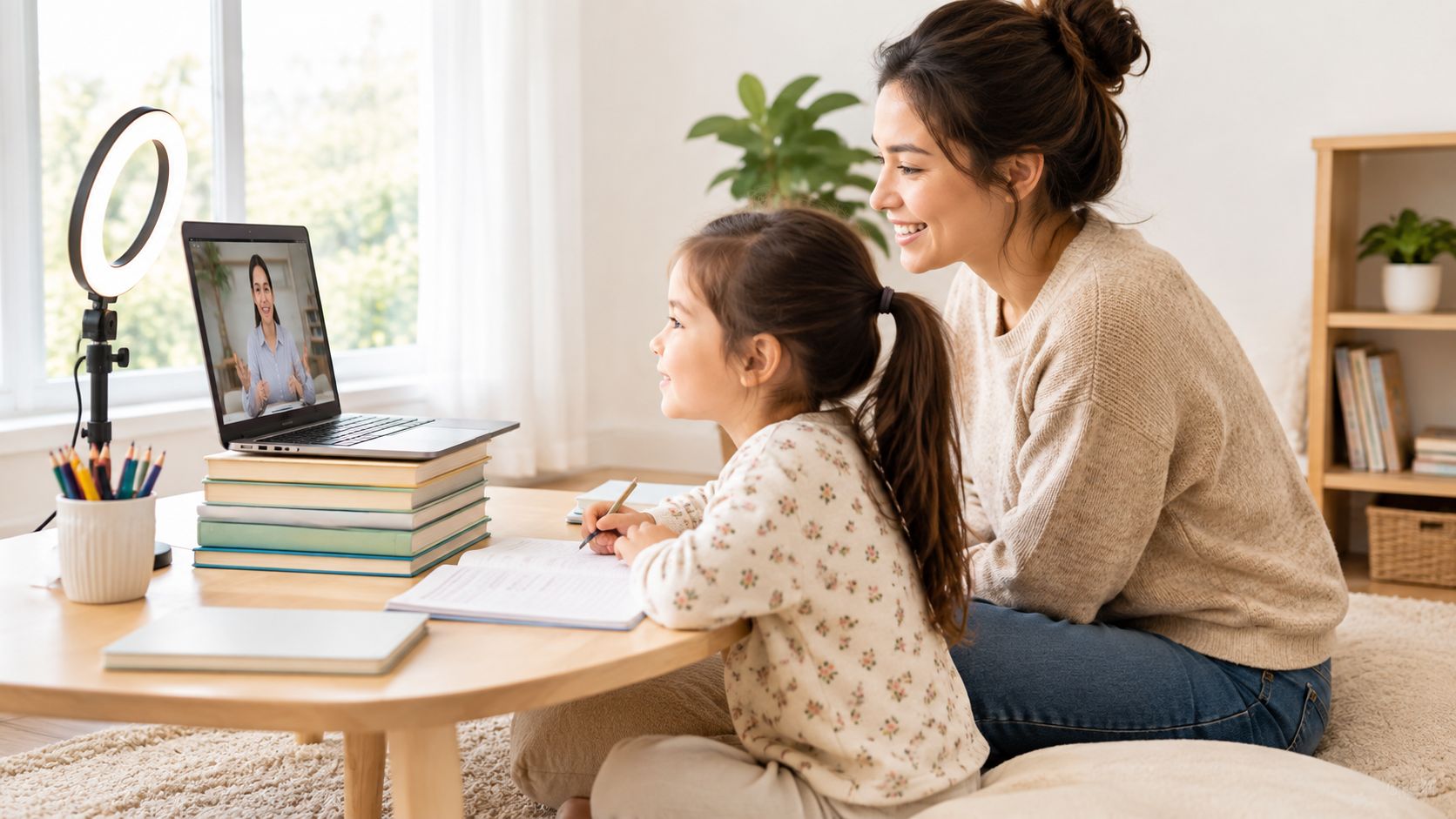
The clinician can only coach what they can clearly see and hear. You don't need a perfect therapy room, but you do need a workable space that allows the provider to observe the child, caregiver, materials, and routine.
Start with the basics:
- Choose a usable space: A quiet, well-lit area with fewer distractions is often enough. Clear a small surface for toys, picture cards, snacks, or other materials.
- Position the device carefully: Use a laptop or larger tablet when possible. Place it so the camera can show both the child and the caregiver, then move it when the routine changes.
- Prepare preferred materials: Keep a small set of favorite toys, books, household objects, or motivating activities within reach. The BCBA can help you decide what supports participation.
- Use headphones strategically: An adult may use headphones when they make coaching easier, but the child still needs to hear the interaction clearly.
- Protect privacy: Tell other household members when the session is taking place and use a private setting whenever possible.
Check the access questions early
Reliable high-speed internet makes it easier to maintain a clear connection, but families shouldn't feel they need expensive equipment. Before the first appointment, practice opening the platform, checking the camera and microphone, and finding a place with the most stable connection.
Caregiver availability is just as important as bandwidth. Ask how much of the session requires you to participate, whether another adult can help, and what happens if work, siblings, illness, or an unexpected routine makes participation difficult. Telehealth can reduce travel, but it doesn't remove the need for caregiver time.
Insurance rules also require confirmation. Medicaid telehealth policy is state-specific, and states may decide which services, practitioners, locations, modalities, and payment levels they cover. A national Medicaid summary reports that all 50 states, Washington, D.C., and Puerto Rico reimburse some form of live-video Medicaid telehealth, but that doesn't mean every ABA service, provider type, or cross-state arrangement is covered (Medicaid telehealth reimbursement guidance).
Before starting: Ask about prior authorization, copays or other coverage requirements, provider licensure, missed-session policies, interpreter access, equipment, and what the family should do if the connection fails.
The provider should explain privacy practices and how session information is handled. If telehealth isn't workable for a particular routine or period of your life, say so early. A responsible team can discuss alternatives rather than treating technology problems or caregiver limits as a personal failure.
Keeping Your Child Engaged During Telehealth Sessions
A child doesn't need to sit perfectly still for telehealth to be useful. Many children learn while moving, playing, looking away briefly, or switching between activities. The goal is active participation that matches the child's developmental level, not screen-time endurance.
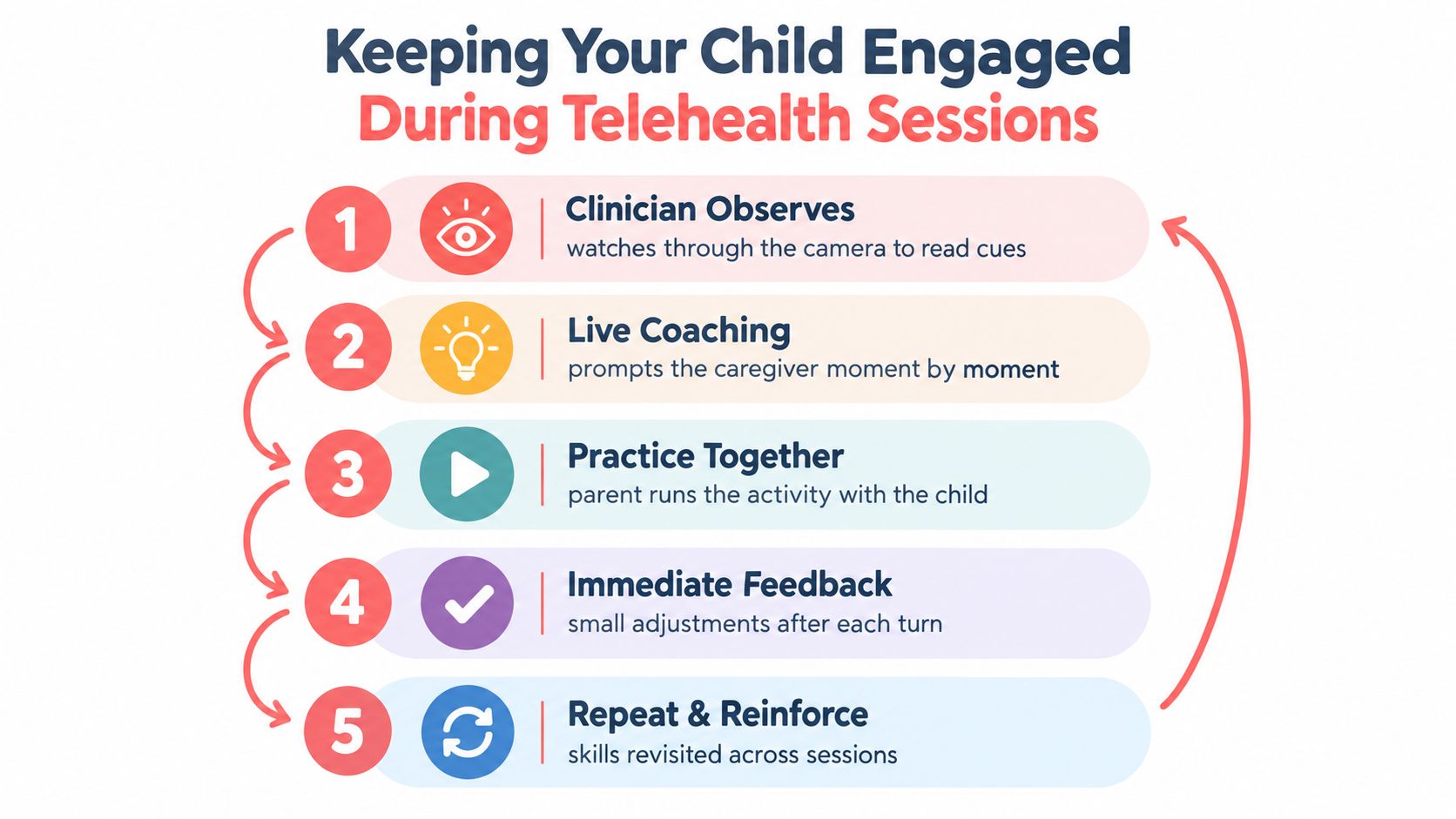
A well-run session often follows a repeating coaching loop. The clinician demonstrates a strategy, watches the caregiver try it during an ordinary routine, gives specific feedback, and invites another practice attempt. The provider might show how to prompt a request during snack, watch you try it, suggest waiting a little longer, and then help you repeat the interaction.
Make practice feel like ordinary life
Short activity blocks often work better than one extended demand. A BCBA may help you alternate a communication practice with movement, a preferred toy, a song, or a simple household activity. If your child loves cars, use cars to practice requesting, turn-taking, or following a small direction. If your child enjoys water play, the clinician might coach communication and waiting during that routine.
Let your child move when movement is safe. The camera may need to be repositioned so the provider can follow the action, but a child doesn't have to remain in one chair to demonstrate learning. Parents can also reduce pressure by practicing skills inside routines that already happen, such as putting on shoes, choosing a snack, or cleaning up toys.
The caregiver's role is important, but it shouldn't mean you must already know how to run therapy. Your provider should make the strategy understandable, model it, and help you practice until it feels manageable.
Questions to ask a provider
A prerecorded lesson can explain an ABA procedure, but explanation alone doesn't show whether you can use it during a difficult moment. Ask whether the program includes:
- Live observation: Will the clinician watch you and your child interact rather than only discuss what happened?
- Rehearsal: Will you practice the strategy during play, meals, dressing, or another real routine?
- Specific feedback: Will the BCBA explain what to change, such as the timing of a prompt or the way reinforcement is delivered?
- Progress measurement: How will the team know whether the caregiver is using the strategy and whether the child is benefiting?
- Adaptation: What happens if the child avoids the activity, the plan is too difficult, or progress slows?
A randomized controlled study of a virtual ABA parent-training program used online modules and scripted role-play through a secure virtual platform. Parents practiced ABA skills in structured work and play-based situations while evaluators observed them directly. The treatment group showed large, statistically significant improvements across all measured skills, while the waitlist control group didn't show comparable improvement, and parents rated the virtual training highly acceptable (randomized controlled virtual ABA parent-training study).
The most important person on camera may be the caregiver. Your child can move, pause, or need breaks while you and the clinician keep the learning active and respectful.
Deciding on Telehealth ABA Therapy With Confidence
Telehealth ABA therapy is a legitimate option, but its value depends on treatment fit. It may be especially useful for caregiver coaching, natural routines, observation, and troubleshooting. A hybrid plan may be more appropriate when your child needs hands-on teaching, peer practice, or direct support for safety. For some families and goals, in-person care remains the better primary format.
The decision doesn't need to be framed as telehealth versus in-person therapy forever. Ask what your child needs now, what you can realistically participate in, how the provider will measure progress, and how quickly the team will reconsider the format if the plan isn't working.
A thorough ABA assessment can help clarify strengths, communication needs, routines, safety concerns, and priority goals before a service model is selected. At FriendlyABA, BCBAs involve caregivers, track progress with real data, and adjust individualized plans across home, school, community, and telehealth settings. The focus is on practical growth through small moments, big milestones, and support that respects the family's priorities.
You don't have to arrive at the first consultation with a perfect answer. Bring the routine that's hardest, the skill you most want your child to gain, and the concerns you have about video sessions. A thoughtful clinician should help you weigh the options, without pressure or promises.
FriendlyABA offers individualized ABA support with BCBA-led assessment, caregiver coaching, progress monitoring, and telehealth or hybrid planning when those formats fit a child's goals. Visit FriendlyABA to book a consultation and talk through the support your child and family need.
Our Latest Insights
















You don't have to figure it out alone
Whether you're exploring ABA therapy for the first time or searching for a provider who truly feels like the right fit, we're here to help.