


Finding the Right ABA Program Near Me: A Parent's Guide
Looking for an ABA program near me? Discover how to find, evaluate, and choose a local ABA therapy provider with confidence and clarity.


At 10 p.m., you're at the kitchen table with a laptop open, a few clinic names in your notes app, and more questions than answers. One provider has a waitlist, another promises quick progress, and a third never calls back. You're searching for an ABA program near me, but what you really need is a team you can trust with your child and your family's daily life.
You don't have to choose perfectly on the first call. You do need a process that helps you compare programs, recognize meaningful quality, ask direct questions, and walk away when a provider isn't transparent. The right search is less like picking a name from a directory and more like having a series of careful conversations, observations, and small decisions.
Table of Contents
Starting the Search When Everything Feels Urgent
The parent at that kitchen table often feels behind before the search even begins. Maybe a pediatrician recommended an evaluation. Maybe your child's school raised concerns about communication, transitions, or participation. Perhaps you already have an autism diagnosis and are trying to understand insurance, waitlists, treatment settings, and unfamiliar clinical terms all at once.
That urgency makes sense. It also makes families vulnerable to the first available opening, even when the program doesn't answer basic questions clearly. A nearby provider matters, but proximity alone doesn't tell you whether the program is organized, individualized, or workable for your family.
ABA, or Applied Behavior Analysis, uses observation, teaching strategies, and measurement to support skills such as communication, daily routines, play, learning, and safety. Its modern history includes behavioral experiments in 1960 by Charles B. Ferster and Marian K. DeMyer, followed by a landmark 1987 study involving intensive ABA. That study reported that 47% of children who received about 40 hours per week for two or more years, beginning before age four, achieved what the study called “normal functioning,” meaning IQ and school placement were comparable to typical peers. The history and later evidence are summarized in this overview of ABA's research history. The study's design and language shouldn't be treated as a promise for an individual child, but they help explain why structured, measurable intervention remains part of many families' care plans.
Replace panic with a manageable process
Before you make calls, write down what you need from the search:
- A reliable lead list: Find programs through several channels rather than trusting one online result.
- Visible quality markers: Look for qualified supervision, individualized goals, useful data, and family involvement.
- A short interview script: Ask every provider the same core questions so comparisons are fair.
- Permission to leave: A program that pressures you, avoids specifics, or dismisses your concerns isn't the right match.
Keep a simple notebook or digital document. Record the provider's name, contact person, service area, settings offered, insurance information, waitlist details, and your immediate impression. You're not trying to predict your child's future from one phone call. You're checking whether the adults responsible for care communicate clearly and treat your family as a partner.
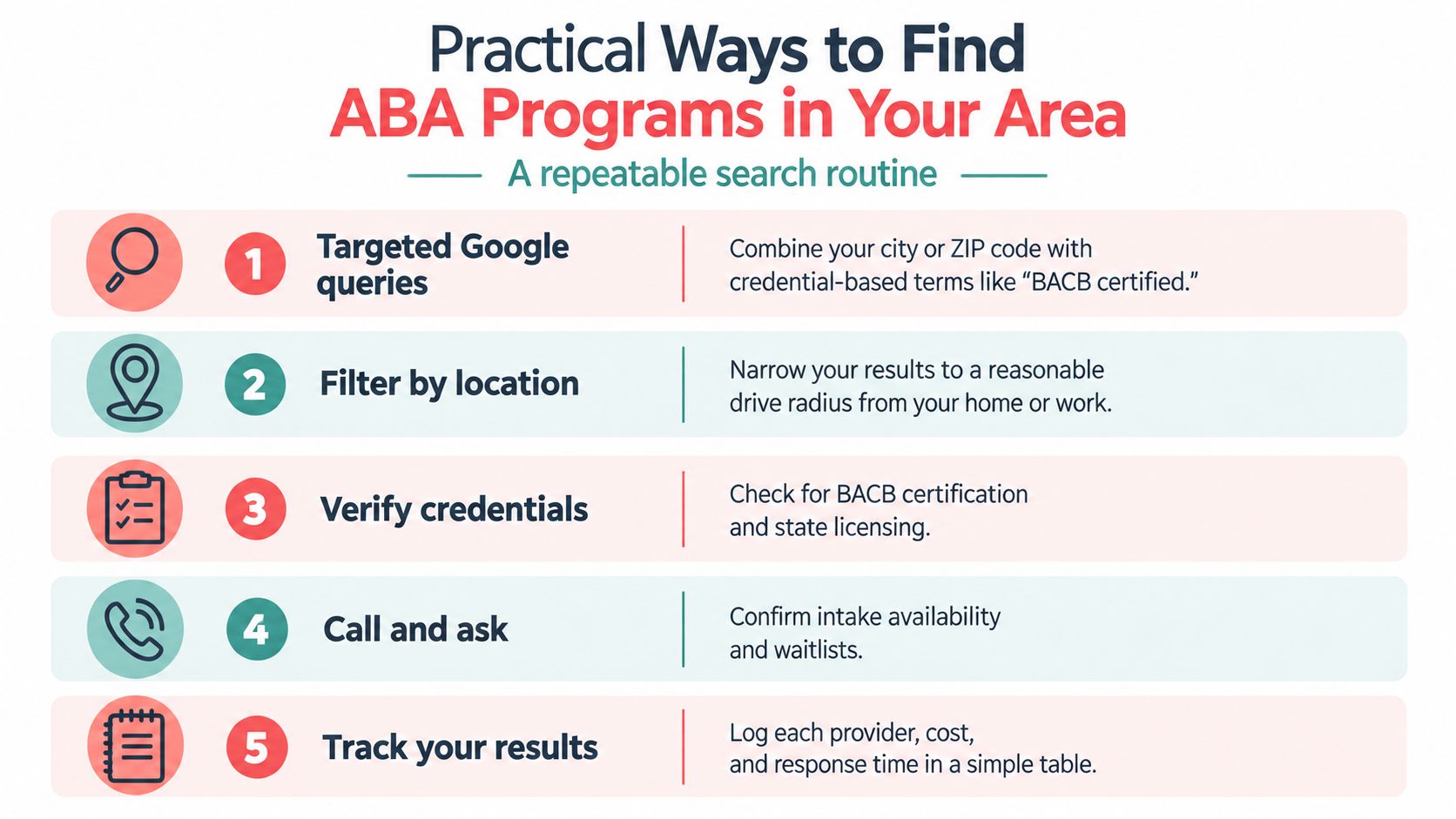
Practical Ways to Find ABA Programs in Your Area
Search deliberately instead of opening dozens of random results. Start with Google queries that combine your city or ZIP code with terms such as “ABA therapy,” “BCBA,” “home-based ABA,” “school-based ABA,” and “BACB certified.” Add the setting that matters most to you, such as “in-home ABA near [city]” or “school consultation ABA near [ZIP code].”
Then check your insurance carrier's provider portal. Filter for in-network behavioral health providers and confirm that the listing includes ABA or behavior analysis, not only general counseling. An insurance directory is a starting point, not proof of current availability, so call the program directly and ask whether it accepts your plan for your child's specific service.
Build a local referral circle
Ask your child's pediatrician, developmental pediatrician, psychologist, or diagnosing clinician which local programs families commonly contact. Your child's special education team may also know providers who coordinate effectively with schools. Ask for names, but ask what the referral is based on. “They communicate well with teachers” is more useful than a vague recommendation to “try this clinic.”
Local autism parent groups can offer practical insight about response times, scheduling, and caregiver experience. State Medicaid waiver programs and autism service directories may add options that don't appear prominently in ordinary search results. If you're looking in Connecticut, you can also review FriendlyABA's Connecticut service information as one starting point for understanding local availability.
Call two or three promising programs within the same week. That keeps details fresh and makes it easier to compare answers.
Use this starter checklist
- Search terms: City or ZIP code, ABA, BCBA, home-based, school-based, in-network.
- Contact columns: Provider, phone, email, contact person, service settings.
- Clinical questions: Assessment process, goals, supervision, parent coaching, data review.
- Access questions: Insurance accepted, current intake status, waitlist process, cancellation policy.
- Follow-up reminders: Date of call, promised response, documents requested, next action.
Don't judge a program only by how quickly someone answers. Judge it by whether the person answering can explain the next step without making you feel rushed or confused.
What a Quality ABA Program Actually Looks Like
Quality isn't hidden in a glossy website. You can usually see its outline during an intake call, assessment, or tour. A strong program can explain who supervises treatment, how goals are chosen, where sessions occur, how progress is measured, and how caregivers participate.
A BCBA, or Board Certified Behavior Analyst, is a credentialed professional who designs and oversees behavior-analytic services. Ask who will assess your child, who will write the treatment plan, and how often that person will directly observe sessions. The Behavior Analyst Certification Board requires supervisors overseeing RBTs and other supervised personnel to complete an 8-hour supervision training before providing supervision, as described in its supervision and training requirements. Ask how the program applies that oversight in daily practice, rather than accepting a credential as the only measure of quality.
Look for useful goals in real settings
Your child's goals should connect to life outside therapy. “Improve behavior” is too broad. A useful goal might involve requesting help during a difficult routine, brushing teeth with fewer prompts, joining a classroom activity, tolerating a transition, or taking turns during play.
Natural-setting care can make those goals easier to practice where they matter. Home, school, and community sessions give the team opportunities to observe the actual routines that create difficulty. The setting still needs structure, though. Playful sessions should have a clear purpose, and child interests should guide teaching without replacing thoughtful measurement.
Effective ABA programs use direct observation, repeated objective measurement, a data-sampling schedule suited to the skill, and fidelity checks for staff and caregivers. Fidelity means checking whether a plan was delivered as designed. It doesn't prove that the plan itself is appropriate, so the team should also review functional outcomes and whether the goals matter to your child and family. This distinction is explained in a review of ABA practice guidelines and procedural fidelity.
Practical rule: Ask to see how a team turns session data into a treatment decision. If the answer is only “we keep notes,” ask what gets measured, who reviews it, and what would cause the team to change the plan.
A good program welcomes caregiver questions and explains progress in ordinary language. It should also coordinate appropriately with teachers and other providers when families authorize that communication. You're looking for a team that can balance technical skill with respect for your child's preferences, dignity, communication style, and comfort.
Quality Markers vs. Vague Promises
| Quality Marker | What It Looks Like in Practice | Vague Promise to Question |
|---|---|---|
| BCBA oversight | A named BCBA assesses, supervises, reviews data, and explains responsibilities | “Our clinical team handles everything” |
| Individualized goals | Goals reflect family priorities and observable daily skills | “We use the same proven plan for every child” |
| Direct measurement | Staff record relevant performance and review trends regularly | “You'll know it's working because sessions feel positive” |
| Fidelity checks | Supervisors observe implementation and correct errors | “Our technicians are trained, so we don't need formal checks” |
| Natural-setting practice | Skills are taught in home, school, or community routines when appropriate | “Clinic sessions are enough for every skill” |
| Family partnership | Caregivers receive coaching and can influence priorities | “Parents only need to receive weekly updates” |
Key Questions to Ask Every Provider You Contact
Take the same question list to every call. A confident provider won't treat reasonable questions as criticism. They'll explain the care model, acknowledge limits, and tell you what they still need to learn about your child before recommending services.
| Question to Ask | What to Look For | Red Flag Response |
|---|---|---|
| Who will supervise my child's program? | The provider names the BCBA, explains their role, and describes oversight of RBTs, or Registered Behavior Technicians | “A supervisor reviews things when needed” |
| How is the treatment plan customized? | The team discusses assessment, strengths, preferences, family priorities, and observable goals | “We'll use our standard curriculum” |
| Where can sessions happen? | Clear options for home, school, clinic, or community practice, based on clinical need and family logistics | “All children must use one setting” |
| How often will the BCBA observe and meet with us? | A specific supervision structure and a clear way to contact the clinical lead | “You probably won't need to speak with the BCBA often” |
| What does parent coaching involve? | Hands-on practice, explanations, feedback, and strategies that fit ordinary routines | “We send instructions home” |
| What data do you collect? | The provider explains what is measured, how often, and how decisions change | “We track overall progress” |
| How will you report progress? | Regular meetings, understandable graphs or summaries, and opportunities to revise goals | “We'll discuss it at the annual review” |
| How do you support generalization? | The team practices skills across people, places, materials, and routines | “Skills learned in sessions usually carry over” |
| How do you handle staff turnover and cancellations? | Honest information about continuity, backup coverage, make-up policies, and communication | Evasive answers or blame directed at families |
| Can I review a sample progress report? | A de-identified example that shows goals, measurement, interpretation, and next steps | Refusal to explain what families receive |
Listen for the quality of the answer
A strong response includes details without pretending to know your child before assessment. For example, a provider might say that the BCBA will complete an assessment, discuss priorities with you, observe relevant routines, and propose goals for your review. That answer respects both clinical process and family decision-making.
Parent coaching deserves special attention. Research reviews have found support for training caregivers to reduce non-productive behavior, increase acceptance of non-preferred foods, improve functional communication, strengthen following of parent requests, and teach imitation skills, while also noting that larger studies and longer-term outcomes are still needed. The overview of parent training in ABA provides that context. Ask what you'll practice, how feedback will be delivered, and how the plan will fit your household.
Write down answers during every call. Afterward, score each provider on communication, clinical clarity, location, availability, family fit, and your own sense of trust. Your notes will be more reliable than memory after several emotionally demanding conversations.
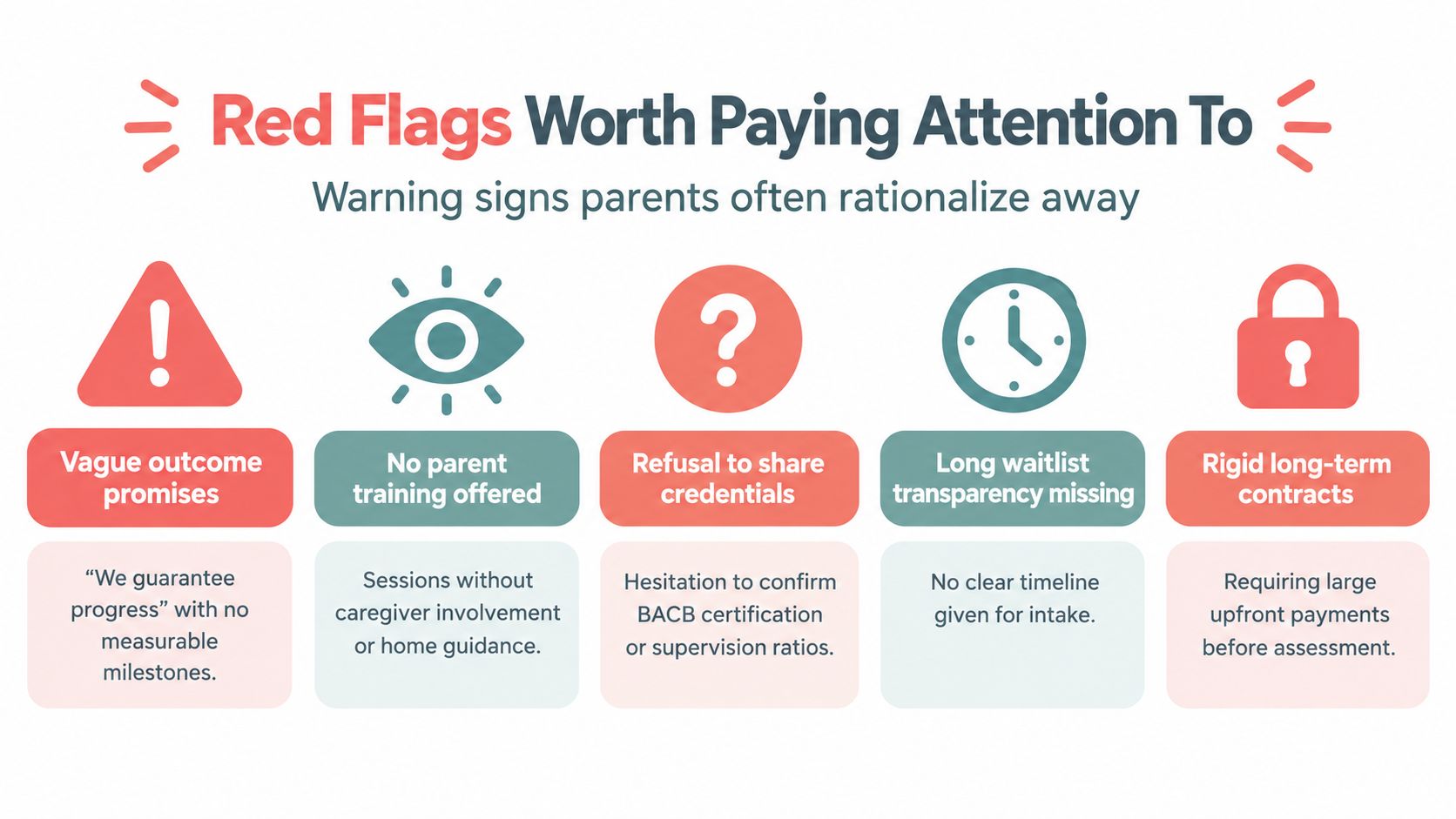
Red Flags Worth Paying Attention To
Not every poor fit is an unethical provider. Some programs may have limited capacity, offer only one setting, or lack the schedule your family needs. The concern begins when a provider avoids basic transparency or asks you to accept claims that can't be measured.
Treat promises as information
“We guarantee progress” and “we can cure autism” aren't reassuring statements. They signal that a provider may be selling certainty instead of describing an individualized clinical process. Ethical care can support meaningful skill development without promising a particular outcome, timeline, or change in identity.
Other warnings deserve equal attention:
- High technician turnover: Frequent staff changes can interrupt rapport, routines, and consistent teaching.
- Weak BCBA involvement: If the BCBA rarely observes, answers questions, or reviews data, supervision may exist mostly on paper.
- Cookie-cutter plans: A plan that ignores your child's interests, communication, sensory needs, and daily priorities won't reflect individualized care.
- No measurable goals: You can't evaluate “better behavior” without defining what the behavior looks like and how it will be observed.
- Resistance to parent observation: A provider should be able to explain privacy and safety policies without treating ordinary questions as a problem.
- Pressure before assessment: You shouldn't have to commit to a long-term arrangement before understanding the proposed goals, setting, schedule, and financial responsibilities.
You're allowed to pause. A vacant opening isn't automatically a good opportunity.
Ask for clarification once if an answer is unclear. If the pattern continues, keep looking. Families often rationalize warning signs because they're exhausted and afraid of losing a place in line. That fear is understandable, but it shouldn't force you into care that doesn't feel transparent or respectful.
From First Call to First Session
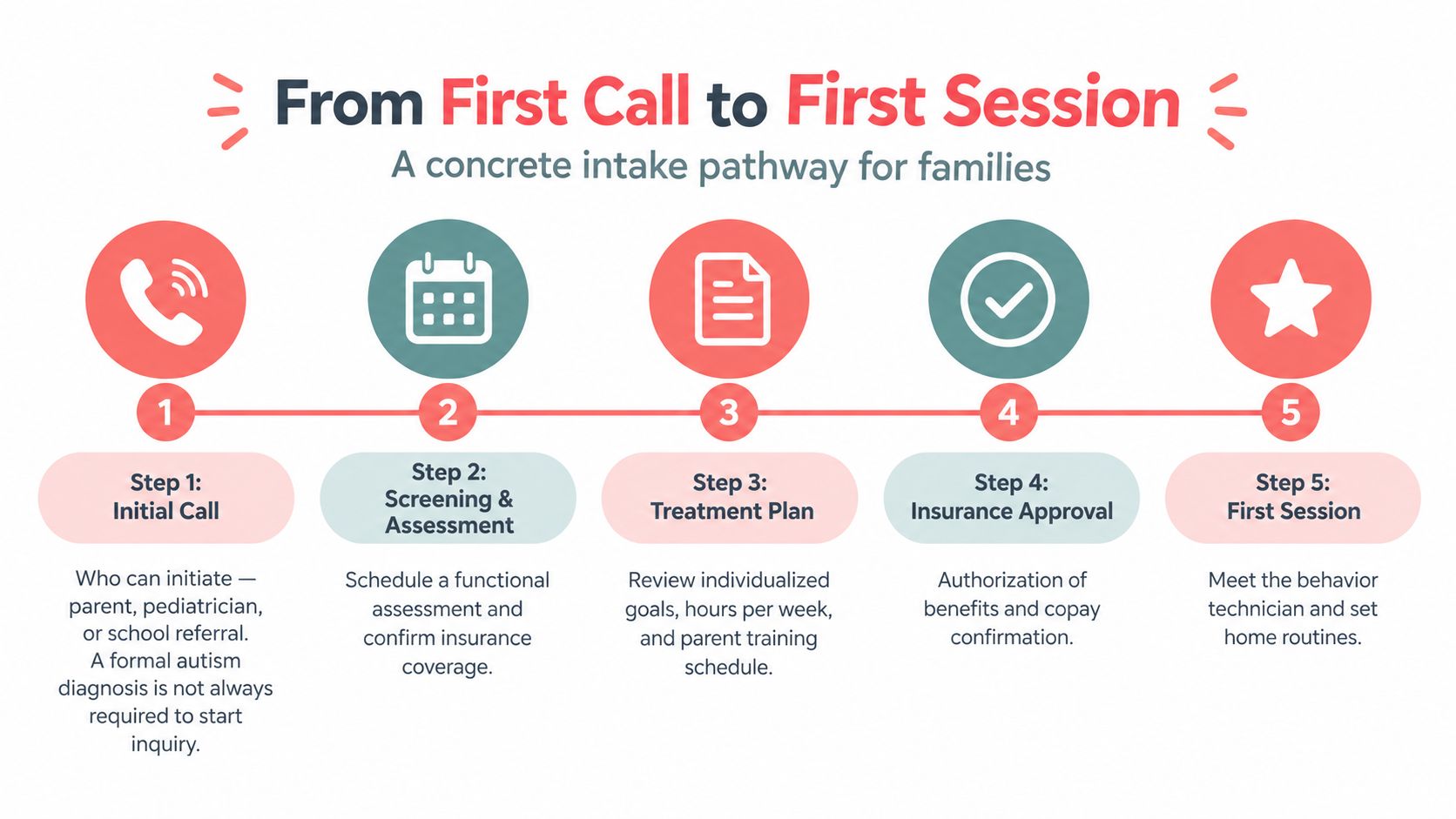
The first conversation doesn't lock you into treatment. It establishes whether the provider can help you understand the pathway. A parent, pediatrician, or school referral may begin the inquiry, and a formal autism diagnosis may not always be required to ask about eligibility or next steps. If your child hasn't received an evaluation, ask the pediatrician or developmental specialist how to request one and whether other early supports can begin while you wait.
Follow the intake pathway
- Initial call: Share your child's age, current concerns, diagnosis or evaluation status, preferred setting, insurance, and location. Ask whether the program is accepting inquiries and what documents it needs.
- Screening and assessment: The team gathers developmental history, interviews caregivers, and observes relevant skills or routines. Ask whether the assessment can include home or school information when those settings are central to your concerns.
- Treatment plan: The BCBA proposes individualized goals, service settings, parent coaching, and a supervision structure. Read the plan and ask for plain-language explanations before agreeing.
- Insurance approval: Confirm benefits, authorization requirements, copays, exclusions, and what happens if the insurer delays or denies authorization. Request written information whenever possible.
- First session: Prepare a short list of routines that go well, routines that are difficult, communication methods your child already uses, favorite activities, and calming supports. The first visit is a chance for the team to learn, not a test your child must pass.
Waitlists and insurance friction can make the process longer than any family wants. In one cohort of children referred for ABA, 13% never received ABA after referral, 66% had started and remained in services at 12 months, and 46% were still receiving services at 24 months, according to this study of ABA access and continuity. The figures don't predict your family's experience, but they show why you should ask how a provider manages delays, scheduling, caregiver burden, and continuity before accepting an opening.
A program may offer home, school, or community support, but availability and clinical fit still matter. Keep a second option in your notes while you wait, and ask when the provider will update you rather than leaving follow-up open-ended.
For a plain-language look at the assessment conversation, review what to expect during your first ABA assessment.
After the first visit, notice how your child responds and how the clinician responds to your observations. You don't need to judge the entire program from one session, but you should leave knowing what was observed, what happens next, and how you can raise concerns.
Taking the Next Step With Confidence
Choosing an ABA program is a parent-led evaluation, not a directory lookup. Use each conversation to test the fit. You know your child's routines, communication, strengths, preferences, and stress signals. A qualified provider should listen to that knowledge, add clinical expertise, and explain recommendations in language you can use.
After services begin, keep your notes open. Record questions for supervision meetings, notice where skills appear naturally, and mark routines that remain difficult. Ask for a plan review when treatment is not addressing meaningful priorities. Poor communication or an uncomfortable fit gives you reason to compare another program. Starting services does not give up your right to make informed choices.
Make one decision today
Choose one provider and schedule an initial consultation. Ask what the first steps involve, who will participate, how observations are handled, and when you will receive an update. Write down the answers. You do not need to resolve every insurance, scheduling, and treatment question tonight. You need a clear next conversation.
Review this guide to ABA therapy cost for practical financial questions families commonly ask. Then return to your priorities, whether they involve communication, independence, participation, safety, connection, or another everyday skill.
FriendlyABA provides individualized ABA services with BCBA and therapist support in home, school, and community settings. Its services also include parent coaching, assessment, treatment planning, and ongoing progress review. If you want to discuss your search for an ABA program near you, visit FriendlyABA to explore services and request a consultation.
Use that conversation to describe your child's priorities and ask how intake works. Compare the provider's answers with your notes, observations, and practical needs before choosing the next step.
Our Latest Insights













You don't have to figure it out alone
Whether you're exploring ABA therapy for the first time or searching for a provider who truly feels like the right fit, we're here to help.