


Autism Therapy Services for Families: A Complete Guide
A parent-friendly guide to autism therapy services. Learn how ABA, speech, OT, and social skills work together and how to choose the right fit for your child.

The first time a parent hears “we should look into autism therapy services,” life can feel like it tilts sideways. Maybe it was a teacher's note, a pediatrician's referral, or a waitlist that appeared before your child even had a full evaluation. In that moment, most families are not looking for a perfect plan. They're looking for the next clear step and someone calm enough to explain it.
That's where the right support can make a real difference. Autism therapy services are not one single thing, and they are not just about “doing therapy” for a few hours a week. They usually involve a team of supports that help a child with autism communicate, handle routines, build independence, and take those skills out into real life at home, at school, and in the community.
A good provider won't ask you to figure it all out at once. They'll help you sort the pieces, keep the goals practical, and adjust the plan as your child grows.
Table of Contents
The First Conversation Every Parent Remembers
A parent often remembers the first conversation because it arrives with relief and fear at the same time. Someone has finally named the concern, and the next question comes fast, what do we do now?
If that sounds familiar, you are not behind. You are at the start of a process that can feel messy at first, especially when you have a referral, a screening result, or a long wait for evaluation. The useful shift is to stop treating autism therapy as one huge decision and start seeing it as a set of supports that can be matched to your child's needs.
Start with the child in front of you
A toddler who does not yet point for help, a kindergartener who melts down during transitions, and a child who speaks well but struggles with peer play may all need different combinations of services. That is normal. The service should fit the child, not the other way around.
A practical first question is simple: where does the difficulty show up most often, at meals, bedtime, school pickup, or play with other children?
Practical rule: Ask the provider to name one routine, such as bedtime or snack time, where the plan will show up in the first two weeks.
Families also need to know that support can begin before every question is answered. The American Academy of Pediatrics recommends developmental screening at 18 and 24 months, and children should be referred for intervention when delays are identified, rather than waiting for every diagnostic piece to be finished (AAP guidance). That matters because early help can lower stress now, even while the fuller picture is still being built.
The healthiest first conversation sounds less like a sales pitch and more like teamwork. You bring the child you know. The provider brings a framework, steady follow-up, and enough experience to help you take one step at a time.
What Each Autism Therapy Service Actually Does
Think of autism support like a sports team. No one position wins the game alone. Each role handles a different part of the field, and the child benefits most when those roles work together instead of competing.
ABA in plain language
Applied Behavior Analysis, or ABA, is a learning framework that looks at what happens before and after a behavior so a child can build more useful skills. In practical terms, a therapist might praise and reinforce a child for asking for help, following a transition routine, or using a safer behavior instead of frustration. The CDC notes that behavioral approaches are widely used in schools and clinics, and that progress is tracked and measured (CDC treatment overview).
For families, that means ABA should feel concrete. A Board Certified Behavior Analyst, or BCBA, helps design the plan. Therapists then work on the goals during sessions and collect data so the team can see what's helping.
Speech therapy, OT, and social skills
Speech therapy focuses on understanding and using language. That can mean spoken words, gestures, pictures, or a device. Occupational therapy, often called OT, supports daily living, sensory regulation, and the fine motor skills a child uses for things like dressing or handling classroom materials. Social skills work gives children guided practice with turn-taking, conversation, and friendship-building.
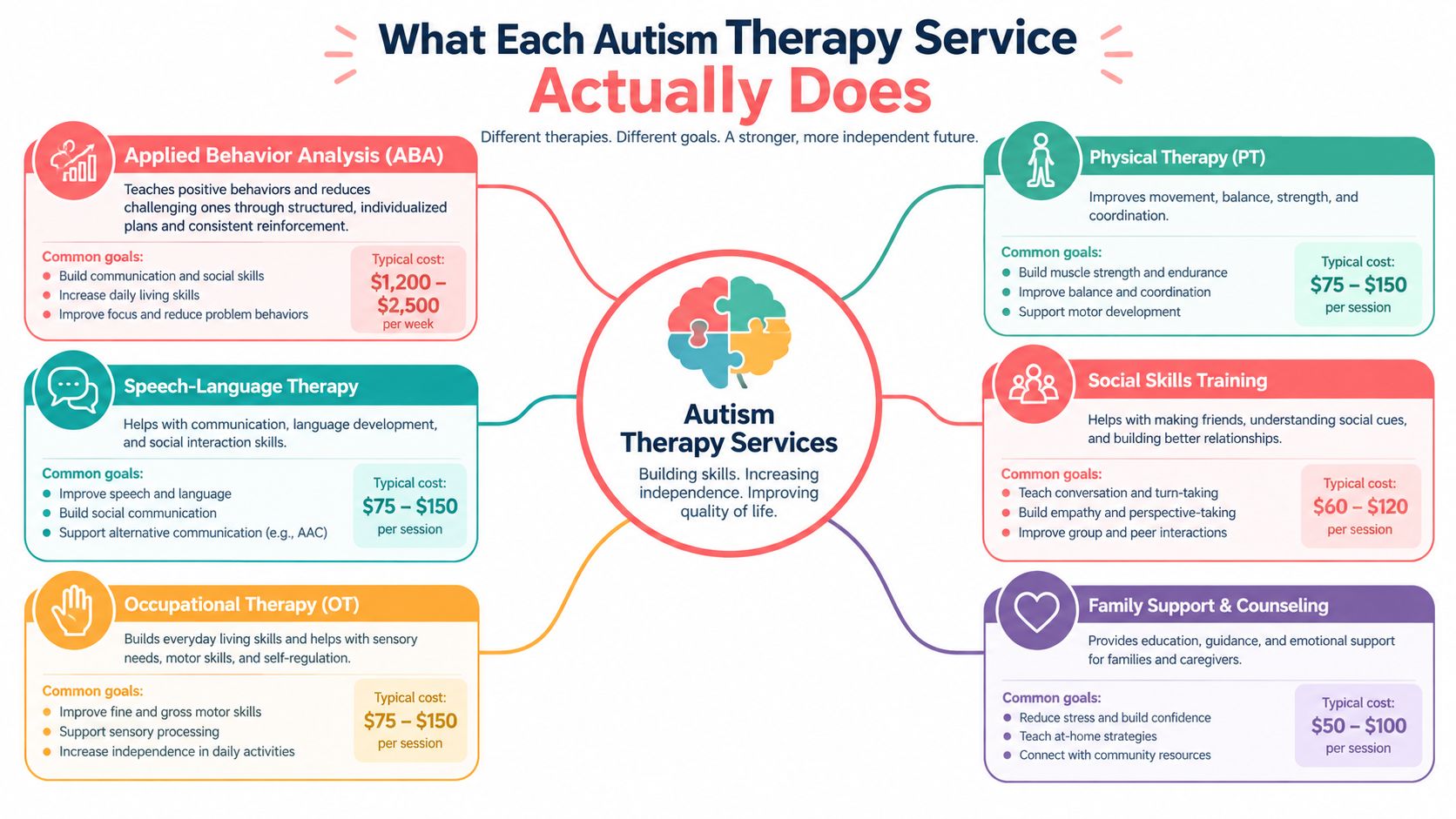
The point isn't to rank these services. It's to know what job each one does. A child might use speech therapy to make words clearer, ABA to practice asking for help during a hard routine, OT to tolerate noisy or messy tasks, and social skills practice to join play with other children.
When parents understand the role of each support, the whole process gets less overwhelming. You're no longer trying to pick “the right therapy” in the abstract. You're matching supports to real needs.
How ABA, Speech, OT, and Social Skills Work Together
A weekday routine is where these services stop sounding like separate categories and start looking like one plan. In the morning, a child may need help getting dressed, following a sequence, and handling the noise of breakfast. Later, the same child may need help asking a teacher for a break, waiting for a turn on the playground, or joining a playdate without shutting down.
One routine, four different jobs
ABA can target the behavior side of the routine, like following steps, transitioning, or asking for help. Speech therapy can focus on the words, pictures, or device the child uses to communicate those needs. OT can help with sensory regulation, motor planning, and daily living skills. Social skills work can practice the exact peer interactions that make recess or a group activity feel possible.
| Therapy | Main Focus | Example Contribution |
|---|---|---|
| ABA | Learning, behavior, and measurable skill change | Practices asking for help during transitions |
| Speech therapy | Understanding and using communication | Builds clearer requests, words, gestures, or AAC use |
| OT | Daily living, sensory regulation, fine motor skills | Supports dressing, self-care, and tolerance for busy environments |
| Social skills | Peer interaction and friendship-building | Rehearses turn-taking, greeting, and group play |
The best collaborations don't duplicate the same lesson three times. They share goals, compare notes, and use caregiver feedback so the child hears consistent support in different places.
FriendlyABA's total approach fits that kind of coordination because it brings home, school, and community routines into the same conversation. That matters when a child can do something in one setting but not another. A skill that only works in one room is still a starting point, not the finish line.
Family check: Ask each provider how they coordinate goals with the others. If they don't have an answer, the child may end up doing extra work for the adults' convenience instead of for real-life progress.
From Screening to a Plan You Can Follow
A parent often hears two words in the same week and wonders why they feel so different. Screening is the early check that raises a concern. Diagnosis is the fuller specialist evaluation that explains what is going on.
As covered earlier, the AAP supports starting intervention before every diagnostic piece is finished, so use that window to book the assessment now.
What a good assessment should cover
An ABA assessment usually starts with interviews and direct observation, then looks at strengths, preferences, developmental history, and the routines that matter most at home and school. The treatment plan should grow out of that process with clear goals, teaching strategies, data collection, parent coaching, and regular review points. If the plan does not explain how progress will be measured, it is not ready yet.
For families who want a simple model of that process, FriendlyABA's assessment overview shows the kind of structure a provider should be able to explain in plain language.
Bring questions to the consultation. Ask which goals matter most to your family, how often progress is reviewed, how caregivers are coached, and how the team decides whether a goal still fits. A provider who answers clearly is helping you make a plan you can use. If the answers stay vague, keep looking.
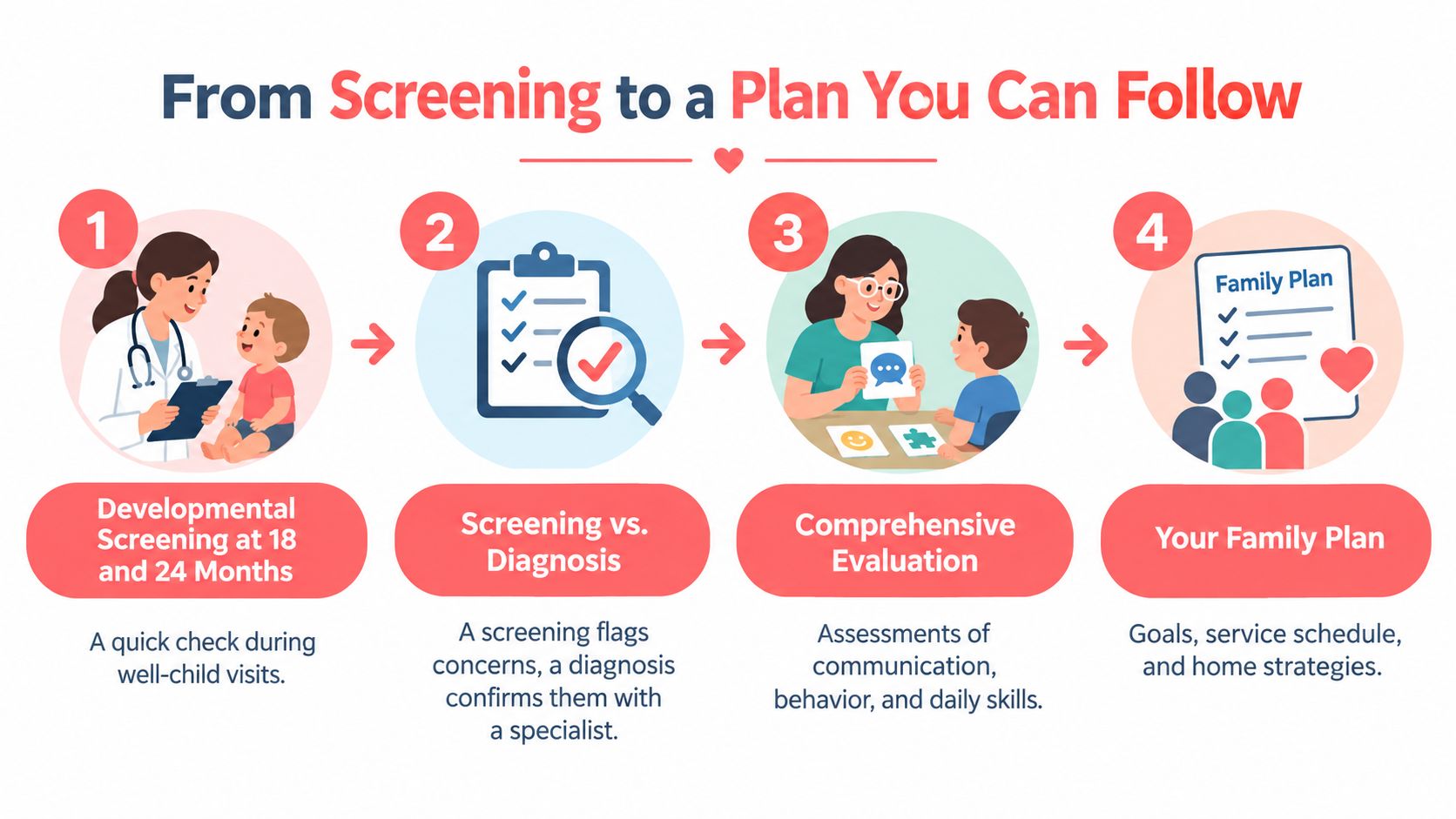
A useful plan should feel like a kitchen-table tool, not a puzzle only the clinic can read. It should tell you what happens next, who does what, and how you will know the support is helping.
What Real Progress Looks Like Beyond the Session
Parents are right to ask whether a skill carries over from therapy to real life. A child may request help beautifully in a session, then freeze at home when a sibling grabs the toy or a teacher changes the routine. That gap is exactly why generalization matters.
Generalization is the real test
Generalization means a skill works with different people, in different places, and with different materials. A child who can ask for a snack with one therapist still needs practice asking a parent, a teacher, or a grandparent. A child who can calm down in a quiet room still needs help using the same skill in a noisy kitchen or on the playground.
Recent evidence also supports looking at outcomes carefully instead of treating more hours as a magic answer. A 2022 systematic review and meta-analysis found statistically significant improvements in cognitive ability, daily living skills, and motor skills, but not additional significant benefit over comparison interventions for communication, socialization, or composite adaptive behavior, including a nonsignificant pooled adaptive-behavior effect and a nonsignificant communication estimate (systematic review). That's one reason families should expect individualized goals and honest conversations, not blanket promises.
What to watch for: independent requests, time it takes to move between activities, peer engagement, caregiver follow-through, and whether the skill still shows up weeks later.
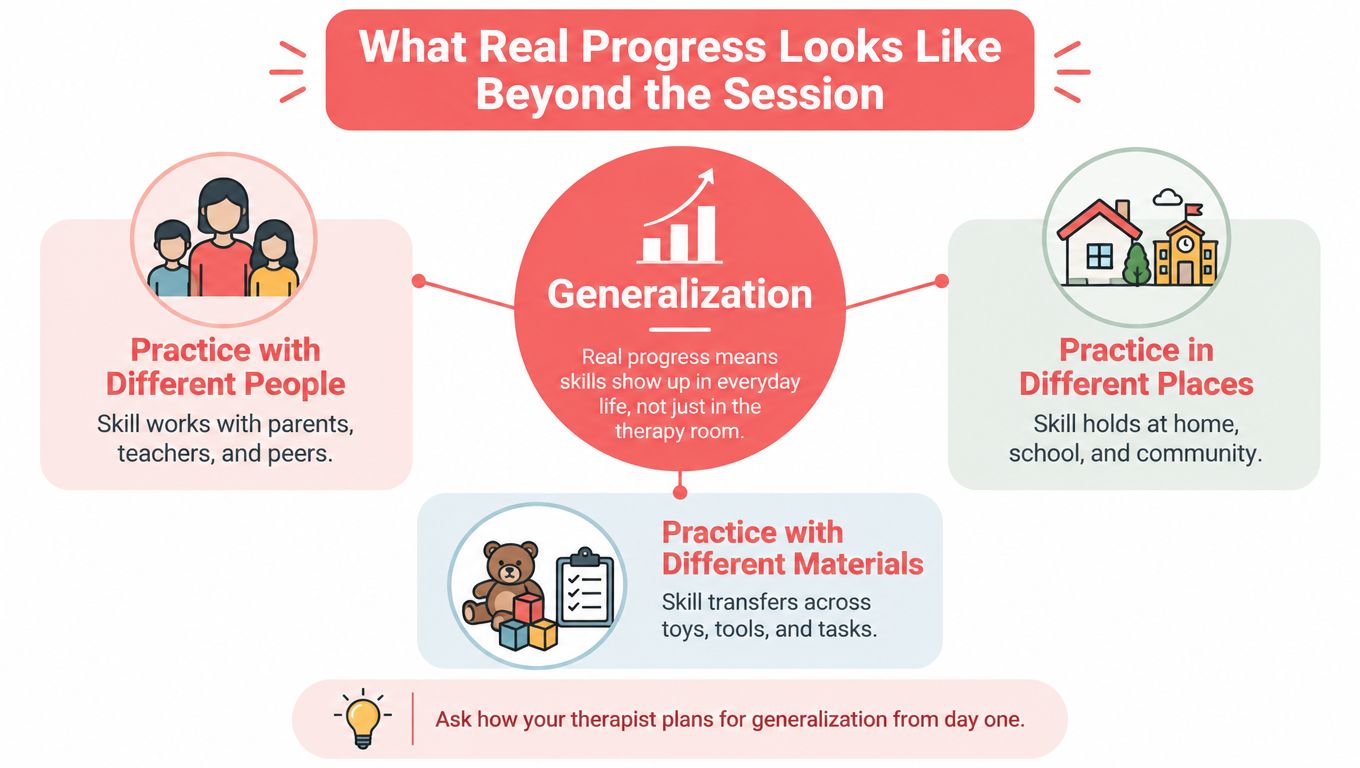
The best sign of progress is usually smaller than people expect. It looks like a child using a skill more often, in more places, with less help. That's not flashy, but it's what lasts.
How to Choose a Provider You Can Trust
Choosing a provider should feel thoughtful, not rushed. You do not need a spreadsheet with every possible variable. You do need a simple way to judge whether the team is built for your child's real life.
Look at four things
First, check the credentials and supervision behind the program. A strong ABA program is typically BCBA-led, with therapists carrying out the plan and supervision checks keeping the work consistent. That matters because the child needs a coordinated team, not random one-off sessions.
Second, ask where services happen. Home, school, and community-based support can make it easier for skills to travel into everyday routines. If your child struggles in one setting but not another, that setting needs to be part of the plan.
Third, ask how the family is included. Parent coaching, regular progress reviews, and plain-language communication should be built in, not treated like extras. The American Academy of Pediatrics says supports should be family-centered and provided in the least-restrictive environment when possible (AAP guidance).
FriendlyABA is one option for families looking for BCBA-led ABA, parent coaching, and therapy in home, school, and community settings. The right provider should be able to explain how the plan changes when the child changes, because real life doesn't stay still.
The fourth area is access. Families run into waitlists, insurance questions, and staffing limits. You want a provider who is honest about those realities and clear about how authorization, scheduling, and communication work.
Good question to ask: “How will you know this plan is still a fit three months from now?”
If the answer feels vague, keep going. A trustworthy team welcomes the question.
What You Can Do at Home Between Sessions
One mother once told me, “I don't need to become a therapist. I just need to know what to do after dinner.” That's the right mindset. Parent coaching works best when it fits ordinary routines, not when it takes over family life.
Small moments matter most
Pause before stepping in right away, so your child gets a chance to communicate. That pause can be the difference between a child learning to request help and a parent accidentally doing the talking for them. Name emotions during play, too. Saying “you look frustrated” or “that was exciting” helps a child connect feelings to words.
Use a visual schedule for transitions if your child gets stuck when one activity ends. Break big tasks into smaller steps. If getting ready for bed is too much in one piece, start with pajamas, then teeth, then story time. Watch what motivates your child, because motivation is useful information, not a bribe.
For a more structured parent-coaching example, FriendlyABA's parent coaching services show how this kind of practice can be embedded into everyday routines.
The goal is not perfect execution. The goal is repetition with enough support that the child can try, succeed, and try again. If something works one day and falls apart the next, tell the BCBA. That feedback helps the plan adapt to your real home, not an idealized version of it.
Taking the Next Step Without the Pressure
You do not need to choose every therapy today. You do not need to know the whole roadmap before you start. A good autism therapy service meets your family where you are, then helps you sort out the next few steps with patience and clarity.
The most useful plans grow from real routines, honest data, and caregiver input. They also leave room for change, because your child's needs, strengths, and comfort level will keep developing. That is not a problem to solve. It's part of the work.
If you're still in the early days, start with one conversation. Ask what support looks like in your child's daily life, how the team will measure progress, and how they'll work with school or other therapies. A calm, skilled provider should make those answers easier, not harder, to find.
If you're ready to talk with a team that can walk through screening, assessment, parent coaching, and day-to-day skill building with you, visit FriendlyABA to book a consultation. FriendlyABA offers BCBA-led autism therapy services in home, school, and community settings, with care focused on practical goals and family collaboration.
Our Latest Insights









You don't have to figure it out alone
Whether you're exploring ABA therapy for the first time or searching for a provider who truly feels like the right fit, we're here to help.